
Original briefings. Zero spin.
Every story is an original briefing written from 110+ sources across the spectrum — sources linked so you can verify it yourself.
 finance
Notable (5/10)
Event date: September 11, 2026
finance
Notable (5/10)
Event date: September 11, 2026
Blackstone Set to Exit Bumble After Nearly Doubling Its Money While Stock Crashed 96%
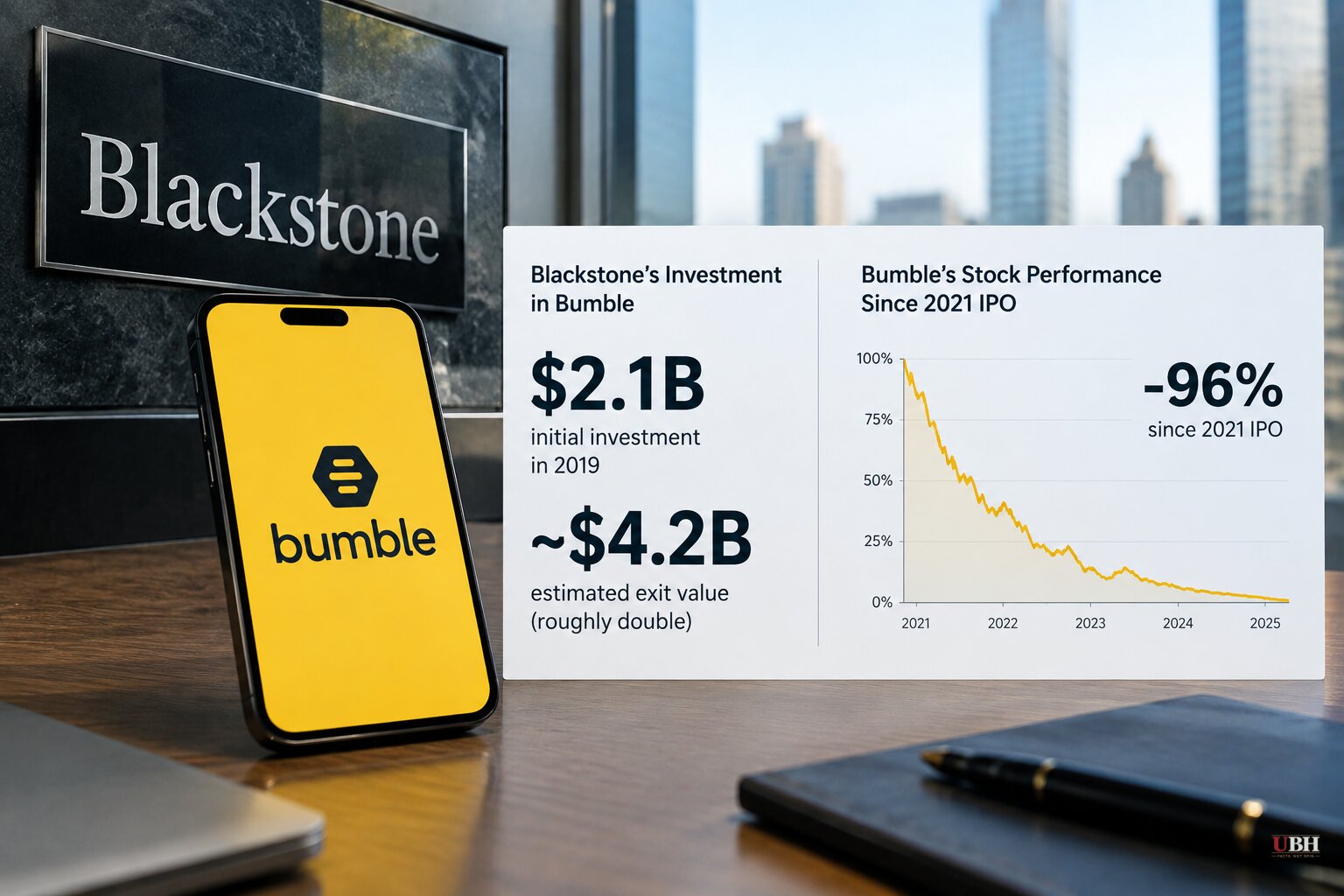
Private equity giant Blackstone Inc. is finishing an exit from Bumble Inc., and it's walking away roughly twice as rich as when it went in, according to Business Insider's analysis of SEC filings. That's despite Bumble's stock cratering 96% since its post-IPO high.
Blackstone and venture firm Accel bought a majority stake in Bumble's parent company, MagicLab, in 2019 at a $3 billion valuation, putting in $2.1 billion combined. Bumble went public in February 2021 and closed its first trading day worth roughly $13 billion, according to Business Insider.
Today Bumble is worth less than $450 million. Shares closed at $2.98 on Thursday, September 10, according to Benzinga, down 16.53% year-to-date and 54.57% over the past year. MarketBeat lists a consensus analyst rating of "Reduce" with a $3.87 price target, and Bumble's P/E ratio is negative because the company isn't currently profitable.
How Blackstone Got Out Early
Blackstone's 98% internal rate of return, a metric that rewards getting cash back fast, came from moving money off the table well before the stock cratered.
In late 2020, Blackstone reportedly used Bumble's own debt to pay itself a $334 million dividend, according to Business Insider. During the February 2021 IPO, Blackstone cut its stake from 83.6% to 53.2%, pocketing nearly $2 billion. Later that year, with shares trading above $50, the firm sold another $1 billion worth of stock.
By the end of 2023, Bumble shares had fallen below $14. Blackstone's remaining 22.4 million shares are now worth about $66.75 million, according to Benzinga, a fraction of the $1.084 billion a similar-sized block fetched in 2021.
Blackstone struck a deal with UBS late last year to sell down just under 5% of the company each quarter. SEC filings show the firm is on track to be fully out by the first half of 2027, according to Business Insider and AOL.
Board Seats Emptied Out
Blackstone has also vacated the two board seats it held at Bumble. Jonathan Korngold stepped down in June, and Martin Brand followed in August, according to Benzinga and Yahoo Finance.
Bumble's core business is struggling. Paying users are down 16.4% year-over-year, according to Benzinga. Chandler Willison, an analyst at M Science, told Business Insider that a private equity buyer is the "most obvious" candidate to take Bumble private again, because public markets put "a lot more pressure to improve performance" than a PE owner would.
Willison also warned Bumble's management against dragging out a turnaround: "The longer management says, 'We're in a turnaround period,' the less confidence not just Blackstone, but investors in general, are going to have with the company."
The Mechanics of the Exit
No regulator has opened an investigation into Blackstone's Bumble exit, and no source in this story alleges wrongdoing. Dividend recapitalizations and staged stock sell-downs after a lockup period are standard private equity tools, not novel or hidden maneuvers. Blackstone disclosed its selling plan through SEC filings, which is exactly how the process is supposed to work.
Blackstone did what private equity firms are built to do: get capital back fast and let public shareholders absorb whatever comes next. Business Insider notes that investors who bought Bumble on IPO day never saw their shares reach that day's highs again. Whether that outcome reflects a flaw in how IPO-stage sell-downs are structured, or simply the risk every public-market investor accepts when they buy a richly-valued new listing, remains an open question.
Bumble's struggles trace to real competitive pressure, not just Blackstone's exit timing. Business Insider points to Match Group's Hinge eating into Bumble's market share as "dating app fatigue" became a cultural talking point through the mid-2020s. Founder and CEO Whitney Wolfe Herd, who took Bumble public in 2021 and remains chair, now has to convince a shrinking pool of paying users and whatever buyer eventually replaces Blackstone that the app has a path back.
Who buys Blackstone's exiting stake, and at what price, once the UBS-arranged sell-down finishes in the first half of 2027, remains unclear. Willison's read is that another private equity shop is the likeliest taker. Nothing in the current SEC filings names a buyer yet.
Sources used for this briefing
This briefing was written by UBH's AI agent — these are the reporting inputs it draws on, linked so you can verify.


