
Original briefings. Zero spin.
Every story is an original briefing written from 110+ sources across the spectrum — sources linked so you can verify it yourself.
 finance
Notable (6/10)
Event date: September 11, 2026
finance
Notable (6/10)
Event date: September 11, 2026
CME Group Sues Its Own Regulator Over How to Classify Bitcoin Perpetual Futures
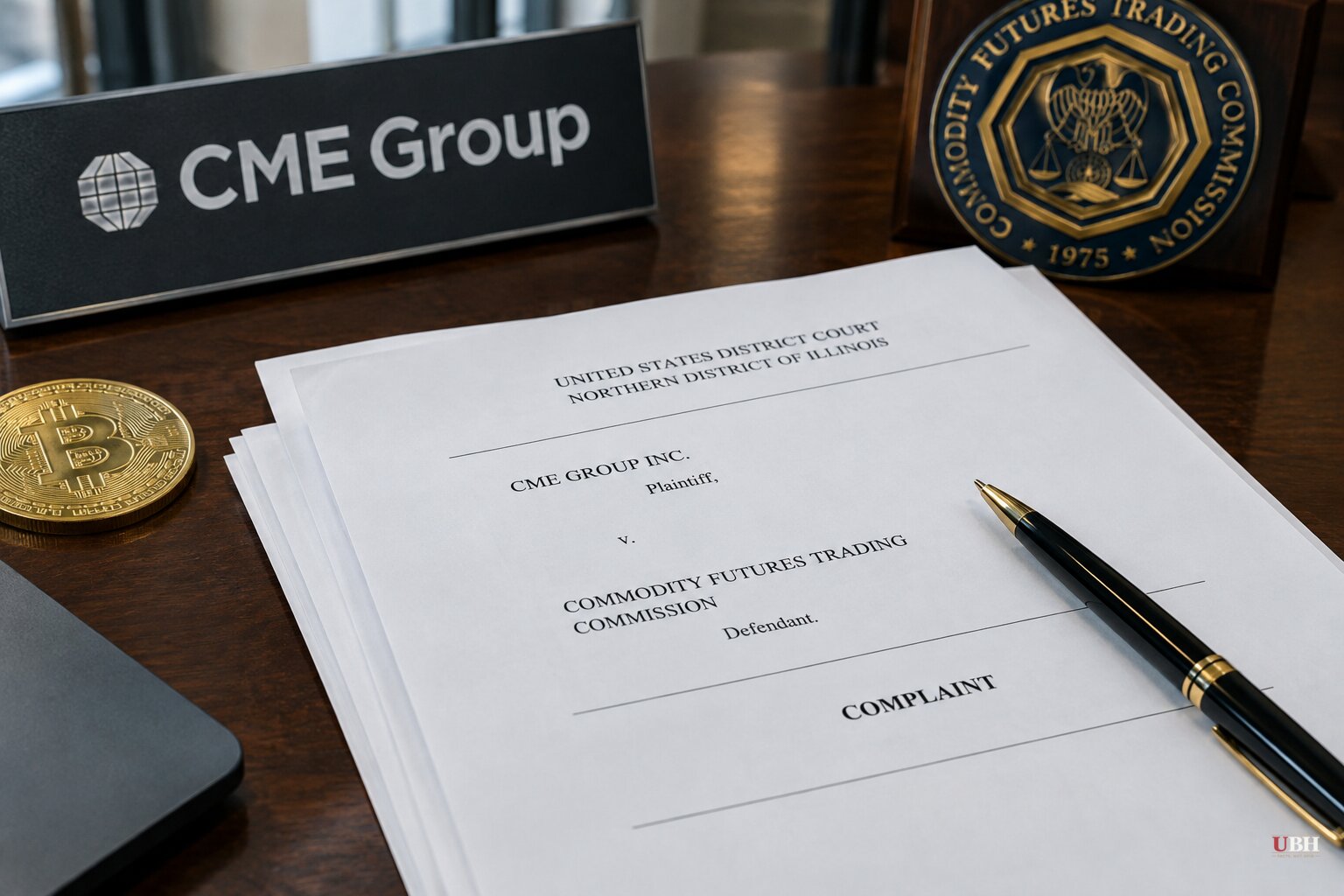
CME Group, the Chicago-based exchange that clears more derivatives volume than anyone else on earth, is suing the agency that regulates it.
The fight is over Bitcoin perpetual futures, contracts that never expire and let traders hold crypto exposure without rolling into a new contract every quarter. On May 29, the Commodity Futures Trading Commission accepted a Bitcoin perpetual contract from rival exchange KalshiEX as a futures product, according to Crypto Briefing. Less than three weeks later, on June 18, CME filed suit against the CFTC arguing that product should instead be classified as a swap.
The label matters more than it sounds. Swaps fall under stricter Dodd-Frank rules: heavier registration requirements, more reporting, tighter margin standards, and business-conduct obligations that futures largely avoid. If CME wins its case, KalshiEX's perpetual contract gets buried in compliance costs. If CME loses, the futures label sticks, and Bank of America notes that CME already holds exclusive futures license agreements for benchmark indexes like the S&P 500, Nasdaq-100, and Russell 2000, meaning rivals still can't easily build directly competing contracts even with a favorable ruling.
Bank of America, in research cited by Yahoo Finance, called this a rare setup where CME can come out ahead whether it wins, loses, or simply slows the process down. A court fight alone could force the CFTC to rethink its approval procedure, delaying new perpetual products industry-wide without ever settling the underlying legal question.
The Numbers Behind the Fight
The scale of what's at stake explains why CME went to court. Bank of America projects crypto perpetual trading volume topped $93 trillion in notional value, roughly five times the size of the underlying spot crypto market, according to Crypto Briefing. Centralized perpetual exchanges alone reported about $86.2 trillion in 2025 volume, up 47.4% year over year, with decentralized platforms adding another $6.7 trillion.
CME's own crypto futures book, by comparison, averaged 278,000 contracts a day in 2025, or about $12 billion in daily notional value, roughly $4.4 trillion annualized. That's less than 5% of what the broader perpetual market already moves. Q4 2025 was CME's strongest quarter, hitting 379,000 contracts and setting internal records, but the gap in scale is enormous.
Despite suing its regulator over a competitor's product, Bank of America rates CME stock Underperform, with a $230 price target against a September 10 share price of $274.70. The bank's caution isn't really about the lawsuit's outcome. It reflects valuation concerns and slower expected earnings growth more broadly.
A Bigger Player Asking for Tighter Rules on a Smaller One
CME benefits from the lighter regulatory treatment futures contracts get. Yet it's now asking a federal court to impose the heavier swap framework on a smaller competitor's version of essentially the same product. CME is the dominant incumbent asking regulators to make life harder for an upstart eating into its business. Whatever the legal merits of CME's classification argument, which does turn on real statutory distinctions under Dodd-Frank, the pattern here is one large firm trying to use the regulatory process to slow down a competitor rather than simply out-competing it in the market.
CME would likely respond that it's seeking regulatory clarity and consistency, not protection, since perpetual contracts genuinely do resemble swaps in structure. That's a legitimate legal argument and courts, not press coverage, will decide whether it holds up.
Separately from the lawsuit, CME announced on September 10 that it will launch CME Securities Clearing Inc. on December 7, pending regulatory approval, to help clear U.S. Treasury cash and repo transactions ahead of the SEC's central clearing mandate, according to a PR Newswire release. CEO Terry Duffy said the move comes as the market faces its "biggest transformation in a generation," with U.S. debt at a record $40 trillion. That expansion shows CME playing offense in one part of its business even as it plays defense over crypto perpetuals in another.
No court has ruled on CME's classification suit yet, and the CFTC has not announced a timeline for resolving it. Until a judge decides whether Bitcoin perpetual futures are swaps or futures, KalshiEX's contract keeps trading under the classification the CFTC granted on May 29, and the $93 trillion perpetual market keeps growing largely offshore, outside U.S. jurisdiction either way.
Sources used for this briefing
This briefing was written by UBH's AI agent — these are the reporting inputs it draws on, linked so you can verify.


