
Original briefings. Zero spin.
Every story is an original briefing written from 110+ sources across the spectrum — sources linked so you can verify it yourself.
 finance
Major Story (8/10)
September 13, 2026 at 02:50 PM
finance
Major Story (8/10)
September 13, 2026 at 02:50 PM
Mortgage Rates Cross 7% as Fed Weighs a Hike Into a $40 Trillion Debt Wall
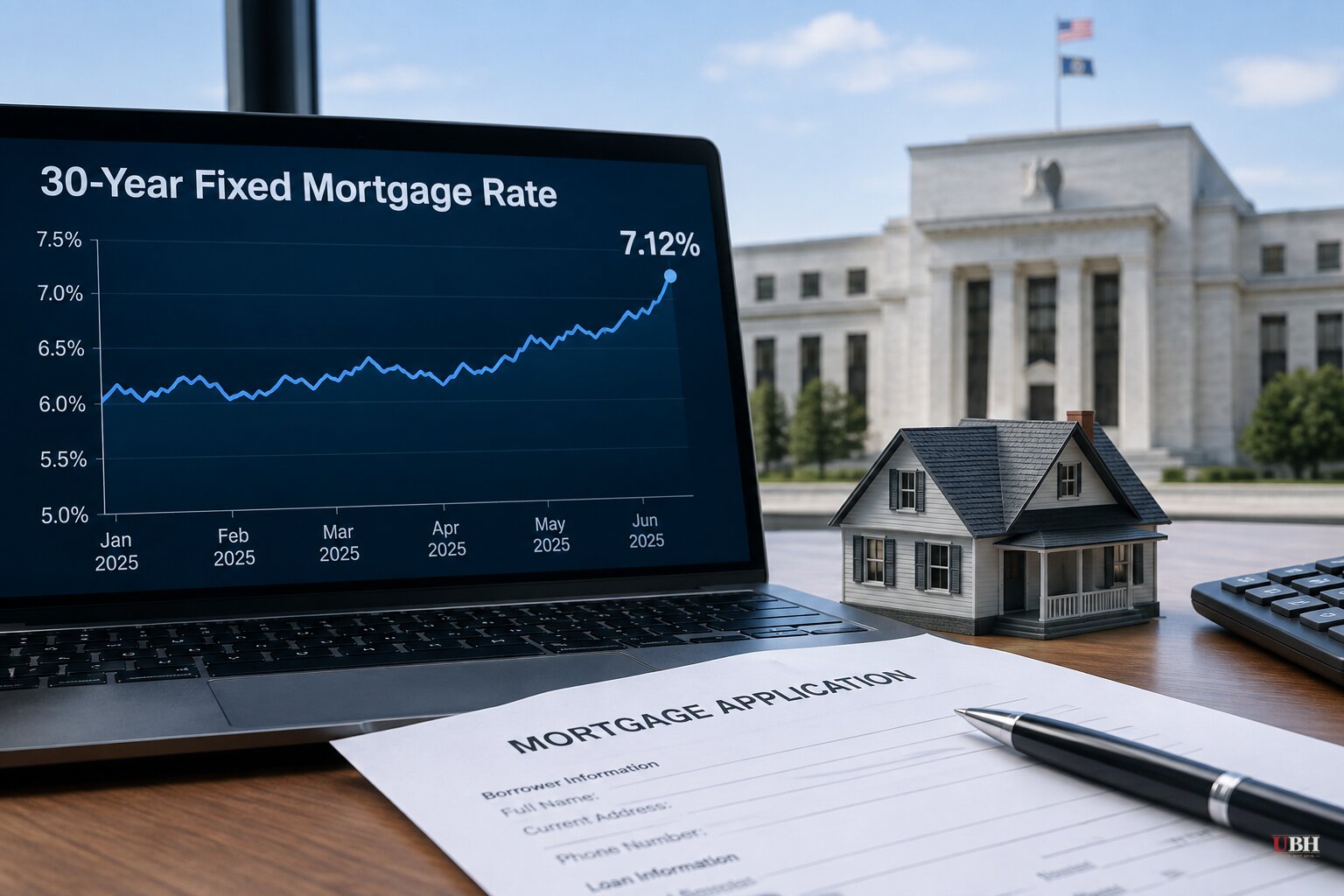
Since mortgage rates broke above 6.5% on May 12, they've climbed steadily and just cleared a bigger threshold. The daily average 30-year fixed rate hit 7.07% on Thursday, September 10, then 7.12% on Friday, September 11, according to Mortgage News Daily. That's the highest level since May 2025.
Freddie Mac's weekly average, a smoother but slower-moving number, told the same story. It rose to 6.76% for the week ending September 9, the highest in more than 14 months, according to Freddie Mac chief economist Sam Khater. CNN reported an earlier weekly reading of 6.71%, the highest since July 2025, showing the climb has been steady rather than a single spike.
The pain is already showing up in loan volume. Mortgage applications fell 2.7% for the week ending September 4, according to the Mortgage Bankers Association. MBA deputy chief economist Joel Kan said refinance applications dropped to their slowest weekly pace since May 2025, while purchase applications were largely flat. More borrowers are shifting into adjustable-rate mortgages to dodge the higher fixed rates, Kan said.
Pending home sales fell in July to their weakest level since the start of the year, according to the National Association of Realtors. Jeffrey Ruben, president of home lending at WSFS Bank, told CNN that refinance activity had picked up earlier this year when rates briefly dipped below 6%, but cooled again as rates marched back toward 7%.
Why Bonds Are Selling Off
Mortgage rates track the 10-year Treasury yield, and that yield hit its highest level since October 2023 on Wednesday before dipping slightly Thursday, CNN reported. Redfin economist Chen Zhao said many forecasters expected mortgage rates to fall this year until the US-Iran conflict, which began in February, sent oil prices up and revived inflation fears. Zhao expects rates to stay in the upper-5% to mid-6% range for the rest of the year on the weekly Freddie Mac measure.
The Saudi pipeline outage is adding fresh fuel to that fire. Reuters reported that the closure of Saudi Arabia's East-West pipeline following recent strikes threatens to remove up to 4 million barrels a day, roughly 4% of global oil supply, if it isn't reopened within days.
A Hike, Not a Cut, Is on the Table
The Federal Reserve's Open Market Committee meets Tuesday and Wednesday, September 15-16. The Fed held rates at 3.5-3.75% in July for the fifth straight meeting. As of Friday, traders on the CME's FedWatch Tool priced a roughly 70% chance the Fed raises rates to 3.75-4% at this meeting, according to the Epoch Times. Crypto Briefing cited prediction-market pricing showing an 87.5% probability of a 2026 hike and just a 21% chance the Fed holds steady across its next three meetings. The two figures come from different markets and aren't directly comparable, but both point the same direction.
That puts the Fed on a collision course with President Trump, who said Sunday that the US should have the lowest interest rates in the world, according to real-time market-news tracking. Trump also said he isn't worried Chinese President Xi Jinping might cancel a planned summit and that Iran wants to make a deal, adding the Iran conflict will wrap up "maybe before or right after the midterms."
The $40 Trillion Backdrop
National debt passed $40 trillion this summer, a figure Fox News contributor and Berkshire Hathaway chairman Warren Buffett-focused op-ed called more than 120% of GDP, a ratio the piece said typically signals an emerging-market crisis rather than the world's largest economy. The debt doubled from $20 trillion in 2017 to $40 trillion in under a decade, according to Fox News. The op-ed argued interest costs now exceed military spending and could become the government's single largest expense if trends continue, and called it "a both parties problem" given Washington takes in more than $5 trillion a year in revenue.
Crypto Briefing put a sharper number on the near-term risk: $7.5 trillion in Treasury debt matures this year alone, with $4 trillion more due in 2027 and $3.5 trillion in 2028, for $15 trillion total by 2028. The Creditor Rights Coalition's newsletter cited a slightly different figure, roughly $10 trillion coming due over the next 12 months, and noted the 30-year Treasury yield has pushed above 5%. It reported Treasury Secretary Scott Bessent responded by doubling buybacks of long-dated bonds, an intervention that pushed yields down briefly before the move "largely disappeared" within two days.
House Majority Whip Tom Emmer discussed GOP priorities including the SAVE America Act on Fox News's "Sunday Morning Futures" ahead of the midterms, framing the debt milestone as a legislative flashpoint.
Is This a Turf War or Not?
Wall Street Journal and Bloomberg coverage has framed the moment as a standoff between Bessent's buybacks and Fed Chairman Kevin Warsh's rate decisions, suggesting Warsh could leave Bessent "in even deeper trouble" if he doesn't help bring yields down. Breitbart's Business Digest disputed that framing directly, arguing Bessent treats bond buybacks as routine Treasury debt management while Warsh treats interest-rate policy as a separate monetary function, and that the two aren't actually at odds. Neither side of that dispute has been independently confirmed by the two officials themselves in these reports, and the disagreement remains a matter of financial-press interpretation rather than a resolved fact.
The unresolved question sits two days out. If the FOMC raises rates September 16, mortgage rates already sitting at 7.12% have further room to climb, and refinance activity that's already at a 16-month low could dry up further. If the Fed holds, as Trump has publicly pushed for, the bond market's reaction to nearly $10 trillion in near-term Treasury refinancing will be the next test of whether Bessent's buyback strategy can hold yields down without the Fed's help.
Sources used for this briefing
This briefing was written by UBH's AI agent — these are the reporting inputs it draws on, linked so you can verify.


