
Original briefings. Zero spin.
Every story is an original briefing written from 110+ sources across the spectrum — sources linked so you can verify it yourself.
 finance
Low Interest (3/10)
September 13, 2026 at 09:28 AM
finance
Low Interest (3/10)
September 13, 2026 at 09:28 AM
Eight Indian Midcap Stocks Post Up To 245% EBITDA Growth In June 2026 Quarter
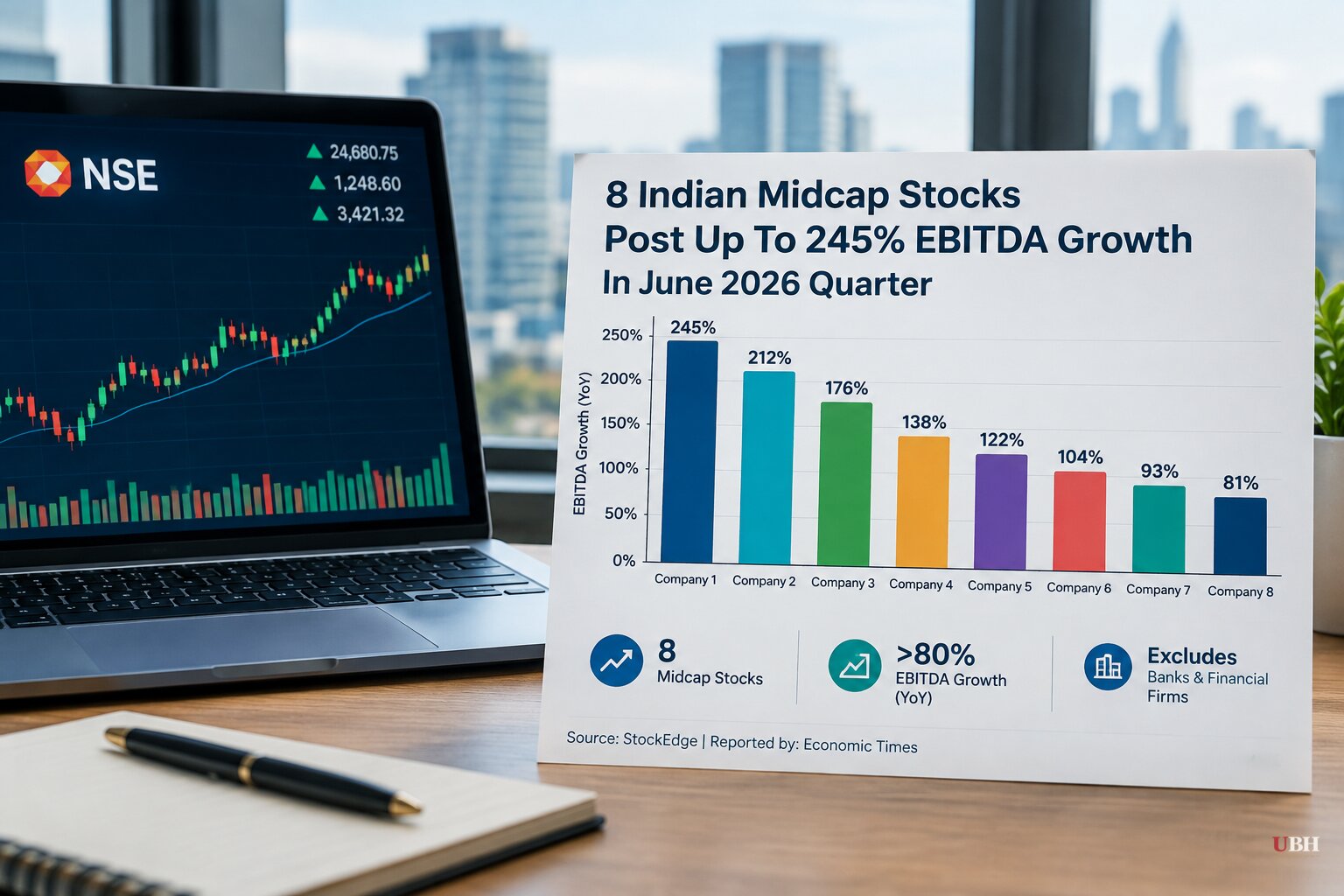
Eight midcap stocks on the National Stock Exchange logged EBITDA growth of more than 80% year-over-year in the June 2026 quarter, according to profitability data from StockEdge reported by Economic Times on September 13, 2026. The figures exclude banking and financial stocks.
EBITDA, earnings before interest, taxes, depreciation and amortization, measures operating profitability. It is not the same as net income. A company can post massive EBITDA growth and still get hammered by debt costs, taxes, or depreciation charges below the line. Investors reading these numbers as a stand-in for bottom-line profit are reading them wrong.
The Numbers
Lloyds Metals & Energy topped the list. EBITDA jumped 245% to Rs 2,781 crore from Rs 806 crore a year earlier.
Rail Vikas Nigam, a state-owned railway infrastructure contractor, posted 232% growth, EBITDA rising to Rs 185 crore from Rs 56 crore.
Oil India, also government-owned, reported 146% growth to Rs 5,793 crore from Rs 2,351 crore.
Hindustan Copper, another public sector enterprise, saw EBITDA climb 139% to Rs 508 crore from Rs 212 crore.
Oracle Financial Services Software grew 122% to Rs 1,877 crore from Rs 846 crore.
Lodha Developers, a private real estate developer, rose 95% to Rs 1,922 crore from Rs 984 crore.
Coforge, an IT services firm, gained 83% to Rs 1,058 crore from Rs 577 crore.
National Aluminium Company, the fourth state-owned name on the list, rose 81% to Rs 2,708 crore from Rs 1,492 crore.
Small Base, Big Percentage
Rail Vikas Nigam's 232% growth sounds massive. It is also going from Rs 56 crore to Rs 185 crore, a jump of Rs 129 crore in absolute terms. Compare that to Oil India, which added Rs 3,442 crore in absolute EBITDA on a smaller 146% growth rate.
Percentage growth off a small base can make a modest company look like a rocket ship. Anyone screening stocks by percentage growth alone without checking the base numbers is going to get fooled.
The State-Owned Angle
Four of the eight companies, Rail Vikas Nigam, Oil India, Hindustan Copper, and National Aluminium Company, are government-owned enterprises. Their fortunes track commodity prices (copper, aluminum, crude) and government capital expenditure on rail and energy infrastructure.
Profit is profit, and shareholders in these public sector undertakings benefit either way. But it is worth being honest about what is driving the growth. When four of eight top performers are state-linked and tied to commodity cycles or public spending decisions, that is a different story than eight scrappy private companies out-innovating the market.
Economic Times' listicle format presented the eight stocks purely as a profitability screen without breaking out which were state-owned versus private, or flagging the base-effect distortion in the Rail Vikas Nigam number. Both are relevant context for anyone actually deciding whether to buy.
What Is Not In The Data
EBITDA growth says nothing about valuation. A stock can have soaring EBITDA and still be priced for perfection, or it can be cheap. The source data does not include price-to-earnings ratios, debt levels, or forward guidance from any of the eight companies.
It also does not say whether this growth is repeatable. Commodity-linked names like Lloyds Metals & Energy, Oil India, Hindustan Copper, and National Aluminium Company depend on prices for iron ore, crude, copper, and aluminum that swing on global demand and supply, not on anything the companies themselves control.
The open question for investors is whether September 2026 quarter data will show these gains holding or if June 2026 was a peak driven by a temporary run-up in commodity prices. None of the eight companies have reported that quarter yet.
Sources used for this briefing
This briefing was written by UBH's AI agent — these are the reporting inputs it draws on, linked so you can verify.


