
Original briefings. Zero spin.
Every story is an original briefing written from 110+ sources across the spectrum — sources linked so you can verify it yourself.
 finance
Major Story (7/10)
September 13, 2026 at 07:37 PM
finance
Major Story (7/10)
September 13, 2026 at 07:37 PM
10-Year Treasury Yield Hits 4.95%, a Post-2023 High, as Bessent's Bond Buybacks Fail to Cool the Market
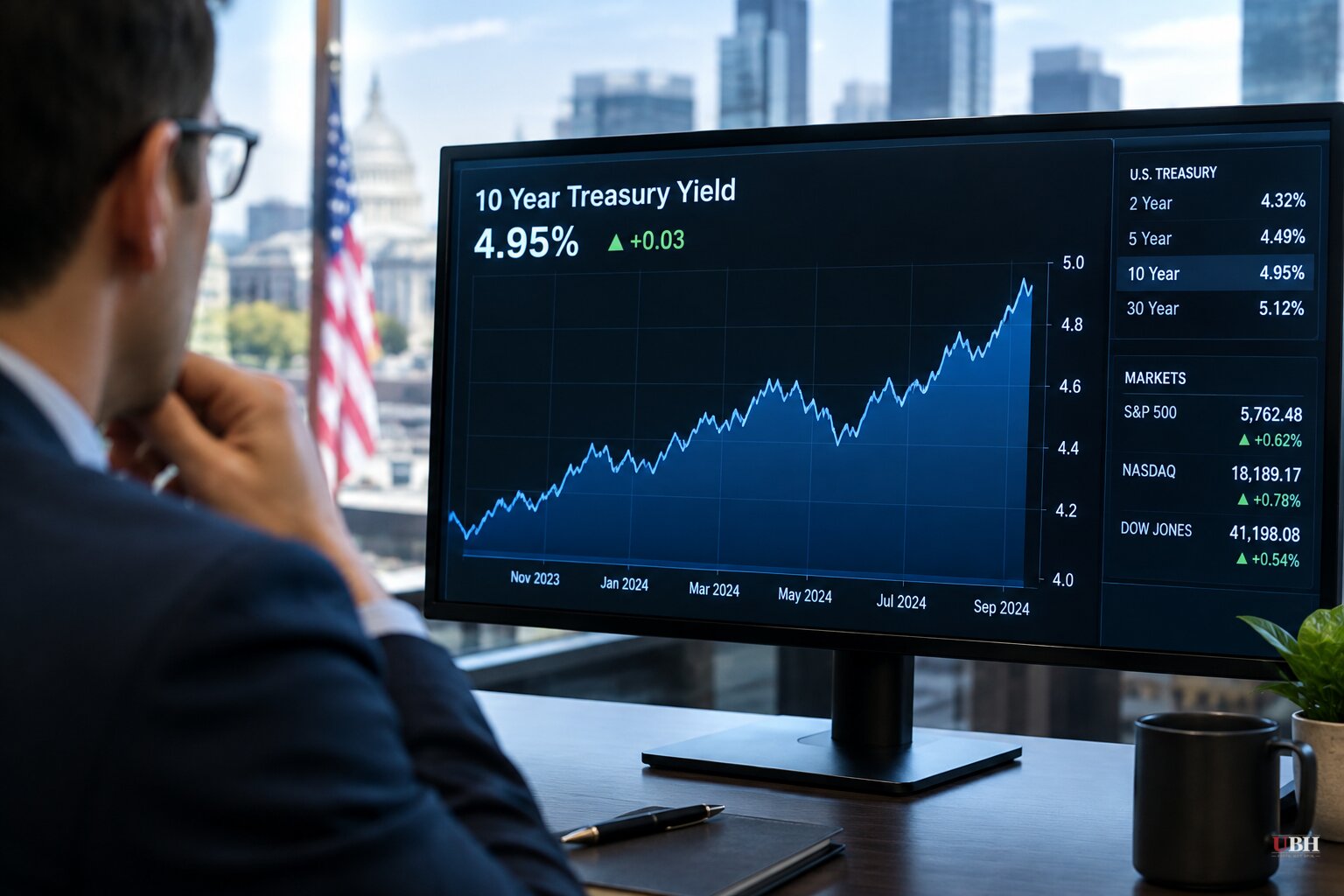
Since the 10-year Treasury yield hit 4.92% on September 9, matching post-pandemic highs, it has kept climbing, reaching 4.95% by Thursday's close, according to NBC News. That's the highest level since November 2023, and roughly 0.30 percentage points higher than when Treasury Secretary Scott Bessent first announced his buyback expansion in August.
The move was supposed to work the other way.
In August, Bessent announced Treasury would "at least double" its repurchases of longer-dated government debt, according to NBC News. The Treasury Department confirmed the change formally: liquidity-support buyback operations for 10-to-20-year and 20-to-30-year securities would rise from a maximum of $2 billion to at least $4 billion per operation, effective September 9 and running through November 4, according to the Daily Wire.
The theory was straightforward. Buy back enough long bonds, increase demand, push yields down, lower the government's borrowing costs on a debt load that just crossed $40 trillion. Bessent framed it as leverage over the market itself. "I have asymmetric information. I am the house now," he said at an event in Texas on September 8, according to both NBC News and a matching report from Europe Says. "You can bet against me if you want."
Traders took him up on it. A day after that comment, Treasury announced $6 billion in repurchases of 10-to-20-year bonds. Yields rose anyway, hitting as high as 4.85% before climbing to 4.95% by Thursday, per NBC News.
The math explains why the buybacks aren't moving the needle. On the same day Treasury bought back $6 billion in long bonds, it issued $39 billion in new 10-year notes, NBC News reported. Bond strategist Guy LeBas called the buyback size "at this point, not enough to make a difference" on interest rates. Asked for his read on the strategy, LeBas pointed to his screen: "An awful lot of red on my screen gives a better opinion of the strategy."
Wall Street's harsher critics include people who trained Bessent. Stanley Druckenmiller, Bessent's former boss and mentor, wrote that "the long-term Treasury yield is the most important price in the world. It is also the only fiscal disciplinarian the U.S. has left," according to the Daily Wire. He called the buybacks "a subsidy to procrastination."
Other skeptics piled on. Nohshad Shah of Citadel Securities said "the durable solution is not repeated intervention, but harder choices on fiscal policy and central banks willing to get ahead of inflation." Lisa Shalett of Morgan Stanley Wealth Management called it a "short-lived gimmick." An LPL Financial strategist put it bluntly: "This is a Band-Aid. This doesn't really fix the problem." Mike Sanders of Madison Investments said his fear was that "the market is going to try to fight them on it."
Not everyone on Wall Street is hostile. Portfolio manager Vincent Ahn told the Daily Wire that "Bessent seems willing to use balance-sheet tools more aggressively when the ultralong end starts deteriorating," reading the moves as a sign of seriousness rather than desperation. Bank of America's research team described the shift more neutrally, telling clients "Treasury debt management is entering a new regime," and calling the intervention "activist" without necessarily calling it a failure.
Breitbart offered a different frame entirely from the crisis narrative running through most coverage. It argued there's no actual standoff between Bessent and Federal Reserve Chairman Kevin Warsh, despite reports suggesting Warsh could leave Bessent "in even deeper trouble" by not helping bring yields down. Breitbart's argument is that Treasury buybacks are debt management, squarely Treasury's job, while Warsh's rate decisions are monetary policy, squarely the Fed's job, and the two aren't in conflict just because journalists find the overlap confusing. The buybacks failing to move yields doesn't necessarily mean Bessent and Warsh are fighting each other, even if it does mean the buybacks aren't working.
Yields are higher, not lower, since the buyback campaign began. Treasury's own numbers show it retired $6 billion in debt the same day it issued $39 billion in new debt, a mismatch no amount of messaging changes.
The buyback program runs through November 4, when Treasury is scheduled to issue new guidance, according to the Daily Wire. Whether Bessent expands the buybacks again, holds steady, or moves toward more drastic options like scaling back long-dated bond issuance altogether remains to be seen. NBC News reports Bessent has left the door open to increasing the program further, but with the yen intervention and now the buybacks both failing to bend the curve, the tools left in Treasury's kit are shrinking.
Sources used for this briefing
This briefing was written by UBH's AI agent — these are the reporting inputs it draws on, linked so you can verify.


