
Original briefings. Zero spin.
Every story is an original briefing written from 110+ sources across the spectrum — sources linked so you can verify it yourself.
 finance
Major Story (7/10)
Event date: September 7, 2026
finance
Major Story (7/10)
Event date: September 7, 2026
Fed Heads Into This Week's Meeting With 87% Rate-Hike Odds Amid Oil Shock and Inflation Data
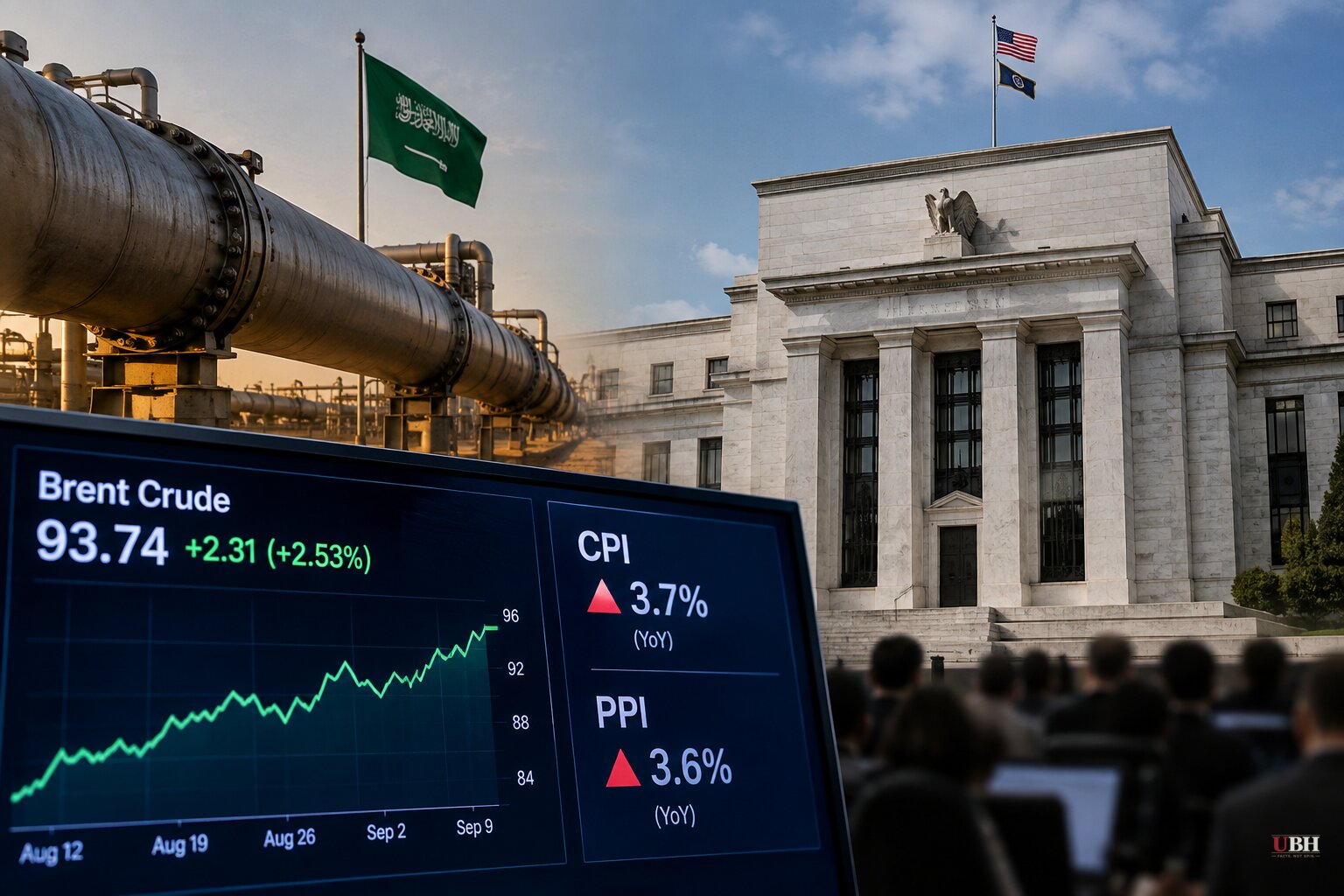
The Trigger: A Pipeline Attack in Saudi Arabia
A drone strike forced Saudi Arabia to shut down its East-West pipeline, a route historically used to move crude around the Strait of Hormuz, according to Tradingpedia. Operations were suspended immediately after the attack last Thursday, and authorities have not said when flows will resume.
Brent crude topped $107 a barrel on September 10, according to the Epoch Times, and climbed toward nearly $110 before pulling back somewhat on Friday, according to T. Rowe Price's Global Markets Weekly Update. WTI was trading near $101 as of Monday, per Mitrade market data. This is a geopolitical shock hitting an already-jumpy inflation picture.
The Data: Inflation Won't Cooperate
The Bureau of Labor Statistics reported Thursday that producer prices rose 0.4% in August, up from July's 0.1% gain, with goods prices jumping 1.1% on a 4.2% spike in energy costs, according to T. Rowe Price. Friday's Consumer Price Index report showed headline inflation at 3.4% year-over-year, unchanged from July, with core CPI up 0.3% month-over-month, the fastest pace since April, according to both T. Rowe Price and FXStreet.
That's the inflation the Fed has to deal with heading into its meeting, which begins Tuesday, September 15, with a decision scheduled for Wednesday, September 16.
Fed Odds Jump to 87%
Markets weren't expecting much of a hike a week ago. FXStreet reported the CME FedWatch tool showed a 59% probability of a quarter-point hike the prior week. T. Rowe Price put the pre-CPI number closer to 70% by Friday morning, and after the CPI report landed, that climbed to roughly 87%, a figure confirmed by both FXStreet and Economies.com. If it happens, Economies.com notes, it would be the Fed's first rate hike since July 2023.
The 10-year Treasury yield has risen for six straight sessions and is approaching the 5% threshold, according to Economies.com, while T. Rowe Price put it at roughly 4.97% and the two-year at 4.63% last week. Heavy Treasury issuance and a smaller-than-expected buyback operation added to the pressure, T. Rowe Price reported.
The ECB Already Moved
The European Central Bank isn't waiting to see what the Fed does. Its Governing Council voted unanimously on September 10 to raise three key rates by 25 basis points, effective September 16, according to the Epoch Times. The deposit rate, main refinancing rate, and marginal lending rate rise to 2.5%, 2.65%, and 2.9%, respectively. It's the ECB's second hike since June, when it delivered its first increase in three years.
The ECB isn't hiding why. "The conflict in the Middle East continues to generate inflation pressures, and inflation is set to remain well above target for an extended period," the bank said in its post-meeting statement, per the Epoch Times. Eurozone inflation hit 3.3% year-over-year in August, driven by a 14% spike in energy costs. ECB staff don't expect headline inflation back at 2% for two more years, and core inflation is projected to stay above target beyond 2028.
ECB Governing Council member Gediminas Simkus said Monday that rate action at every upcoming meeting can't be ruled out, and that the bank will watch energy prices closely before its October meeting, with December marked as a natural reassessment point, according to Tradingpedia.
The ECB also revised its 2026-2028 growth forecasts upward, to 0.9%, 1.4%, and 1.5%, respectively, citing "greater-than-expected resilience" in the euro area economy, per the Epoch Times. Hiking into resilient growth is a defensible call, though hiking into an energy shock that's already squeezing consumers presents a harder argument. The ECB itself admits the outlook is "highly uncertain."
Currency Fallout
The euro fell to $1.1558 Monday, a four-week low, its third straight daily decline, according to Economies.com. The Dollar Index rose 0.3% to a two-week high of 99.40. Emerging-market currencies took a bigger hit: an EM currency index fell 0.1% for a third straight day, its first weekly loss since June, with the Polish zloty, Hungarian forint, and Czech koruna leading declines, according to Bloomberg. ING analysts, cited by Mitrade, flagged that a dovish Czech National Bank could weaken the koruna further against the euro even as the ECB tightens.
The Canadian dollar is the notable winner here, strengthening against the euro as oil-linked currencies benefit directly from the Saudi supply disruption, according to Tradingpedia.
Stocks Already Wobbling
U.S. equities finished last week's holiday-shortened trading lower across the board, with the Russell 2000 down 2.41% and the S&P MidCap 400 down 1.87%, according to T. Rowe Price. Monday futures pointed further down: Dow futures off 0.17% near 52,500, S&P 500 futures down 0.64% near 7,610, and Nasdaq 100 futures down 1.46% near 28,960, according to FXStreet.
Part of Monday's tech-heavy futures slide traces to a separate story: Anthropic CEO Dario Amodei said Saturday that AI companies should slow development of their most advanced models over safety concerns, while OpenAI CEO Sam Altman said the company has no plans to go public this year, FXStreet reported. That's an AI-sector story running parallel to, not caused by, the oil and rate story.
Rabobank analysts, quoted by FXStreet, summed up the mood as broadly risk-off, pointing to "mounting constitutional tensions" in the UK and shifting alignments in North America as additional sources of political friction layered on top of the Middle East and Eastern Europe. Those specific characterizations are Rabobank's own framing of the geopolitical landscape, not independently confirmed developments, and should be read as one bank's risk commentary rather than established fact.
Whether the Fed follows through Wednesday and whether the Saudi pipeline comes back online before winter demand and low European gas storage levels, flagged by Catalyst Energy Infrastructure's Simon Lack to the Epoch Times, turn a supply shock into a supply crisis remain open questions.
Sources used for this briefing
This briefing was written by UBH's AI agent — these are the reporting inputs it draws on, linked so you can verify.


