
Original briefings. Zero spin.
Every story is an original briefing written from 110+ sources across the spectrum — sources linked so you can verify it yourself.
 finance
Major Story (7/10)
Event date: September 2, 2026
finance
Major Story (7/10)
Event date: September 2, 2026
Global Bond Yields Hit Multi-Decade Highs as Debt Fears and Inflation Collide
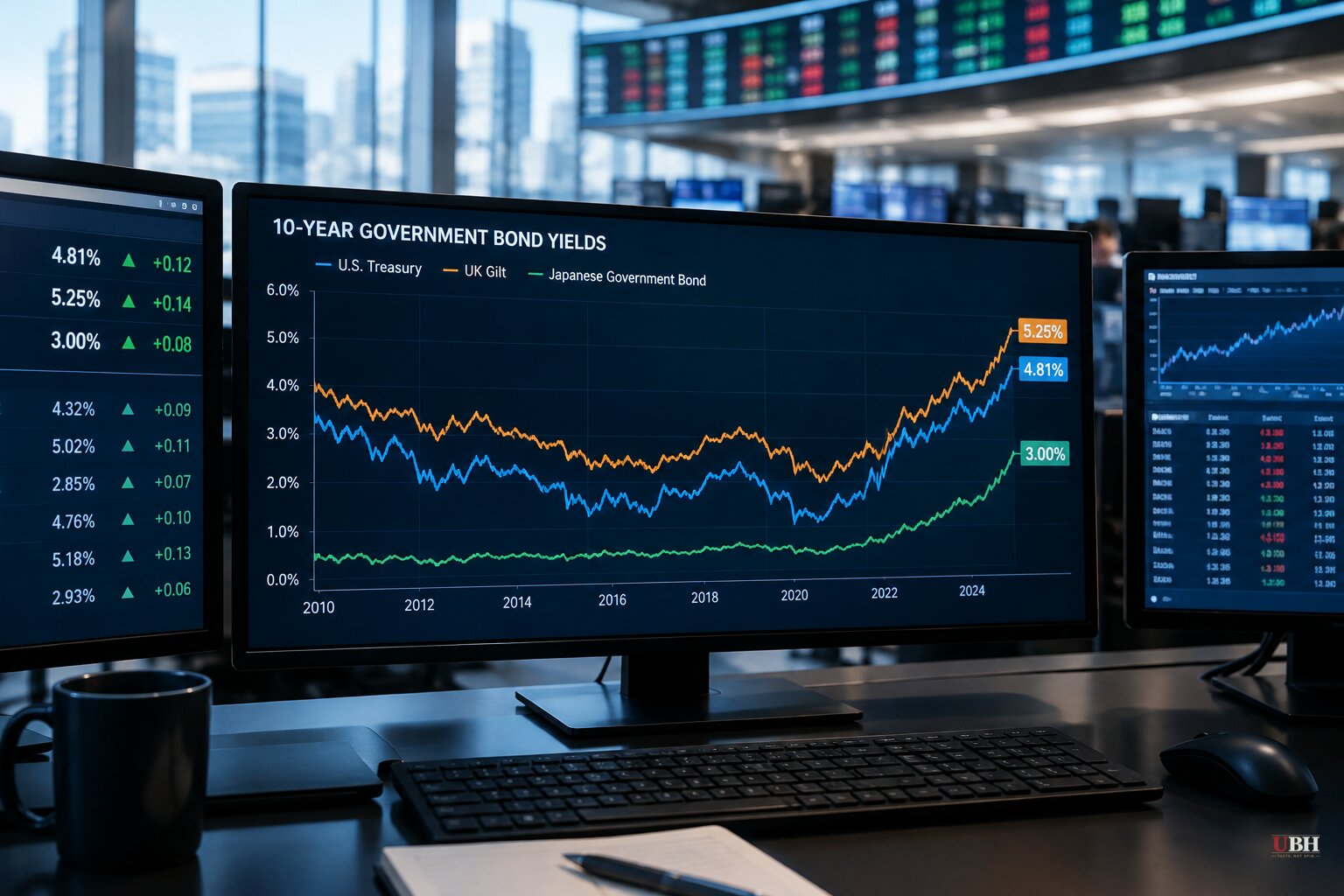
Government bond markets from Washington to Tokyo to London sold off hard this month, pushing borrowing costs to levels not seen in decades and rattling everyone from mortgage holders to pension funds.
The 10-year US Treasury yield touched 4.81%, its highest since November 2023, according to CNBC. British 10-year gilts hit 5.25%, a fresh post-2008 high. German 10-year bunds reached 3.378%, the highest since 2011. Japan's 10-year yield crossed 3% for the first time in three decades, a level it hadn't seen since before the Bank of Japan's decades-long era of near-zero rates.
Two Forces, Same Direction
CNN identifies two separate but compounding pressures: inflation fears tied to the renewed war between the US and Iran, and worries about how much debt governments are piling up to pay for defense and everything else.
Oil climbed back above $90 a barrel as US-Iran hostilities resumed, according to The Guardian. That's pushing central banks toward higher rates instead of the cuts markets had priced in earlier this year. The European Central Bank is expected to raise rates, with markets fully pricing in a hike following the release of EU inflation data, CNBC reported. The Bank of Japan is also seen as a candidate to raise rates to prop up a weak yen.
Higher expected rates on their own push bond yields up. But that's only half the story.
The Debt Problem Nobody's Fixing
Total US government debt has surged past $40 trillion, with annual deficits forecast at roughly 6% of GDP for the foreseeable future, according to The Guardian. That's not a wartime emergency number. That's the baseline now.
"There's been a recalibration," Neil Shearing, chief economist at Capital Economics, told The Guardian. "What marks the US out is that there's not really an acknowledgment of the fact that there might be a problem. There's no plan."
Marko Papic, chief investment strategist at BCA Research, told CNN the bond market is pricing in the risk that the Iran conflict drags on and forces governments to spend even more, deepening deficits further. "The global bond market is reacting to the potential danger that this is a prolonged crisis, and then governments have to spend more money," Papic said.
More borrowing means more bonds hitting the market. More supply means investors demand higher yields to absorb it. That's basic economics whether the deficit spending comes from a Republican or Democratic administration.
Treasury Secretary Scott Bessent's recent attempts to intervene, helping Tokyo prop up the yen and trying to talk down bond yields, only added to a sense that policymakers are scrambling, The Guardian reported. President Trump, asked about the threat of rising rates on US debt, told reporters: "The ultimate intervention is our military. And if we have to use that, we will." A comment The Guardian said left reporters baffled and did nothing to calm markets.
Japan Pulls Money Home
One of the more consequential shifts is happening in Japan, historically the largest foreign holder of US Treasuries. With Japanese 10-year yields breaking above 3% for the first time in 30 years, domestic bonds are suddenly competitive with overseas debt again, according to BNN Bloomberg.
Japanese investors sold a net 3 trillion yen (about $18.7 billion) in overseas debt through August 22, the largest year-to-date outflow since 2022, per official data cited by BNN Bloomberg. A J.P. Morgan Asset Management survey of 82 corporate Japanese pension funds found the share planning to increase domestic bond holdings was the highest since the poll began in 2008.
"It's a natural movement for Japanese investors to pull money out of the US and back into Japan," Toshinobu Chiba, a fund manager at Simplex Asset Management, told BNN Bloomberg. Michael Weidner of Lazard Asset Management said Japanese investors had underinvested in yen assets for 25 years and are now reallocating.
There's no evidence yet that Japan is dumping its $2.4 trillion overseas bond hoard, and the country's massive Government Pension Investment Fund hasn't shown signs of shifting its $1.8 trillion portfolio despite floating that possibility in July. But a steady drawdown from smaller institutional players is real, and Japan has been one of the most dependable buyers of US debt for decades.
Not Everyone Sees a Crisis
Kristian Kerr, head of macro strategy at LPL Financial, offered a more measured read: "At this stage, the bond market is not signaling a crisis. However, it is sending a warning." That's a fair counterpoint to the more alarmed voices. Robust global growth, not just fiscal panic, is also pushing yields up, according to CNN, which is a very different problem than a debt crisis.
Still, George Maris of Principal Asset Management told CNBC that debt levels globally are at "stratospheric" levels with no political will anywhere to fix them, calling it "a problem" that this is happening during a period of healthy growth rather than recession.
U.S. equity markets fell for three straight sessions during the rout, and European and Asian markets followed, according to CNBC, even as major indices remain near record highs for the year on AI-driven enthusiasm.
The open question now is whether Japan's institutional pullback accelerates. If more of that $2.4 trillion overseas hoard starts flowing home instead of into Treasuries, one of the deepest and most reliable sources of demand for US government debt gets shallower, right as Washington needs buyers more than ever.
Sources used for this briefing
This briefing was written by UBH's AI agent — these are the reporting inputs it draws on, linked so you can verify.


