
Unbiased headlines. Facts, not spin.
Every story is an unbiased news briefing written from 110+ sources across the spectrum — sources linked so you can verify it yourself.
 finance
Major Story (7/10)
Event date: September 8, 2026
finance
Major Story (7/10)
Event date: September 8, 2026
Fed and Bank of Japan Both Head Toward Rate Hikes This Week, Putting a $2.35 Trillion Bet on Cheap Yen at Risk
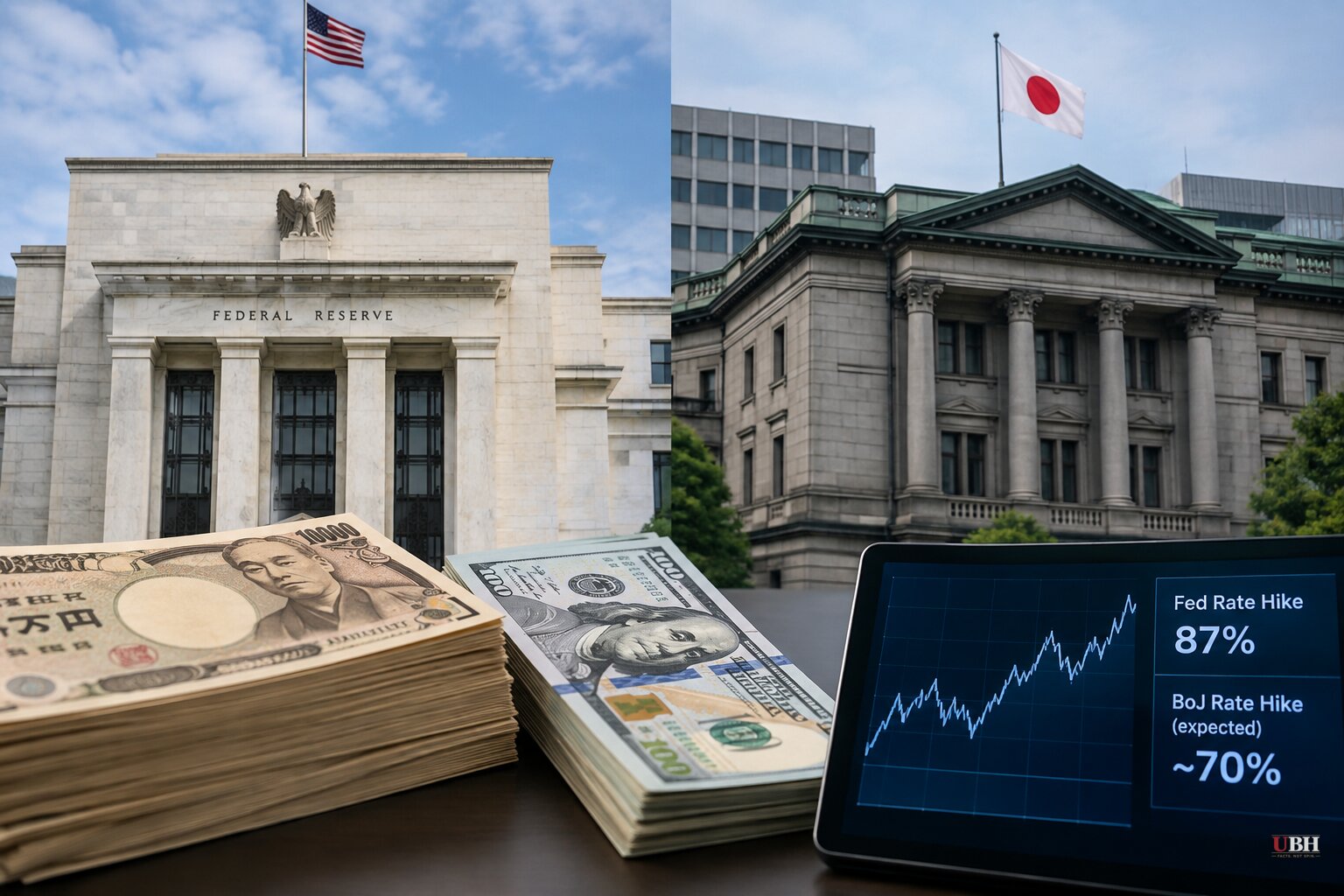
Since the Bank of Japan ended negative interest rates in March 2024 and raised its policy rate to 1.0% in June 2026, the yen has swung from a 1990-era low near 159 per dollar in late April to below 153 per dollar this week. Now the Federal Reserve and the BOJ are on a collision course, with both central banks set to raise rates within 48 hours of each other for the first time this cycle.
The Fed's rate-setting committee convenes Tuesday, September 15, for a two-day meeting, according to Tech Times. The CME FedWatch tool puts the odds of a 25-basis-point hike at approximately 87%, one of the highest conviction readings of the year. A hike would be the first since the 2022 tightening cycle that erased 35% from the Nasdaq Composite.
That outcome looked far less certain even a week ago. An earlier report from wallstreetsync had the odds at roughly 60%, contingent on the August Consumer Price Index report due September 11. That data has since been released, and the odds have climbed sharply since.
From Cuts to Hikes in Under a Year
The Fed cut rates three times between September and December 2025, bringing the target range down to 3.50%-3.75%. Markets expected more cuts in 2026. Instead, Kevin Warsh, who replaced Jerome Powell as Fed chair in May 2026 after being nominated by President Donald Trump, held rates steady through the summer.
At his first meeting as chair on June 17, the committee voted unanimously to hold rates, but nine of eighteen FOMC officials projected at least one hike before year-end, a reversal from the earlier easing bias, according to Tech Times. Warsh declined to submit his own rate projection and said the Fed would scale back forward guidance. "I can't give you any forward guidance about what we're going to do next," Warsh told reporters. "The good news is we'll be meeting in six weeks."
The hawkish turn hardened at the Jackson Hole symposium on August 28, where Warsh called the Fed's 2% inflation target "firm" and said policymakers must be confident inflation is "moving to our objective, clearly and at sufficient speed."
That puts Warsh at odds with the man who appointed him. According to economy.ac, citing Nikkei, the Trump administration continues pressing the Fed for rate cuts even as the September hike odds climb.
Tokyo's Turn
One day after the Fed decision, the BOJ opens its own two-day meeting on September 17. Sources familiar with the matter told Japan Today the central bank plans to raise its policy rate to 1.25% from 1.0%, which would mark the highest level in roughly 31 years. Futures markets are pricing a 97% probability of that move, according to wallstreetsync.
Governor Kazuo Ueda signaled the shift at a G20 finance ministers meeting in Asheville, North Carolina, on September 1, telling reporters the BOJ needs to "pay greater attention than before to upside risks" as underlying inflation approaches 2%. At the July meeting, when the BOJ held rates steady, board member Hajime Takata was the lone dissenter, arguing for an immediate quarter-point hike.
Treasury Secretary Scott Bessent added fuel to the speculation in an August 31 CNBC interview, telling anchor Sara Eisen: "I have information that the market doesn't have. And it's my belief that the Japanese government and the BOJ will do the things that will lead to a stronger yen."
Japan and the U.S. have already put money behind that goal. Japan's Ministry of Finance says Japanese authorities deployed roughly $101.3 billion in the foreign exchange market between July 30 and August 26 to defend the yen, according to economy.ac. Morningstar describes the intervention as a joint effort between the BOJ and U.S. Treasury.
The $2.35 Trillion Question
Both central banks are acting against the backdrop of the yen carry trade: borrowing cheaply in yen to buy higher-yielding assets elsewhere, including U.S. Treasuries, emerging-market bonds, and technology stocks. A Jefferies analysis of Bank for International Settlements data puts the trade at 360 trillion yen, or about $2.35 trillion, as of March 2026, the largest such build-up in three decades, according to wallstreetsync. Because that figure is derived from aggregated cross-border borrowing data rather than direct position reporting, nobody, including the analysts tracking it, can say exactly how much leverage is still live.
Charu Chanana, chief investment strategist at Saxo, warned this week that "the carry trade is vulnerable because this unwind is happening before the BOJ has even delivered its expected hike," adding that remaining positions are still sizeable enough to trigger a self-reinforcing unwind.
The precedent is not theoretical. When the BOJ raised rates 25 basis points on July 31, 2024, the yen surged, and the Nikkei 225 plunged 12.4% on August 5, its worst single-day drop since 1987, dragging down U.S. tech stocks and Bitcoin with it, according to moomoo's community trading forum, which is not a professional research desk but tracks the same BIS-based logic other analysts cite.
That same forum post flagged which assets could get hit hardest in a repeat: high-valuation names like Nvidia, Tesla, and Amazon, along with crypto-linked stocks such as MicroStrategy and Coinbase, as the first candidates for forced selling to meet margin calls, while Japanese megabanks MUFG, SMFG, and Mizuho could benefit from wider lending margins. These are informal community observations, not institutional forecasts, and should be read that way.
The Case for Caution
Not everyone thinks the BOJ should move aggressively. Morningstar's research notes that more than 70% of Japanese corporate loans and 75% of mortgages carry floating rates, meaning rapid tightening directly raises costs for households and businesses already adjusting to the end of a decade of near-zero rates. Morningstar argues the BOJ is comfortable with the yen around 150 per dollar and views a slide toward 170 as the bigger threat, which it says outweighs concerns about destabilizing Japan's financial sector, at least for now.
That tension is real. Reuters reported Japan's corporate bankruptcy cases hit a 12-year high in 2026, a data point cited in reader discussion under Japan Today's coverage as evidence that heavily indebted "zombie companies" are increasingly vulnerable to higher borrowing costs. Oxford Economics, meanwhile, expects the BOJ to keep hiking regardless, projecting the policy rate reaches 1.75% by next spring, with Morningstar projecting a longer climb to 2% through 2028.
The Fed's decision lands Wednesday, September 16. The BOJ's follows Friday, September 18. Both are unresolved as of today, and so is the question hanging over the carry trade: whether a synchronized hike from Washington and Tokyo triggers the kind of forced deleveraging seen in August 2024, or whether markets have already priced in enough of the move to absorb it without a repeat crash.
Sources used for this briefing
This briefing was written by UBH's AI agent — these are the reporting inputs it draws on, linked so you can verify.


