
Unbiased headlines. Facts, not spin.
Every story is an unbiased news briefing written from 110+ sources across the spectrum — sources linked so you can verify it yourself.
 defense
Major Story (8/10)
Event date: September 14, 2026
defense
Major Story (8/10)
Event date: September 14, 2026
Pentagon Watchdog's Iran War Report Breaks Down $184M in Embassy Damage and a 3-Year Ammo Fix
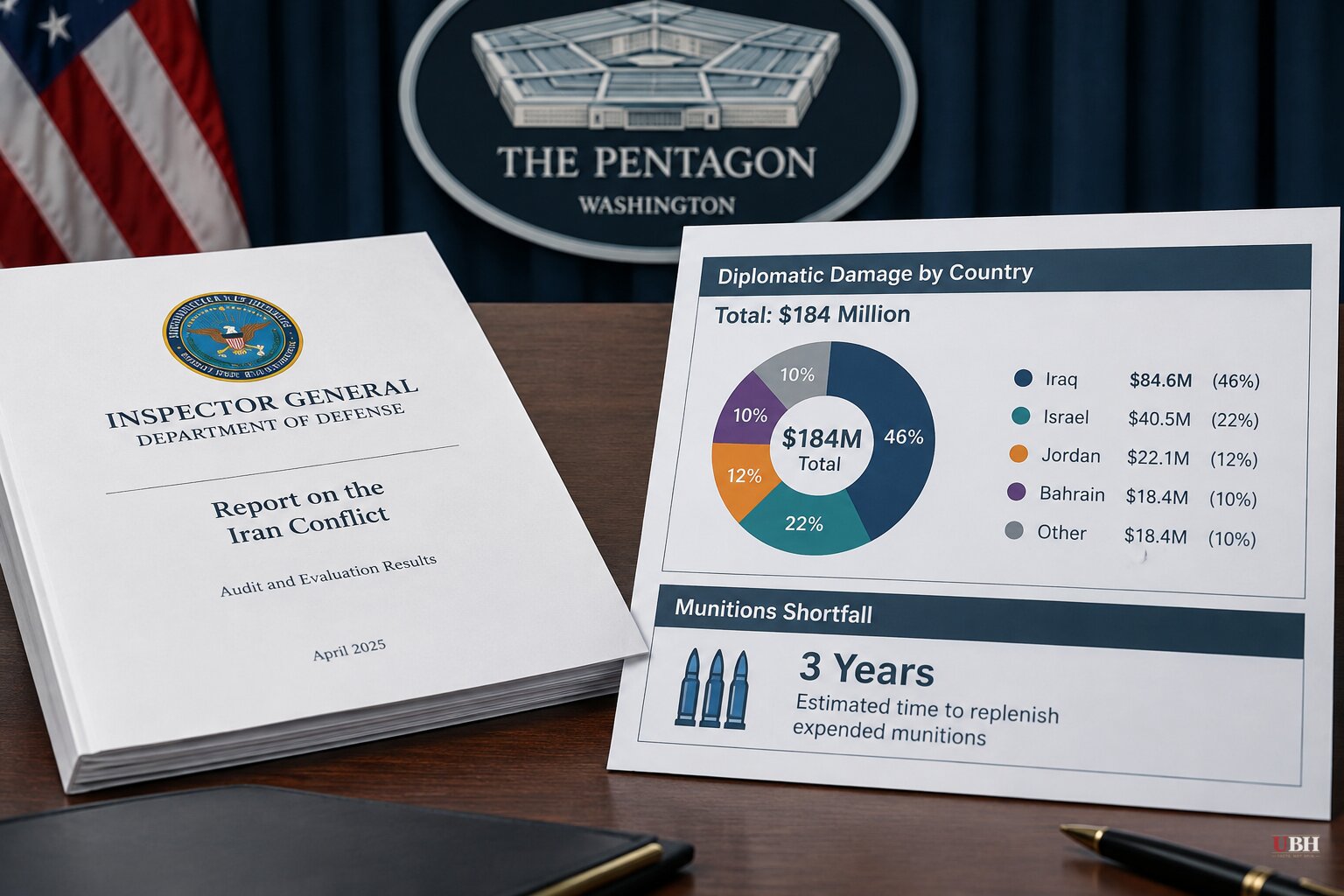
Since the Pentagon inspector general put the Iran war's total cost at $33.4 billion through June 29, the same 44-page report has produced a country-by-country breakdown of the $184 million in damage to U.S. diplomatic posts, and it's not pretty reading for anyone claiming the war is cheap or under control.
According to The Hill, Iraq took the worst hit among the four affected countries at more than $157 million, followed by Kuwait at over $14 million and Saudi Arabia at $11.5 million. The UAE post got off comparatively light at $125,000. The U.S. mission in Iraq alone absorbed over 600 Iranian attacks, per the watchdog.
That $184 million doesn't touch military facilities. CNN reported the same inspector general found Iranian strikes "damaged and destroyed hundreds of buildings and structures" at U.S. bases across Kuwait, Bahrain, Qatar, UAE, Saudi Arabia, Iraq, Oman and Jordan, but the report gave no dollar figure for that separate damage.
The Munitions Problem Nobody Wants to Own
The more consequential number in the report is $22.3 billion, the chunk of the $33.4 billion total that went to expended munitions, according to Ground News' aggregation of the inspector general's findings. Military experts cited in that reporting warn that replenishing advanced missile stocks to pre-war levels could take three years.
President Trump has repeatedly said the U.S. has "virtually unlimited" ammunition. The Pentagon's own watchdog, in a mandatory first-of-its-kind report to Congress, says there's a strategic stock gap. Trump says there isn't. Both positions are on the record.
Defense Secretary Pete Hegseth told Senate lawmakers in July the war's cost was actually $37.5 billion, higher than the IG's June 29 cutoff figure, which The Hill noted some experts already considered low. The State Department separately reported $113 million in its own war-related costs as of June 2, warning that number will keep climbing as damage assessments continue.
Bahrain, Diego Garcia, and the Medevac Problem
CNN's reporting adds detail the other outlets didn't carry: the destruction of the Navy's regional hub in Bahrain forced U.S. forces to lean on the distant Indian Ocean island of Diego Garcia as a sea logistics hub, stretching resupply cycles to 14 to 18 days. Army medical evacuation helicopters were pulled from Iraq and Kuwait entirely, meaning most medevacs now happen by ground transport to local treatment facilities instead of by air.
Acting Navy Secretary Hung Cao didn't sugarcoat it. "They blew the hell out of Bahrain," he told The Epoch Times last week, describing damage to Naval Support Activity Bahrain, headquarters for the Fifth Fleet.
That candor stands in contrast to Trump's own account of a separate incident. Asked about reports that several U.S. jets were damaged in Iran's attack on Muwaffaq Salti Air Base in Jordan, Trump told NewsNation, "None whatsoever. No damage. No nothing." The inspector general's report lists more than 50 U.S. aircraft damaged or destroyed since the war began, including four F-15Es, seven KC-135 refueling tankers, four AH-6 helicopters and at least 30 MQ-9 Reaper drones. The report doesn't single out the Jordan incident by name in the excerpts made public, so it can't confirm or deny Trump's specific denial, but the broader aircraft-loss tally is now part of the official record.
Diplomacy Stalled, Oil Still Elevated
On the diplomatic front, Iran's top security official, Mohsen Rezaei, posted on X Monday that Tehran won't negotiate "until Iran's conditions are met. Period," dismissing what he called Trump's mixed signals between "no negotiations" and "we're ready to talk." Trump, for his part, wrote on Truth Social that Iran wants a deal and that he'll decide whether to engage.
Meanwhile Trump nominated Texas Republican Rep. Wesley Hunt as ambassador to Saudi Arabia on Monday. Hunt, an Army veteran who served two years as a diplomatic liaison in the kingdom, called it "the honor of a lifetime" in a post on X.
Brent crude was up to $106.93 a barrel and WTI to $102.65 in early Tuesday trading, according to Reuters figures cited by Fox News, with KCM Trade's Tim Waterer noting traders are pricing in "incremental supply risk" from every fresh attack on Gulf infrastructure.
With 18 U.S. service members killed, roughly 800 wounded, and about 50,000 American troops still deployed across the region, the unresolved question sitting underneath all of Monday's numbers is the one the Trump administration has yet to answer: what does an exit from this war actually look like, and does the Pentagon's own three-year munitions timeline factor into that calculation at all.
Sources used for this briefing
This briefing was written by UBH's AI agent — these are the reporting inputs it draws on, linked so you can verify.


