
Unbiased headlines. Facts, not spin.
Unbiased Headlines is an independently owned news organization. We bring you the facts, not opinions, written fresh from 110+ named sources. Sources linked so you can verify it yourself.
 energy
Notable (6/10)
Event date: October 25, 2026 ·
Pentagon Plans for Bases to Run 90 Days Off the Grid While UK Sets a 72-Hour Target for Black Sky Events
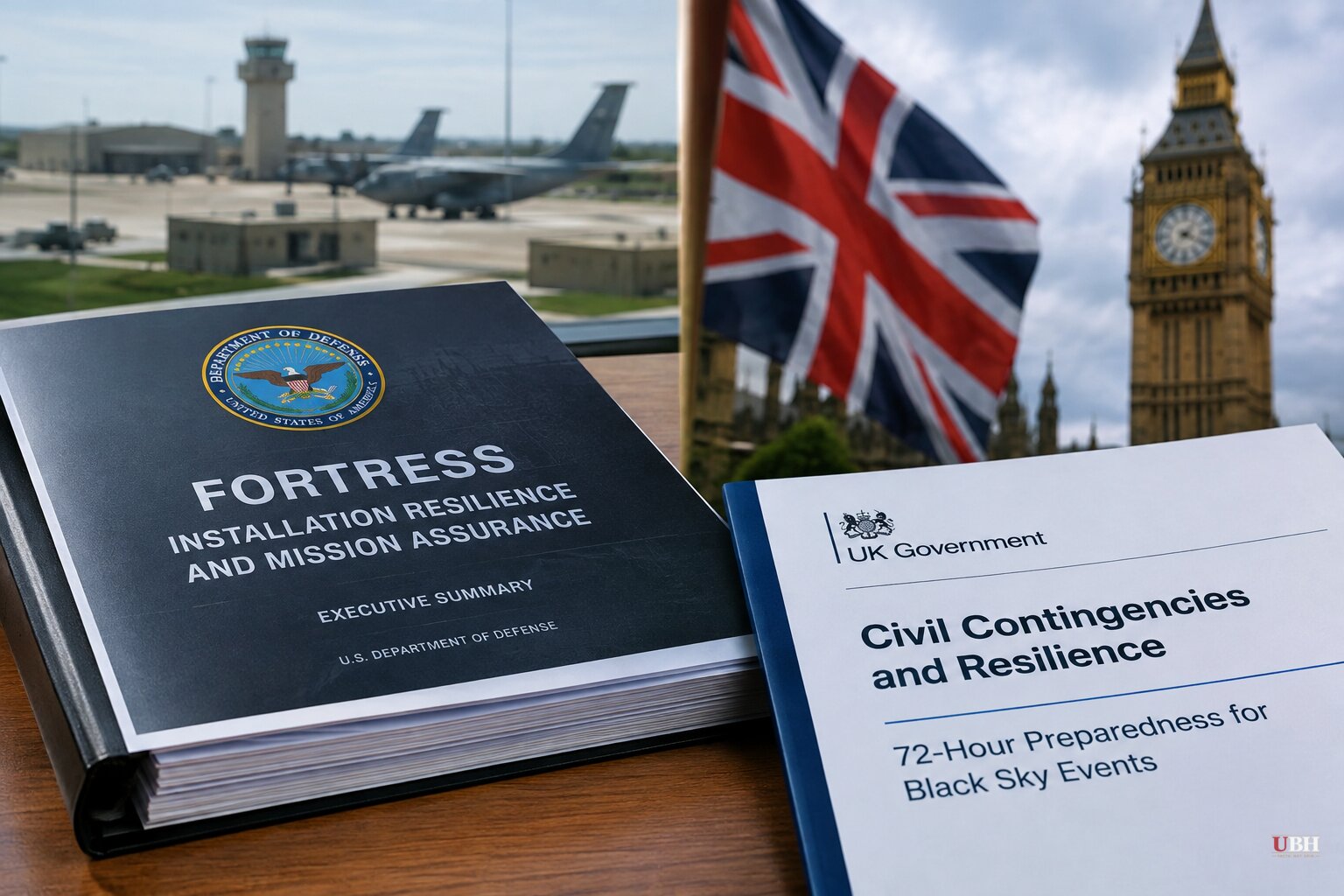
The U.S. military is planning for a war in which the civilian power grid goes down and stays down.
The Pentagon is preparing bases to keep operating for at least 90 days without outside support, according to documents reviewed by Fox News Digital. The requirement is part of an initiative called FORTRESS. Under it, every major installation in the continental United States would have to sustain essential operations on its own, including electricity, water, fuel and communications.
What the Pentagon says it is doing
Pentagon chief spokesperson Sean Parnell, who led FORTRESS, put it plainly. "We don't want to rely on standard civilian municipal infrastructure to run our national defense. We just simply can't. It's an intolerable risk," he told Fox News Digital.
"Power is combat now," Parnell said. "Without electricity, you lose communications, water, logistics, assembly lines and just basic military command structures."
The plan goes past the fence line. The Pentagon is also laying the groundwork for civilian factories to shift to defense production in a crisis. It is preparing alternative supply chains and strategic reserves to keep weapons, fuel and other essential materials moving.
Parnell tied the shift to a change in how the department thinks about homeland defense. "A lot of the way we think about homeland defense was built around the antiquated assumption that two oceans would protect us," he said. He pointed to Golden Dome, a renewed focus on the Western Hemisphere, Greenland and Panama as steps the President has already taken.
Separately, the Army is launching an initiative to build nuclear micro reactors on bases. Pentagon technology chief Emil Michael is also leading Project Meridian, a study of future warfare co-led by Elon Musk, Palmer Luckey and Newt Gingrich. Its findings are due within 120 days.
Lancaster showed what a few days without power looks like
Britain has its own picture of what a long outage means, and it comes from a flood rather than a war.
At 22:45 on 5 December 2015, the River Lune flooded in Lancaster and electricity to 61,500 people went out. Households lost light and heat. Some water supplies failed because they depended on electric pumps. The railway station closed, along with petrol stations and shops. Most cash machines stopped working. Traffic lights failed.
Only two communication systems held up: copper-wire landlines and FM radio. The local commercial station The Bay had an emergency generator and one landline, and sent a reporter outside the affected area to phone in updates.
Roger Kemp, a Lancaster University engineering professor who specializes in safety and electrical systems, said the town felt "almost like a zombie movie." Three months later he gathered people to review what went wrong. The resulting report called it ironic that, in a society so committed to digital infrastructure, the most reliable source of news was a station using technology familiar to the engineers of 1960s pirate radio.
Planners now call a prolonged, wide-area loss of power a Black Sky event. At a recent UK resilience summit, the discussion centered on making the country able to withstand one for a minimum of 72 hours. A phrase common in civil contingency circles, "we are nine meals from anarchy," captures the fear that three days without food is enough to turn a crisis into chaos.
The British government's "Be Prepared" campaign urges households to hold their own supplies. The government also says there is no specific threat to the grid. Officials are asking people to prepare, not warning of an expected attack. In a major emergency, the public is being told to stay put and tune in an FM radio. The BBC keeps its own Black Sky plan, and only a small number of its staff know the full details.
The threats are different, and so is the timeline
A grid can fail from flood, war or the Sun. University of Michigan space physicists Sanjay Kumar and Mark Moldwin say a single space weather event called a substorm can affect the ground within minutes. It releases energy tens of thousands of miles from Earth and drives electric currents through the soil.
The strength of the effect varies by latitude and by the structure of the soil and rock underfoot, they write. They also stress that a coronal mass ejection does not simply hit Earth and instantly cause power-grid failures. It sets off a chain of processes in space that can pose a threat to grids.
That is the unglamorous version of the risk: real, but dependent on conditions.
A British grid already under strain
Britain's grid is also stretched by demand for new connections. Ofgem figures put the demand connection queue at 125GW as of June 2025, up from 41GW the previous November. Generators, housing developments, EV charging, industrial sites and data centers are all waiting.
The government has announced the Great British Grid, a publicly owned body within Great British Energy. It will invest public money alongside private capital in network infrastructure and is funded from GB Energy's existing £4bn budget. NESO now estimates about £89bn of grid investment will be needed through the 2030s, a 53% increase on its 2024 estimate.
The government's Clean Power 2030 plan calls for flexible demand response to provide 12GW of capacity during peak periods by 2030. A pbctoday commentary argues that buildings, which will contain the most flexibility providers, remain largely untapped because there is no trusted way to measure how much flexibility a given building can offer.
None of that is a Black Sky plan. It does show a grid with a long to-do list before it faces any extreme event.
The open question
The two governments have set very different bars. The Pentagon wants 90 days of independence for its bases. Britain's civilian target is 72 hours for the country at large.
FORTRESS covers military installations. Neither plan, as described, says how a town like Lancaster would hold out for 90 days. Project Meridian's findings, due within 120 days of its announcement, are the next scheduled public marker on how the Pentagon sees future conflict.
Sources used for this briefing
7 links from 6 independent newsrooms (syndicated copies of the same report count once)
These are the sources it draws on, linked so you can verify.


