
Unbiased headlines. Facts, not spin.
Every story is an unbiased news briefing written from 110+ sources across the spectrum — sources linked so you can verify it yourself.
 defense
Major Story (8/10)
August 8, 2026 at 10:47 AM
defense
Major Story (8/10)
August 8, 2026 at 10:47 AM
Pentagon Munitions Stockpiles Have Dropped Sharply After Iran Strikes, CSIS Data Shows
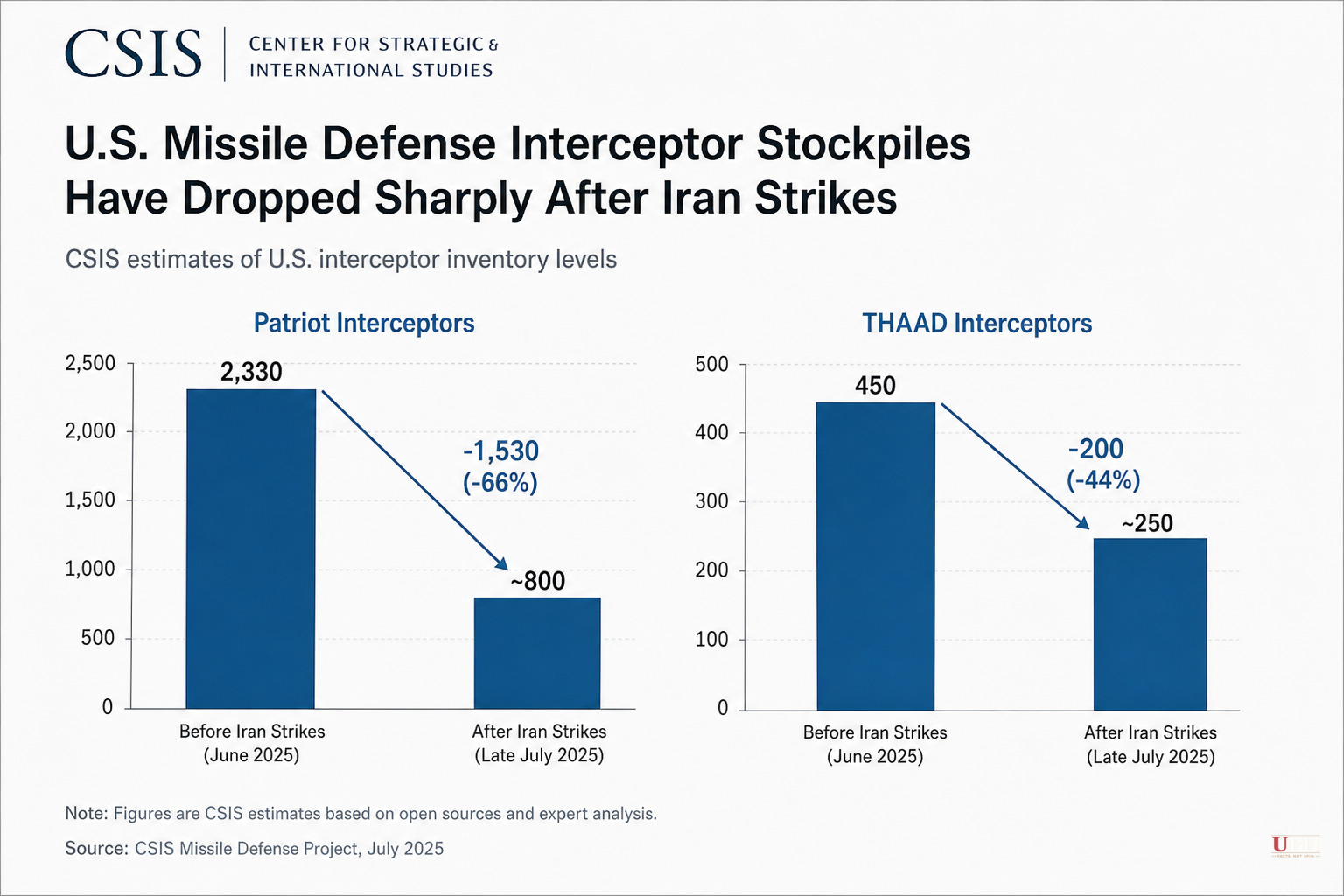
The numbers are specific, and they are not in dispute: according to an estimate from the Center for Strategic and International Studies published at the end of July, the U.S. arsenal of Patriot interceptors fell from 2,330 before recent military action against Iran to roughly 800 remaining. THAAD interceptor stocks dropped from 450 to about 250 over the same stretch.
Those figures come from outside tracking, not a leak. CSIS is a Washington think tank that publishes open-source assessments of U.S. and allied military capacity, and its interceptor estimates have been widely cited by outlets across the political spectrum covering the aftermath of Operation Midnight Hammer, the 2025 U.S. strike on Iranian nuclear facilities.
Separately, multiple news organizations have reported the U.S. is running low on Army Tactical Missile Systems (ATACMS), the ground-launched precision-strike missile, along with its newer replacement, the Precision Strike Missile. Reports also indicate the U.S. has used roughly half its Tomahawk cruise missile inventory, a weapon the Pentagon has historically produced at a rate of fewer than 100 units per year.
President Trump has publicly condemned media leaks about low weapons stocks, calling them irresponsible. This criticism carries weight on its own terms. Operational details about remaining U.S. missile inventories are exactly the kind of information adversaries want, and broadcasting weakness in real time carries genuine strategic risk. A president pushing back on leaks of sensitive military logistics is not an unreasonable position, regardless of who occupies the office.
But CSIS's estimates are public, peer-reviewed by other defense analysts, and have been tracked for months. The tension here isn't between truth-telling and security. It's between a legitimate concern about operational secrecy and a fact pattern that outside experts have already documented in open-source reporting.
Mackenzie Eaglen, a defense analyst at the American Enterprise Institute, has warned for years that the Pentagon under-invested in munitions stockpiles to stay within budget constraints, betting on optimistic assumptions about the length and intensity of future conflicts. That bet is now being tested. The Pentagon also prioritized exquisite, expensive interceptor systems over cheaper mass-production alternatives, which left the U.S. firing costly Patriot and THAAD interceptors against inexpensive drone swarms during the Iran engagement, a mismatch defense planners have flagged as unsustainable in a longer war.
The strategic stakes go beyond Iran. CSIS war-gaming on a hypothetical Taiwan Strait conflict with China has found the U.S. running out of key precision munitions within days or weeks of sustained combat, well before a conflict with a peer military power like China would likely be resolved. Iran is, by any reasonable measure, a lesser military power than China. If U.S. stockpiles were strained fighting Iran, the gap between current production and what a China contingency would require looms large for Pentagon planners.
There is no dispute among defense analysts, across the ideological spectrum, that Tomahawk production at fewer than 100 units annually is inadequate for sustained high-intensity conflict. The question is what replaces that production model, and how fast.
Defense hawks are pushing to put missile production on what they call a wartime footing, expanding contracts to newer defense manufacturers alongside traditional primes like Lockheed Martin and Raytheon, which currently produce the bulk of Patriot and THAAD interceptors. Whether Congress funds that expansion, and how quickly newer firms can scale manufacturing of complex guided munitions, remains unresolved. The Pentagon has not announced a public timeline for rebuilding depleted interceptor stockpiles to pre-war levels, and CSIS has not published an updated estimate of current inventories beyond its late-July figures.
Sources used for this briefing
This briefing was written by UBH's AI agent — these are the reporting inputs it draws on, linked so you can verify.


