
Unbiased headlines. Facts, not spin.
Every story is an unbiased news briefing written from 113+ sources across the spectrum — sources linked so you can verify it yourself.
 finance
Major Story (7/10)
Event date: October 2, 2026
finance
Major Story (7/10)
Event date: October 2, 2026
Paramount Skydance's $52 Billion Bond Sale Sours Within Hours, Pulling Oracle's Credit Down With It
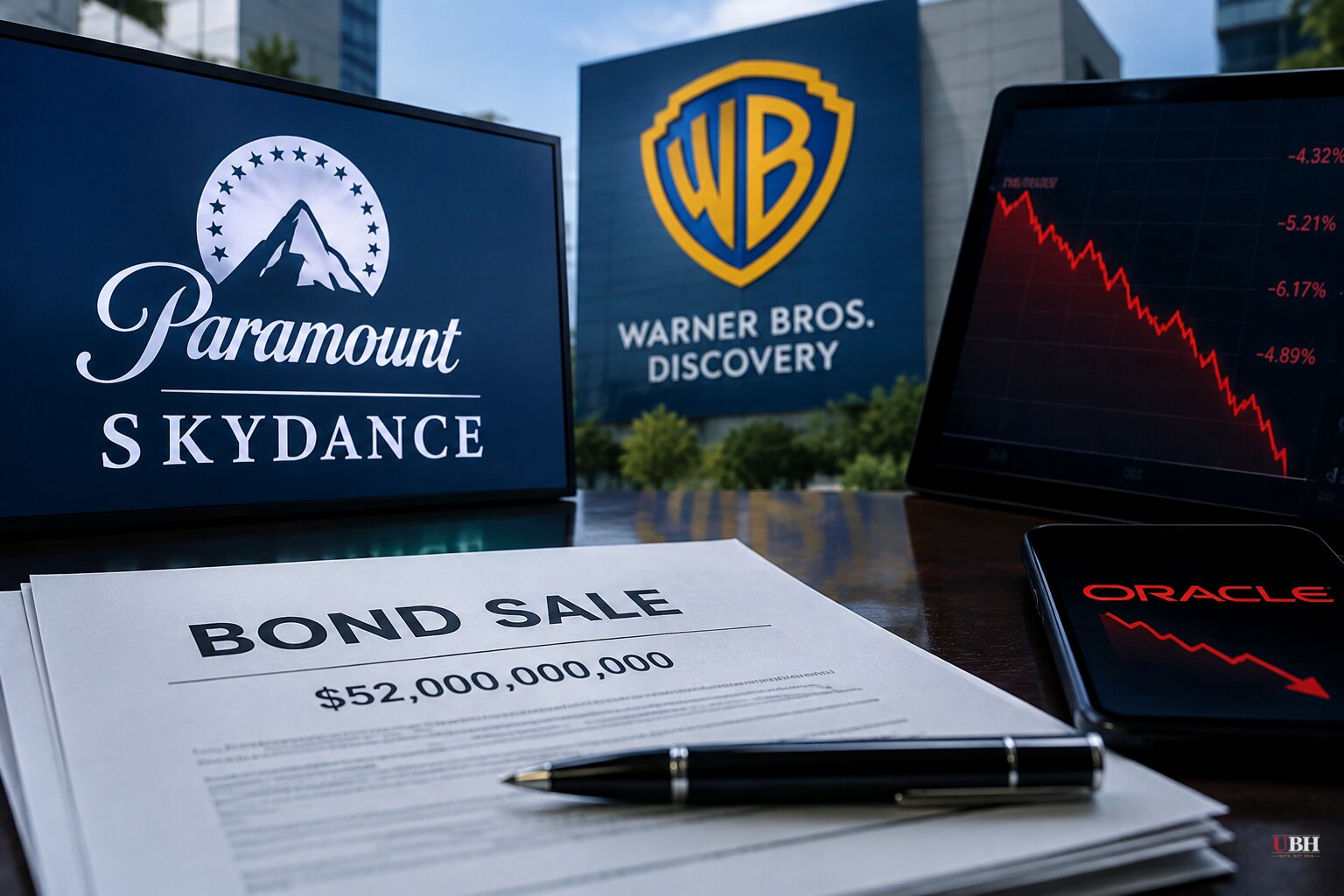
Since Paramount Skydance priced $52 billion of new debt on September 30 to fund its $110 billion purchase of Warner Bros. Discovery, the bonds have slid, bondholders have flooded Wall Street banks with complaints, and investors have started treating Oracle's credit risk as inseparable from Paramount's. The merger is now scheduled to close Tuesday, October 6, with the combined company carrying close to $80 billion in debt.
The numbers are blunt. Eight-year junk-rated dollar notes priced at 100 cents on Wednesday were trading near 95 to 96 cents by Thursday morning, according to Bloomberg. A $6 billion slug of 8.25% second-lien notes due 2031 changed hands at $97.50, more than two points below issue price, Barron's reported. Paramount's existing 6.875% bonds due 2036 fell six points to $79 from $85, pushing their yield to 10.4% from 9.25%, also per Barron's. Bloomberg estimated investment-grade paper alone carried more than $100 million in unrealized losses, with total paper losses across the package potentially topping $200 million.
Paramount stock fell 9.6% that Thursday, its worst single day since December, according to Quartz. The cost to insure Paramount's debt against default jumped to its highest level in 17 years. Investment-grade order books, advertised at roughly $109 billion at their peak, shrank to about $80 billion once banks trimmed the premiums they were offering, and long-end demand dropped by more than half, according to figures cited by Briefs.
Why It Priced Now, and Why It Cost More
Paramount didn't choose this moment. Lawsuits that had blocked the borrowing were resolved in late September, and the merger agreement required Paramount to pay Warner Bros. Discovery shareholders roughly $7 million a day for every day the deal stayed open past October 1, Bloomberg reported. Moneycontrol framed it plainly: borrowing this week instead of three months ago meant paying more, because Treasury yields climbed during the delay. Bloomberg's Credit Weekly column noted the average yield on a high-grade U.S. corporate bond topped 6% this week for the first time since 2023, with risk premiums at a six-month high across the board, driven by renewed inflation fears. Briefs drew a comparison to SpaceX's $25 billion bond rollout in June, which also stumbled almost immediately after pricing.
Apollo Global Management, Bank of America and Citigroup led the financing, selling roughly $30 billion in investment-grade debt, $12.4 billion in junk bonds and $9.46 billion in loans inside a single week, according to TheWrap. Bondholders' complaint, in plain terms: the advertised demand didn't match what showed up when the discounts got cut. That's a legitimate gripe from money managers who bought in believing the order book was stronger than it turned out to be. Paramount CFO Dennis Cinelli called the selloff "one-day choppiness" and said the company wasn't in it "for a one-day trade." Citigroup's Leon Kalvaria said the financing "turned out incredibly well in a choppy market." Both sides have stated their case. The bond prices are the only thing that settled anything so far.
The Larry Ellison Problem
Oracle presents a separate complication. Bloomberg, via Yahoo Finance, reported that the cost to insure Oracle's and Paramount's debt against default has started moving in lockstep, because both companies' financial backstops trace to the same 82-year-old man. Larry Ellison's family trust guaranteed roughly $47 billion of the equity financing behind the Warner Bros. Discovery deal, and the Ellison family separately pledged to help bring Paramount's leverage down over time, a commitment ratings firms and investors read as a tacit promise of more capital if needed.
The issue, per Wellington Management portfolio manager Campe Goodman: most of the Ellison family's wealth sits in Oracle stock, and Oracle is mid-way through its own capital-intensive AI buildout. "You have to consider your total Larry Ellison risk," Goodman said, arguing investors should treat Oracle and Paramount as related bets rather than separate credits. Representatives for Paramount and Oracle didn't respond to requests for comment, and attempts to reach Ellison through his foundation went unanswered, according to Bloomberg.
One piece of coverage got the basic fact backwards. Career Ahead Online published a piece describing a "Paramount debt reduction" supposedly signaling tighter credit across media. There's no reduction. Paramount just added $52 billion in new debt and the combined company will carry roughly $80 billion once the merger closes. What dropped was the bond price, not the debt load, and conflating the two inverts the story.
The merger closes Tuesday. The combined company, renamed Skydance, begins trading on the NYSE under ticker SKYD that day, with warrants to follow October 13. David Ellison has already installed HBO's Casey Bloys over the combined streaming operation and brought in Mattel CEO Ynon Kreiz as co-CEO. Whether the Ellison family's leverage-reduction pledge gets tested, and how fast, depends on whether the promised $6 billion in annual cost cuts materialize once the two companies are actually one.
Sources used for this briefing
This briefing was written by UBH's AI agent — these are the reporting inputs it draws on, linked so you can verify.


