
Unbiased headlines. Facts, not spin.
Unbiased Headlines is an independently owned news organization. We bring you the facts, not opinions, written fresh from 110+ named sources. Sources linked so you can verify it yourself.
 tech
Notable (6/10)
Nvidia Projects Physical AI Revenue Above $25 Billion for Fiscal 2027, Up From $6 Billion a Year Earlier
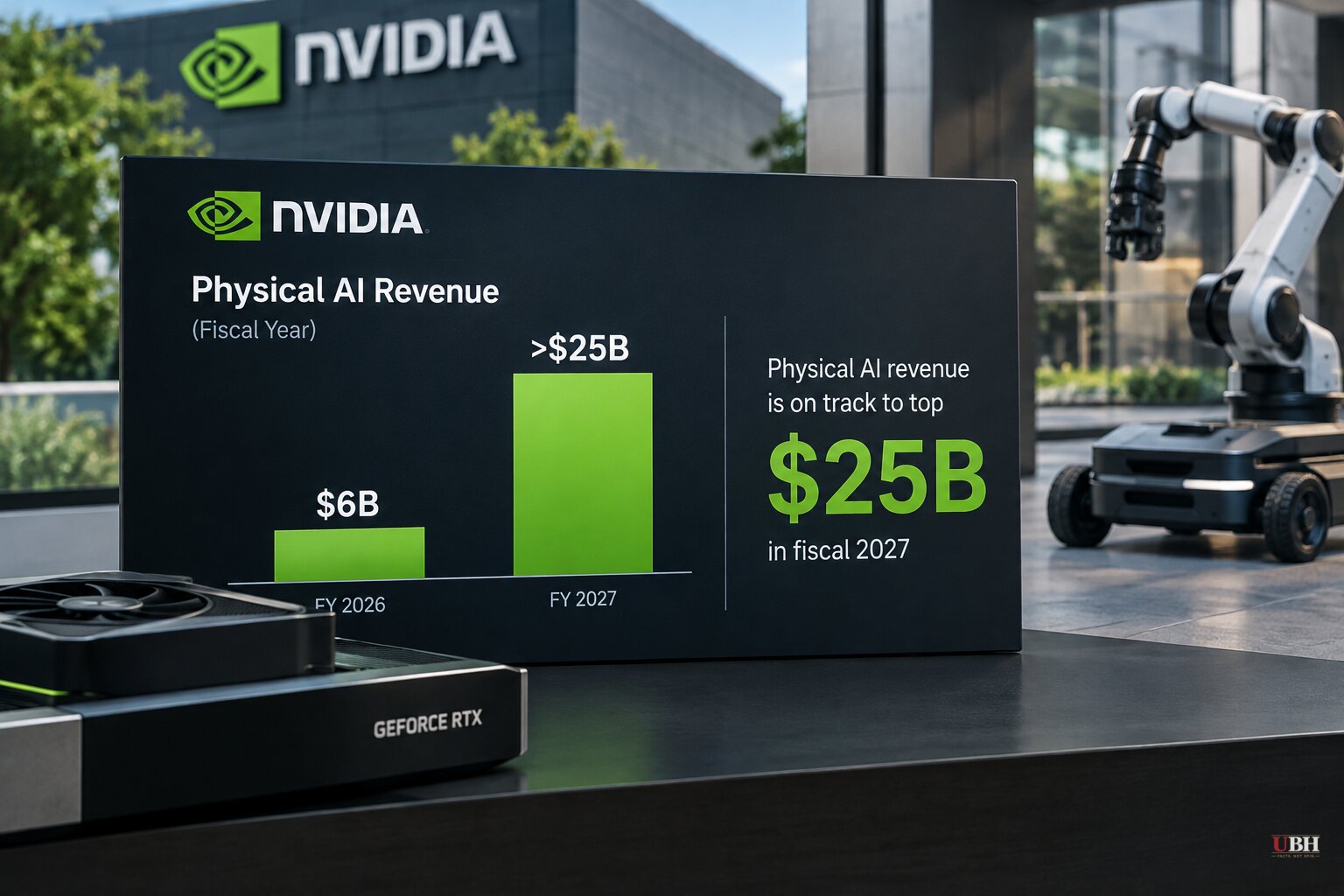
Nvidia says its physical AI business, the robots, autonomous vehicles and industrial machines that run its chips, is on track to bring in more than $25 billion this fiscal year.
The company made the claim on its third-quarter fiscal 2027 earnings call on Tuesday, Nov. 17. The fiscal year ends in late January 2027.
That is a big jump. Nvidia's physical AI revenue was about $6 billion in fiscal 2026, so the new target is more than four times that. Third-quarter physical AI revenue nearly tripled from a year earlier, the company said.
What the number actually is
Interim CEO and CFO Colette Kress said on the call that Nvidia does not report physical AI as a separate segment. The $25 billion is management's own carve-out from products sold across the company.
The figure draws on the Isaac robotics platform, which developers use to train and simulate robots. It also draws on the Jetson and Thor onboard computers, which let machines run AI locally rather than ping a data center.
Motley Fool analyst Harsh Chauhan, whose own estimate puts Nvidia's fiscal 2027 revenue near $424 billion, calculates that physical AI would be nearly 6% of the total. Chauhan lists Caterpillar, Boston Dynamics and LG Electronics among the companies using Nvidia's robotics tools.
The quarter behind it
Nvidia posted $115.8 billion in third-quarter revenue, up 103% from a year earlier and 20% from the prior quarter. Data Center revenue was $107.6 billion, up 110%. Edge Computing, which includes workstations, added $8.2 billion, up 42% year over year.
The new Vera Rubin platform generated nearly $20 billion in its first quarter of production shipments. Nvidia called it the fastest product ramp in company history.
Guidance for the fourth quarter is $130 billion, plus or minus 3%. Management raised its fiscal 2028 growth outlook to roughly 75% from 70%, excluding Hopper data center sales to China.
Nvidia shipped $2.4 billion of licensed Hopper products to China in the quarter. Management said it is no longer shipping them, and a summary of the call ties the halt to new export controls from the U.S. Department of Commerce. China remains the open wound on an otherwise lopsided balance sheet.
A rough two weeks at the top
The numbers landed in the middle of a leadership mess. Co-founder Jensen Huang resigned as CEO on Nov. 12. Kress ran the call five days later as interim chief executive.
On that call, Chairman Harvey Jones said the board did not plan to reinstate Huang, even though Huang was willing to return. Huang was back as CEO on Monday, Nov. 23. Nvidia's board has not publicly explained the reversal in the material reviewed for this story.
The stock has taken the hits. Its 52-week high is $243.37, and Wednesday's trading range was $141.17 to $150.37. The Motley Fool describes a "massive rally" after Huang's reinstatement earlier this week. A quote displayed Thursday, Nov. 26 showed shares down 3.91%.
Some published accounts tie Huang's exit to a personal scandal. Nvidia has not detailed its reasons in the call remarks cited here, and Kress told analysts the company was operating "business as usual."
The skeptic's case
Not everyone treats the $25 billion as proof the robots are paying off. The analysis site blackscarab.ai argues that Nvidia's growth measures demand for the infrastructure behind intelligent machines. It "does not necessarily establish the profitability of the applications being developed."
That is a fair line to draw. Nvidia sells the training, simulation and onboard chips before a robot does a day of productive work. Its revenue can climb whether or not its customers ever earn a return.
Customers are spending in the meantime. On Nov. 18, Rockwell Automation announced a deal to buy Austrian autonomous-robot maker AGILOX, which has more than 400 customers and 2,500 deployed robots. Rockwell expects the deal to add only about one percentage point to its annual growth.
What comes next
The next hard data point arrives after the fiscal year closes in late January 2027. Nvidia will report full-year results then. Whether it breaks out physical AI or simply repeats the $25 billion claim is up to management.
Sources used for this briefing
7 links from 7 independent newsrooms (syndicated copies of the same report count once)
These are the sources it draws on, linked so you can verify.


