
Unbiased headlines. Facts, not spin.
Every story is an unbiased news briefing written from 110+ sources across the spectrum — sources linked so you can verify it yourself.
 defense
Major Story (8/10)
August 12, 2026 at 03:39 PM
defense
Major Story (8/10)
August 12, 2026 at 03:39 PM
Nvidia Chip Found in New Russian Missile as Moscow Hits 3,000 Drones a Month and Ukraine Runs Low on Patriots
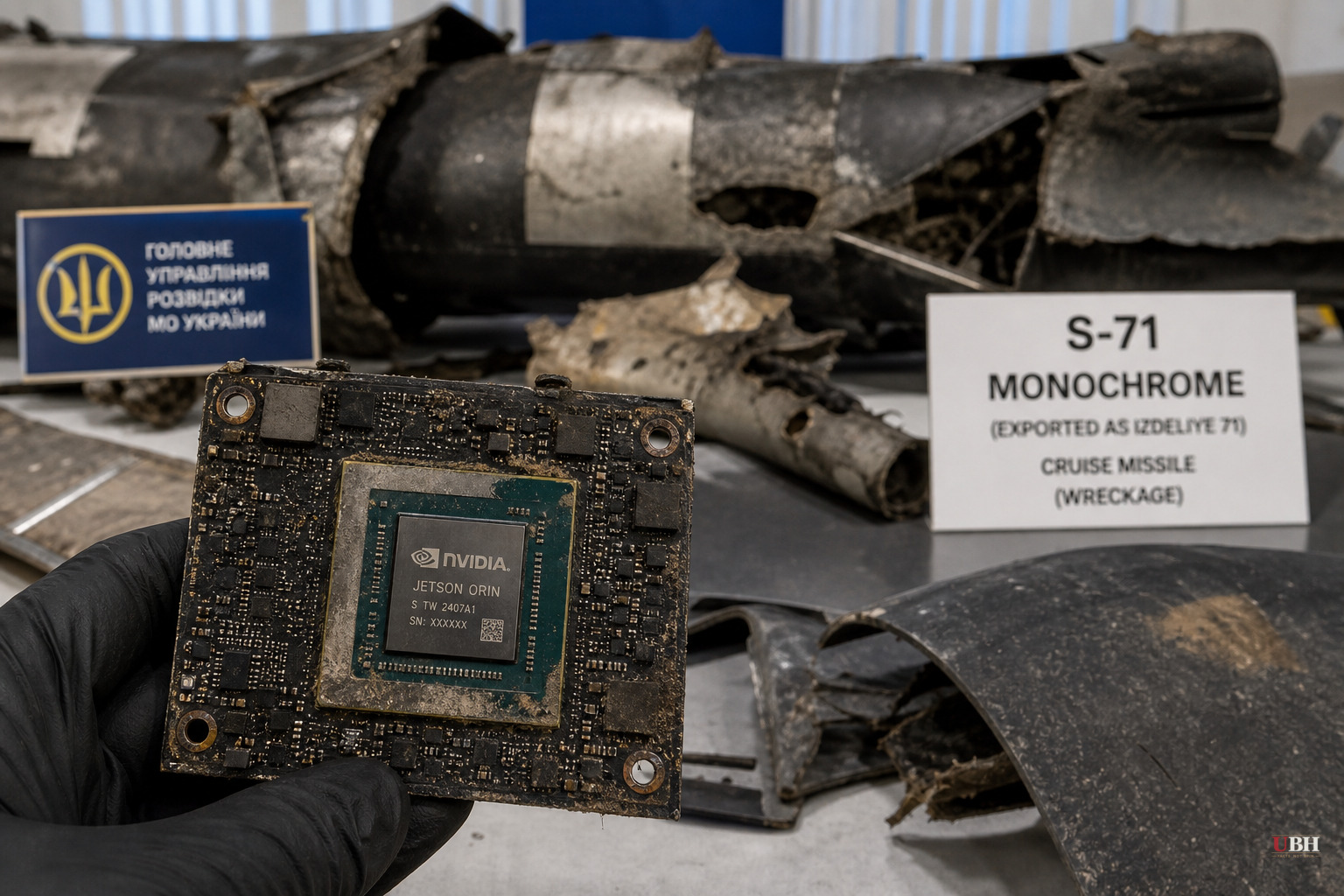
Ukraine's Defense Intelligence Directorate, known as HUR, says it recovered an Nvidia Jetson Orin computing module from the wreckage of Russia's S-71 Monochrome, a new air-launched cruise missile built for the Su-57 stealth fighter, according to a report published Wednesday, August 12 and covered by Crypto Briefing. HUR says it has now catalogued 35 foreign electronic components across various Russian weapons systems, sourced from companies in the US, China, Switzerland, Japan, Germany, Taiwan and Ireland.
The Jetson Orin is an AI compute module built for real-time computer vision and object detection. Inside a missile, that likely means machine-vision terminal guidance, the ability to visually identify and lock onto a target in the final seconds of flight instead of relying only on GPS or inertial navigation. The S-71 reportedly has a radar cross-section of just 0.007 square meters, about the size of a small bird's signature. AI-assisted terminal homing on top of that would make it a genuinely hard target to shoot down.
This is not a new pattern. Similar Jetson Orin modules turned up in 2025 inside Shahed-derived drones, the Shahed MS001 and Shahed-236 variants, where Ukrainian officials say the chips enabled autonomous target recognition. Nvidia does not sell to Russia directly. The chips are getting there through intermediary firms in third countries, which is exactly the kind of transshipment loophole Western sanctions regimes have struggled to close for years.
Russia's drone production is scaling, not shrinking
While that single chip discovery draws headlines, the bigger operational story is volume. HUR told the Ukrainian outlet Militarnyi, in a report published August 12, that Russia's defense industry is now producing roughly 3,000 Geran-4 and Geran-5 kamikaze drones per month, with serial production centered at a facility in Yelabuga inside Tatarstan's Alabuga Special Economic Zone. United24Media reported the same figure and added that Russia's broader industrial target is 11,000 strike drones total in August, spanning the Geran-1 through Geran-5 families plus Harpy, Gerbera, Gerbera Strike and Gerbera Seeker variants, according to HUR deputy chief Vadym Skibitskyi speaking to RBC-Ukraine.
The Geran-4 carries a turbojet engine producing roughly 160 kilogram-force of thrust, about double its predecessor, pushing cruise speeds up to 350-500 km/h and extending range from 600 to 850 kilometers, per Militarnyi's technical breakdown. Satellite imagery reviewed by Militarnyi shows new construction at Alabuga since May 2026, suggesting Russia intends to expand capacity further even as former Ukrainian Armed Forces Commander-in-Chief Oleksandr Syrsky said in June that jet-powered drones could eventually make up half of all Russian attack UAVs.
Skibitskyi also told RBC-Ukraine that Russia cut drone production and attack intensity in July to restructure its manufacturing lines toward the faster Geran-4/5 variants, and that Moscow has suspended Kh-47 Kinzhal missile production, redirecting that rocket fuel toward other ballistic missile programs.
A record month for ballistic missiles, and Ukraine's air defense is thinning out
Russia fired 126 ballistic missiles at Ukraine in July, a new monthly record for the war, according to the New York Times as cited by the Atlantic Council. Around 400 people were killed in July's bombing campaign, and UN data shows 1,396 Ukrainian civilians died in the first six months of 2026, a 37 percent increase over the same period last year.
Ukraine's primary defense against ballistic missiles is the US-made Patriot system, and the Atlantic Council cites a Center for Strategic and International Studies estimate that US Patriot interceptor stockpiles fell from more than 2,300 missiles in February to around 800, attributed in part to competing demand from the US conflict with Iran. President Trump has floated licensing Ukraine to produce Patriot missiles domestically, but no agreement has been finalized, and any production boost is not expected to meaningfully scale before 2030. President Volodymyr Zelenskyy says Ukraine needs at least 300 interceptors to protect civilians through the winter.
The other front: sanctions
The EU adopted its 21st sanctions package on July 23, adding 48 individuals and 170 entities to its asset-freeze lists, including 94 banks such as Moscow Exchange, according to details compiled by globaltradeandsanctionslaw.com. Starting August 13, transaction bans extend beyond Russian institutions to Eco-Islamic Bank in Kyrgyzstan, Chinggis Khaan Bank in Mongolia, Sberbank India and India VTB, while the A7 cross-border payments network and its A7A5 stablecoin infrastructure face bans from the same date, with 11 additional crypto platforms added from August 23. Notably, Yelo Bank of Azerbaijan was removed from the ban list in this round.
The sanctions package targets financial plumbing. It does not touch the chip-transshipment problem HUR's findings point to. Nvidia's Jetson Orin modules keep surfacing in Russian weapons more than four years after the invasion began, which raises an unresolved question for Washington and Brussels: whether existing export-control enforcement on dual-use AI hardware is actually working, or whether intermediary countries have simply absorbed the compliance burden without closing the pipeline. No new export-control measure targeting Jetson Orin specifically has been announced as of this writing.
Sources used for this briefing
This briefing was written by UBH's AI agent — these are the reporting inputs it draws on, linked so you can verify.


