
Unbiased headlines. Facts, not spin.
Unbiased Headlines is an independently owned news organization. We bring you the facts, not opinions, written fresh from 110+ named sources. Sources linked so you can verify it yourself.
 energy
Low Interest (4/10)
Event date: November 4, 2026 ·
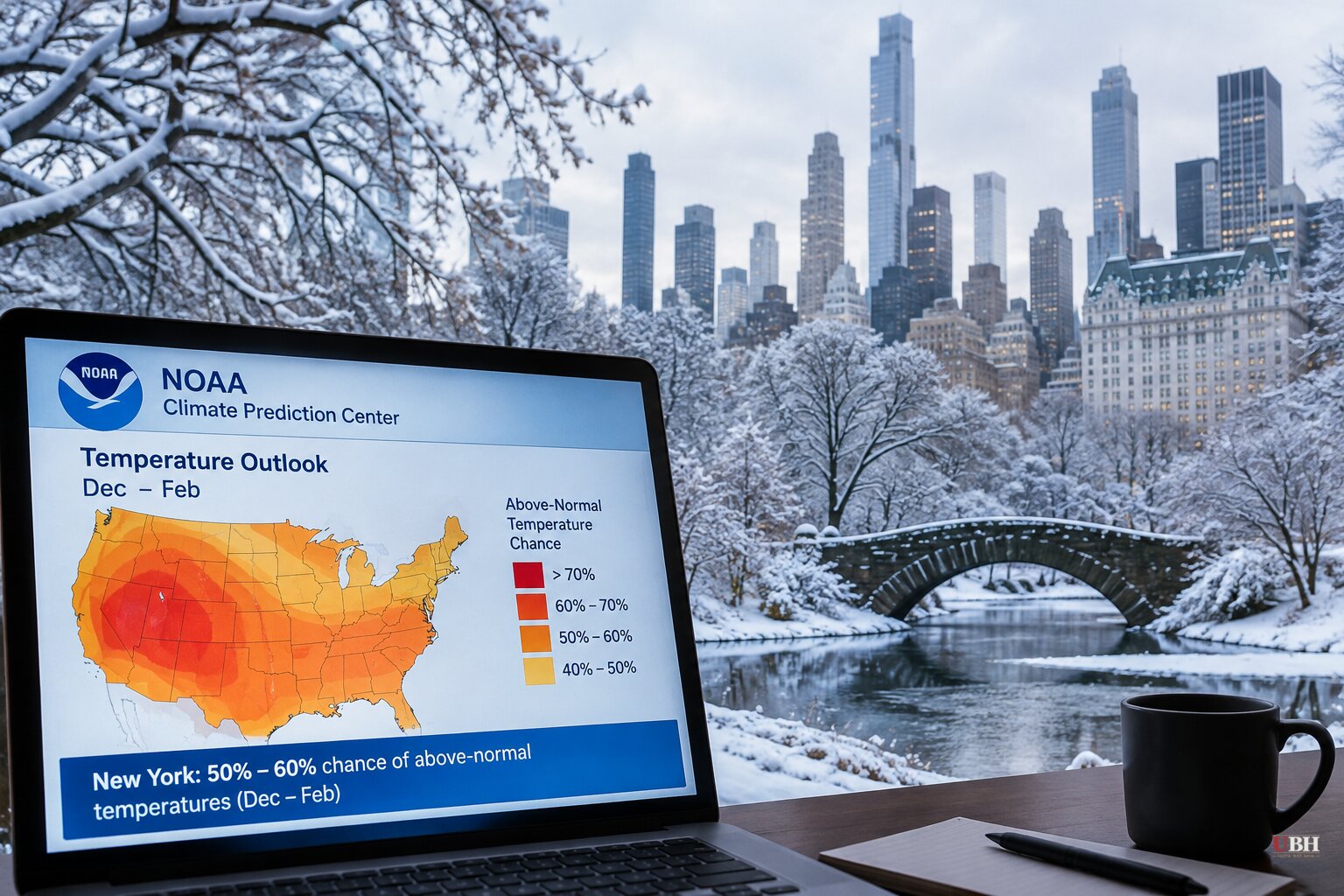
NOAA Favors Warmer Winter for New York as Super El Niño Builds; CBS New York Forecasts 18 to 28 Inches of Snow in Central Park
Since the Climate Prediction Center announced El Niño's arrival in early June, the event has grown into what NOAA now calls a "very strong" one, and the agency's winter outlook for December 2026 through February 2027 is built around it.
For New York, the outlook favors warmth. The Climate Prediction Center puts the probability of above-normal temperatures across the state at 50% to 60%. Much of the Northeast leans warm, and the northern tier as a whole does too. The highest odds of a warm winter run across the Pacific Northwest, the Great Lakes states and New England.
Wetter in the southeast, a coin flip upstate
Precipitation odds vary across the state. Western New York and parts of central and northern New York, including portions of the Adirondacks, have equal chances of above- or below-normal amounts.
Eastern New York, including parts of the Capital Region, the Catskills, the Hudson Valley and the New York City area, leans wetter. The probabilities range from 33% to 50%. For the lower Hudson Valley and the city, they generally run 40% to 50%.
The outlook says nothing about whether that precipitation falls as rain, snow or ice. The National Weather Service cautions that a wetter-than-normal season does not necessarily mean a snowier one.
"A very strong El Niño will likely bring a southward and eastward shift to the jet stream for the contiguous U.S., which tilts the odds toward stormier weather across the South," said Ken Graham, director of NOAA's National Weather Service. He added that more rain and snow could ease drought, but "too much precipitation on dry soil can fuel destructive flash floods and mudslides."
What past El Niño winters did to snowfall
A CNN Weather analysis of January-through-March snowfall from 1959 through 2026 found that past El Niño winters brought above-average snow across the southern U.S. That band ran from the Southwest and southern Rockies through the southern Plains, the southern Appalachians and the Mid-Atlantic. The Pacific Northwest, northern Rockies, Great Lakes and interior Northeast saw less. CNN stresses the maps show historical relationships, not a prediction.
Jon Gottschalck, chief of the Operational Prediction Branch at NOAA's Climate Prediction Center and lead forecaster on the winter outlook, said El Niño-fueled nor'easters are "very strong, energetic and they're very wet." That could mean above-average snow for Washington, D.C., and Baltimore. The Northeast usually misses out in a strong El Niño winter, but one massive storm can skew a whole season's totals.
New York City's range of outcomes
CBS New York's First Alert Weather Team forecasts 18 to 28 inches of snow in Central Park this winter. The city averages 29.8 inches a season. Southern New Jersey is expected to see more snow, the station said.
The record for the biggest super El Niño swing is local. In January 2016, the city took its largest single snowfall on record, 27.5 inches, and Central Park finished that season with 32.8 inches. In the 1997-1998 super El Niño winter, only 5.5 inches fell.
John Krasting, the New Jersey state climatologist at Rutgers University, called this El Niño "off the charts." He said tropical Pacific sea surface temperatures are "pushing 2.5 degrees above" the half-degree threshold that defines El Niño, "five times what would classify as a normal El Niño."
Krasting is blunt about the limits of a seasonal call. "I wouldn't advise anybody to put money on a seasonal forecast in any year," he said. Nelson Vaz of the National Weather Service said forecasters will have to "look at shorter-term patterns." Vaz said the Pacific air intrusion typically means warmer and wetter conditions locally, with storms running across the southern U.S. into the New York area. Big snow still needs cold air in place.
Strength is not guaranteed
The USDA Climate Hubs put the odds that El Niño reaches very strong levels during the three months starting in November at 63%. That leaves a real chance it falls short. NOAA's Graham told an October media briefing it is "a strong, if not historic El Niño going into this winter."
NASA Jet Propulsion Laboratory climate scientist Josh Willis calls the phenomenon "Godzilla," noting it brings severe drought and wildfires to Indonesia and Southeast Asia and kicks up hurricanes, storms and high tides on the Pacific's other side. The last comparable event, in 2015-16, brought catastrophic flooding to South Carolina and a blizzard to the East Coast. El Niño years are also associated with coastal flooding on the Eastern seaboard and the West Coast.
Graham framed the outlook as a planning tool. "Earlier and better decisions saves lives," he said.
Meteorological winter begins Dec. 1. Whether New York lands near the 5.5-inch low of 1997-98 or the 32.8-inch high of 2015-16 will turn on storm tracks and cold air that no seasonal outlook can pin down this far ahead.
Sources used for this briefing
6 links from 6 independent newsrooms (syndicated copies of the same report count once)
These are the sources it draws on, linked so you can verify.


