
Unbiased headlines. Facts, not spin.
Unbiased Headlines is an independently owned news organization. We bring you the facts, not opinions, written fresh from 110+ named sources. Sources linked so you can verify it yourself.
 energy
Major Story (7/10)
Event date: November 12, 2026 ·
NOAA Calls El Niño 'Very Strong' as California Coast Braces for King Tides and Flood Claims
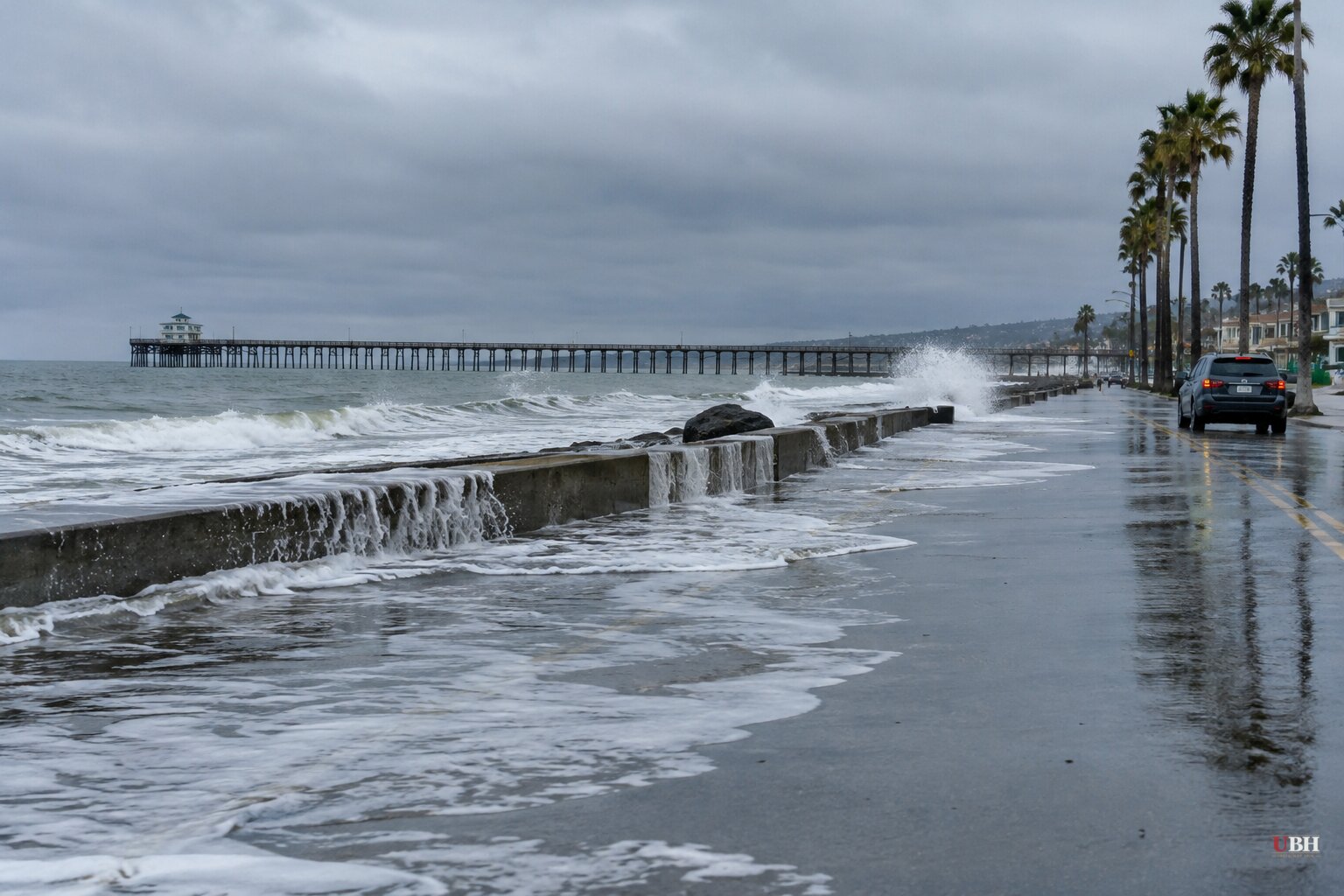
NOAA classified the current El Niño as "very strong" on Nov. 12, its highest intensity category. Only three earlier events have reached that level since records began in 1950: 1982-83, 1997-98 and 2015-16.
California is already feeling it. Coastal flooding has hit towns from San Diego to the Bay Area over the past few weeks, and this week it reached several Orange County coastal communities.
What NOAA is forecasting
NOAA's Climate Prediction Center said in October that a strong-to-very strong El Niño is likely to persist through January to March 2027, at a probability above 79%. The agency put the odds of a "historic" event at roughly 60% for October to December. That means sea surface temperatures exceeding +2.5°C on the three-month Relative Oceanic Niño Index, higher than any El Niño since 1950.
The strongest three-month average is likely to come in October-December or November-January. NOAA gives a 61% chance of a return to ENSO-neutral conditions in April-June 2027, and a 38% chance El Niño is still in place.
London-based specialty insurer Atrium analyzed El Niño winters and found an average of 104 intense storm events along the U.S. west coast, against 87 in non-El Niño years. That is about 19% more.
"Many are predicting that this winter could see the strongest El Niño of our lifetimes. That will likely mean more storms, more property damage and more losses for real estate owners," said Thomas Hobbs, Atrium's joint head of North American property binding authority.
The tides come first
The first big test is not rain. It is water level.
Climate scientist Daniel Swain wrote on his Weather West blog that increased coastal flooding is "already occurring, and will rise yet further." He expects risks to climb starting around December.
King tides, the highest of the year, are due Nov. 24 to 26, Dec. 23 to 25 and Jan. 21 to 22. Warmer, expanded ocean water means those tides will run one to two feet above normal, according to KQED's reporting on Swain's analysis. If a storm lands on top of one, Swain foresees widespread and "probably historic" flooding.
So far the rain has not matched the surge. KQED's Ezra David Romero told NPR that extreme rain events have not shown up this year. But he said scientists consider it plausible that king tides, big waves and storms line up, putting several feet of water on the coast at once.
Long Beach saw damage to boardwalks and homes last month. Public Works Director Joshua Hickman said the city is reinforcing beaches with sand, strengthening the wall between its boardwalk and the ocean, and handing out sandbags to residents.
"I'd be lying if I didn't say it keeps me up at night," Hickman said. He told NPR it is unclear whether the work will be enough.
Towns up to the Oregon border are preparing too. Pacifica, south of San Francisco, is among them.
The insurance gap
Flood damage is typically excluded from standard homeowners and commercial property policies. A policy covering "water damage" generally covers a burst pipe or overflowing faucet, not a river over its banks or rain pouring into a basement.
Matt Brannon, senior economic analyst at Insurify, called that "one of the bigger misconceptions in all of home insurance." He pointed to Hurricanes Helene and Milton in 2024, where many affected people had no flood coverage. Around Asheville, North Carolina, fewer than 1% of homes were insured against flood when Helene hit.
The cost of being wrong is steep. FEMA estimates a single inch of water in a home can run $25,000 in repairs.
On the commercial side, Insurance Business reports that surplus lines carriers are replacing admitted coverage across California, often without flood protection.
Demand for flood cover is surging. "Phones are wild with worried people," said Aaron Farmer, president of California Flood Insurance. He said the firm turned off its Google advertising because it no longer needs it.
Homeowners insurance costs are also climbing, including in fire zones along the coast, the Los Angeles Times reports.
The long-run bill on the coast
The El Niño winter lands on top of a slower problem. USC research scientist Essam Heggy co-authored a 2024 report finding that development is deteriorating California's coast, shrinking shorelines and removing sand. He said the cost of beach nourishment will rise fivefold by 2050 because of higher global sand prices.
"The coast is beautiful and the cliffs are nice, but these are fragile environments that shouldn't have been built on in the first place," Heggy said.
A separate 2024 report from the Public Policy Institute of California found that rising seas could destroy billions of dollars in buildings. It also found that one-third to two-thirds of Southern California's beaches could erode without costly, large-scale intervention.
What owners are being told to do
Insurance specialists and California emergency management professionals are urging owners to document belongings now. A continuous smartphone video of each room, with cabinets and drawers opened, takes roughly 10 minutes and can serve as evidence in a claim.
Santa Clara Valley Water, which issued its own flood-readiness notice on Sept. 29, is telling residents and business owners in designated high-risk areas to check their address against flood zone maps at valleywater.org/floodready.
Flood policies typically carry a waiting period, and the first king tide window opens Nov. 24. The next two follow on Dec. 23 and Jan. 21. Swain's warning is that any storm overlapping one of those dates is the scenario that produces the worst flooding.
Sources used for this briefing
7 links from 6 independent newsrooms (syndicated copies of the same report count once)
These are the sources it draws on, linked so you can verify.


