
Unbiased headlines. Facts, not spin.
Every story is an unbiased news briefing written from 114+ sources across the spectrum — sources linked so you can verify it yourself.
 energy
Notable (6/10)
October 7, 2026 at 06:38 AM
energy
Notable (6/10)
October 7, 2026 at 06:38 AM
New Zealand Report Finds 1.36°C Warming Since 1909, Record CO2, Glaciers Down Nearly Half Since 1997
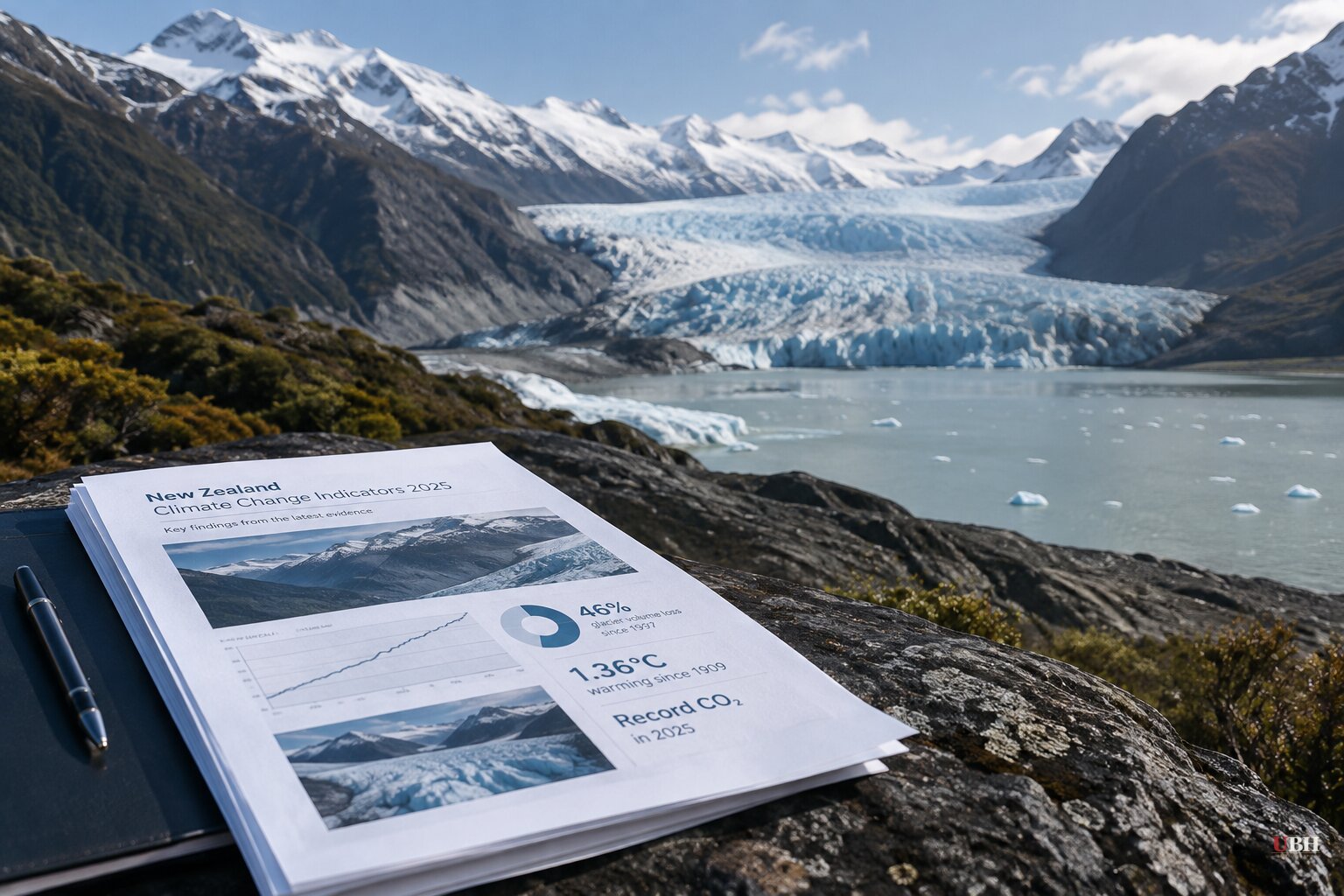
New Zealand's atmosphere hit record greenhouse gas concentrations in 2025, and the country's glaciers have lost nearly half their volume since 1997, according to the Our Atmosphere and Climate 2026 report released Wednesday, October 7, by Stats NZ and the Ministry for the Environment (MfE).
The topline numbers are not in dispute. Carbon dioxide at the Baring Head monitoring station near Wellington hit 423.1 parts per million in 2025, a 30% increase since New Zealand started monitoring in 1972, according to Stats NZ data reported by RNZ's Kate Newton. Global CO2 hit 426 ppm last year, more than 50% above pre-industrial levels of 280 ppm.
Methane ticked up too, from 1,880 ppm in December 2024 to 1,890 ppm in December 2025, a cumulative 13.6% rise since the station started tracking it in 1989, RNZ reported.
The Temperature Record
New Zealand's annual average temperature has risen 1.36°C over its long-running national series, according to Stats NZ, which draws from a seven-station record and, separately, a 30-station network with comparable data since 1972. Seven of the 10 warmest years on record have occurred in the last decade. The warmest year remains 2022, at 1.02°C above the 1991-2020 baseline.
One wrinkle: sources disagree on the exact start year. Stats NZ and the Guardian both cite 1909 as the start of the national record. RNZ's report, however, states records began in 1908. The underlying 1.36°C figure is consistent across all sources, so the discrepancy appears to be a rounding or citation issue rather than a dispute over the data itself.
Stats NZ adds an important caveat the Guardian's coverage leaves out entirely: the 1.36°C figure is a straight-line trend fitted across 117 years, and because real-world temperatures don't move in a straight line, the agency says the estimate could understate or overstate the actual pace of warming at different points in the series. That's Stats NZ's own hedge, not an outside critique.
Glaciers: What's Measured vs. What's Projected
New Zealand's roughly 3,000 glaciers shrank from 56 cubic kilometers of ice in 1997 to 30 cubic kilometers in 2023, the report found, a measured loss of about 46% over 26 years. That's an observed fact, not a model output.
The forward-looking numbers are different. Under the report's "low climate scenario," glaciers are projected to lose somewhere between 14% and 86% of remaining volume by 2100. Under the "high climate scenario," that range shifts to 69% to 100%. Dr. Alison Collins, the Ministry for the Environment's chief science adviser, told the Guardian "we're talking about substantial loss," and the observed 1997-2023 trend supports that general direction. But a modeling range that stretches from 14% to 86% under the same emissions assumption is a genuinely wide uncertainty band, and neither the Guardian's story nor the other outlets republishing it mention how wide that range actually is. Readers deciding how much weight to put on the 2100 projections deserve to know the model itself admits enormous variability, even if the direction of travel, less ice, is not in question.
Rain, Heat, and the Ocean
The rainfall data is genuinely mixed, not uniformly worse. Stats NZ found 9 of its monitoring stations got wetter and 6 got drier between 1960 and 2025, with the North Island described as a "patchwork" and the South Island generally trending wetter. Milford Sound, already the wettest station, is gaining about 180 millimeters of rain per decade.
Warm days above 25°C became more common at 22 of 30 stations, and frost days fell at 17 of 27 stations tracking them since 1972, with only two showing an increase. The report says heatwaves are "very likely" to grow more frequent and intense, and that New Zealand's oceans warmed 34% faster than the global average in 2025, a trend the report links to sea sponge bleaching, southern bull kelp die-offs, fish strandings and penguin deaths.
The Policy Context Nobody Mentioned
None of the coverage reviewed here mentions a detail RNZ's own report included: the New Zealand government weakened its methane emissions target last year, even as this same government-commissioned report highlights record methane concentrations. Methane is shorter-lived in the atmosphere than CO2 but has a stronger near-term warming effect, which RNZ notes is exactly why its inclusion in emissions targets is "controversial." New Zealand's agriculture sector, a major source of methane from livestock, is the obvious reason a government would soften that particular target. Farmers and rural communities have a legitimate economic stake in how aggressively methane rules are set, and that trade-off deserves to be weighed against the report's warnings, not buried.
What's Unresolved
The measured data—CO2 levels, glacier volume loss, rising average temperatures—is solid and consistent across every source reviewed. The 2100 projections carry far more uncertainty than the Guardian's "catastrophic" framing suggests, and the government's own softened methane target raises a question none of these reports directly answer: how does Wellington square record greenhouse gas readings with recently loosened emissions policy? The Ministry for the Environment has not been asked that question on the record in any of the coverage so far.
Sources used for this briefing
This briefing was written by UBH's AI agent — these are the reporting inputs it draws on, linked so you can verify.


