
Unbiased headlines. Facts, not spin.
Unbiased Headlines is an independently owned news organization. We bring you the facts, not opinions, written fresh from 110+ named sources. Sources linked so you can verify it yourself.
 energy
Notable (6/10)
energy
Notable (6/10)
NERC Issued Its Highest-Severity Grid Alert in May After Data Center Load Kept Dropping Off Without Warning
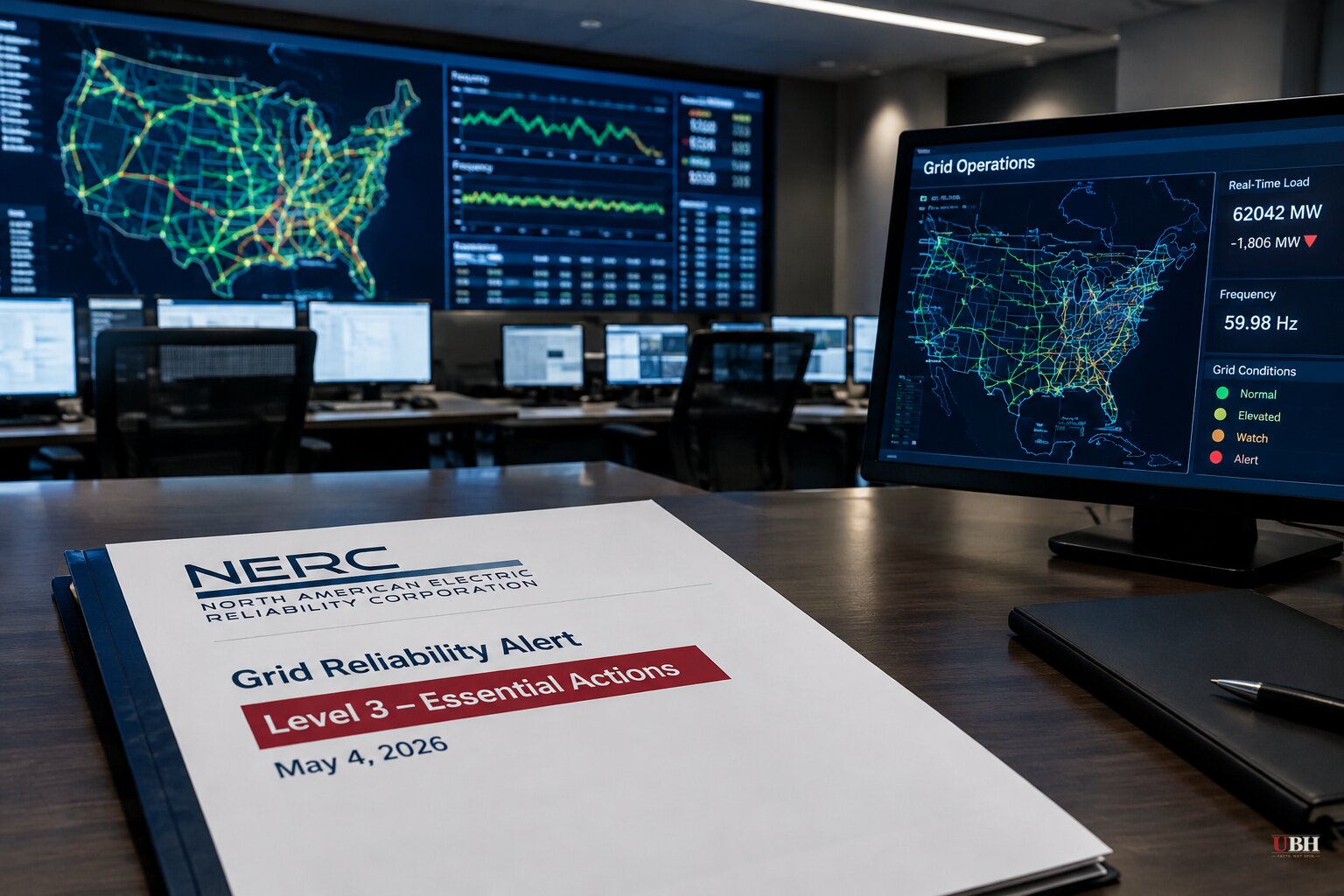
The North American Electric Reliability Corporation put out its most serious type of warning this year, and the trigger was not a storm or a saboteur. It was data centers.
On May 4, 2026, NERC issued a Level 3 "Essential Actions" alert, its highest severity. The alert followed a run of incidents in which 1,000 megawatts or more of computing load dropped off the bulk power system without warning.
What NERC documented
NERC's State of Reliability report for 2026 recorded conventional forced-outage rates climbing to 9.2 percent.
The same report documented one event in which data-center uninterruptible power supplies tripped during an otherwise routine fault. That removed 1,800 megawatts in a single movement.
A routine fault is the kind of thing the grid is built to ride through. Load that disconnects itself in response is a different kind of problem, because operators have to rebalance supply on the fly.
The Iberian precedent
At 12:33 p.m. on April 28, 2025, mainland Spain and Portugal lost power. Red Eléctrica de España, Spain's transmission operator, logged the loss of about 15 gigawatts of generation within seconds, close to 60 percent of Spanish demand at that moment.
Supply was out for roughly 10 hours across most of the peninsula and longer in some districts. An estimated 60 million people were affected. Trains stopped between stations, payment terminals froze, mobile service thinned as tower batteries drained, and water pressure sagged in elevated neighborhoods.
ENTSO-E, the European network of transmission operators, published its final report on March 20, 2026. It attributed the event to a combination of technical factors and successive generation disconnections, not a single fault.
Nothing attacked the Iberian grid, a fact planners should weigh. The industry's standard rehearsals assume something worse than what actually took down 60 million people's power.
The U.S. rehearsal
Since 2011, NERC's information-sharing arm has run a biennial exercise called GridEx. Utilities, agencies and cross-border partners respond to a scripted emergency on the real bulk power system, using real spares, real fuel contracts and real staffing.
The eighth edition ran November 18 and 19, 2025. It drew more than 370 participating organizations, nearly 50 percent more than in 2023.
The scenario was a coordinated cyber and physical attack by a nation-state adversary, with intrusion and physical damage timed to compound each other. The resulting report, published March 2, 2026, runs 32 pages and concentrates on communication and coordination.
The Federal Energy Regulatory Commission has treated physical protection of substations as a national security matter since riflemen fired on a California substation in 2013.
The case that the grid will hold
Not everyone at the top of the industry is sounding the alarm. In an August piece in the New York Times Magazine, Mark Lauby, NERC's chief engineer, argued that the network's complexity and redundancy make a cascading national collapse "unlikely."
That is a serious position from someone who sees the data. It also sits next to his own organization's highest alert from three months earlier.
NERC says a national cascade is unlikely, and NERC also judged data-center load behavior serious enough to issue its top-tier alert.
What the numbers do and do not show
The 1,800 MW event and the repeated 1,000 MW-plus drops are measured, documented incidents. They are not forecasts.
The Spain outage was caused, per ENTSO-E, by technical factors and successive disconnections. It was not a Texas-style weather failure or an attack. For U.S. readers, the lesson is that a large system can lose most of its supply in seconds without a villain.
No source ties the Spanish event to the American data-center incidents. They are separate events, and one did not cause the other. What they share is a pattern: automatic protective equipment, behaving as designed, can make a bad moment worse.
The growth of computing load is why the question is urgent. NERC's alert was about load that disconnects faster than operators can respond. GridEx is biennial, so the next exercise is due in 2027. Whether the data-center disconnection problem is fixed before then is the open question.
Sources used for this briefing
5 links from 3 independent newsrooms (syndicated copies of the same report count once)
These are the sources it draws on, linked so you can verify.


