
Unbiased headlines. Facts, not spin.
Unbiased Headlines is an independently owned news organization. We bring you the facts, not opinions, written fresh from 110+ named sources. Sources linked so you can verify it yourself.
 energy
Major Story (8/10)
Event date: October 16, 2026 ·
energy
Major Story (8/10)
Event date: October 16, 2026 ·
China Proposes Export Bans on 14 Technologies and Limits on 26 More Across AI, Biotech and Solar
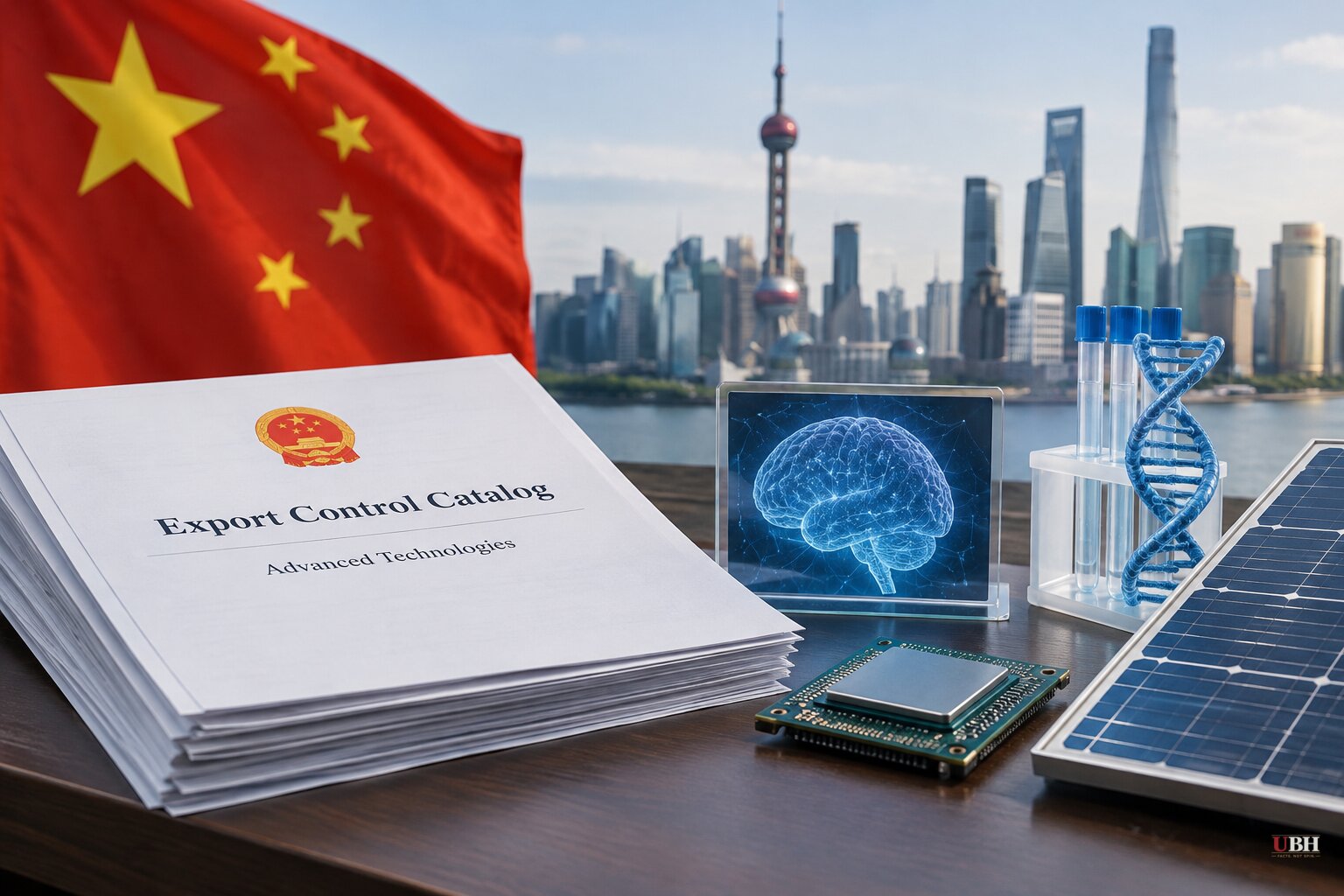
Beijing, already under scrutiny this month for its grip on critical minerals, moved Friday, Oct. 16 to fence in its technology as well. The Ministry of Commerce and the Ministry of Science and Technology released a draft revision, titled Announcement No. 48, to China's catalog of technologies prohibited or restricted from export.
The draft adds 40 technologies. Of those, 14 are proposed for a complete export ban and 26 for restricted export, meaning a license would be required.
What is on the list
Artificial intelligence accounts for 23 of the 40. They include large AI models, AI agents, computing clusters and information processing. AI-driven technology that could generate and mutate malicious code is proposed for prohibition.
Biomedicine accounts for five, including cell and gene therapy platforms, small nucleic acid drugs and pathogenic microorganisms. Some of the cell and gene therapy platforms are on the ban list.
Solar photovoltaics accounts for 12. These cover manufacturing processes and core equipment for polysilicon, silicon wafers and cells. Perovskite and perovskite-silicon tandem cell and module production technology is on the proposed prohibited list. Polysilicon engineering technology is restricted where production lines have annual capacity of at least 30,000 tonnes.
The Global Times reported that restricted AI items also include design technologies for 2.5D and 3D AI chips and 3D flash memory. That detail sits in a draft annex, not in the ministry's web summary.
Registration is already in force
The draft is a proposal. The registration requirement is not.
An interim pre-export registration regime took effect Oct. 16. Exporters must register before transferring ownership of listed technology, licensing it to overseas entities, or otherwise moving intellectual property abroad. The rule also covers transactions that began before Oct. 16 but have not closed.
For Chinese biotech companies, which are frequent licensors of drug candidates to overseas partners, that means deal teams must check whether a planned out-licensing touches a listed item and file before closing. The ministry said licensing of IP-owned process platforms would not be controlled, and that automatic licensing would apply to IP-owned target discovery technology.
Where the lines are drawn
The ministry carved out technology already in the public domain, including open-source releases and academic papers.
On AI, it separated moving model technology out of mainland China from selling access to it. Offering a model through APIs, apps, web interfaces, software-as-a-service or lightweight on-device deployment is not treated as a technology export. Localized deployment of a restricted model on overseas servers can be. Deployment on a Chinese company's own overseas cloud may qualify for streamlined licensing. The ministry said most AI technologies remain freely exportable.
A commerce ministry spokesperson said: "We want to ensure that AI technologies remain safe and controllable."
Beijing's explanation and the competing read
The ministries said the proposal does not target any particular country, region or entity and is part of routine technology trade management. In a statement, the ministry said AI, biomedicine and photovoltaic technologies have seen "expanding applications in sensitive fields," and that major economies already impose varying degrees of export controls in these areas.
That last point is accurate on its face. The U.S., Europe and Japan all enforce technology export controls, and those are widely seen as aimed primarily at China.
Lian Jye Su, chief analyst at research firm Omdia, called the move a likely response to Western countries imposing sovereignty requirements on AI, robotics, telecommunications and other key technologies. He said the aim would be to better regulate access to Chinese technology.
The draft also follows a pattern. On July 1, China began enforcing rules that tighten controls on overseas investment and outbound transfer of technology, data and expertise. That came after a legal dispute over Meta's $2 billion deal to buy Chinese AI agent firm Manus, which Beijing blocked on national security grounds.
Fallout outside China
Solar is where third countries could feel it first. Santosh Pai, honorary fellow at the Institute of Chinese Studies and a cross-border lawyer, said Indian manufacturers could face licensing delays. India amended its restrictions on Chinese investment in March and listed polysilicon and ingot-wafer segments as priority sectors for fast-track approvals. Pai said those efforts "might not receive traction" because Chinese firms will face constraints on joint ventures and licensing deals with Indian counterparts under Announcement No. 48.
The draft does not restrict most solar exports. The pressure falls on manufacturing know-how and tools, the layer that determines who can build a competing supply chain.
For Western governments, the practical issue is leverage. Beijing already controls much of the polysilicon, wafer and cell base. It is now asking for a legal gate over the technology that built it, plus a say over where Chinese AI models can run.
What comes next
The ministries are taking public comment until Nov. 15. Final text could differ from the draft, including the annex details on chips and memory. The ministries have not said how quickly registrations will be processed, and that timing will determine whether the interim regime works as a paperwork check or a brake on pending deals.
Sources used for this briefing
6 links from 6 independent newsrooms (syndicated copies of the same report count once)
These are the sources it draws on, linked so you can verify.


