
Unbiased headlines. Facts, not spin.
Unbiased Headlines is an independently owned news organization. We bring you the facts, not opinions, written fresh from 110+ named sources. Sources linked so you can verify it yourself.
 energy
Major Story (7/10)
Event date: October 10, 2026 ·
energy
Major Story (7/10)
Event date: October 10, 2026 ·
Alberta votes Monday on starting a separation process, 18 days after Ottawa fast-tracked the Pacific Link pipeline
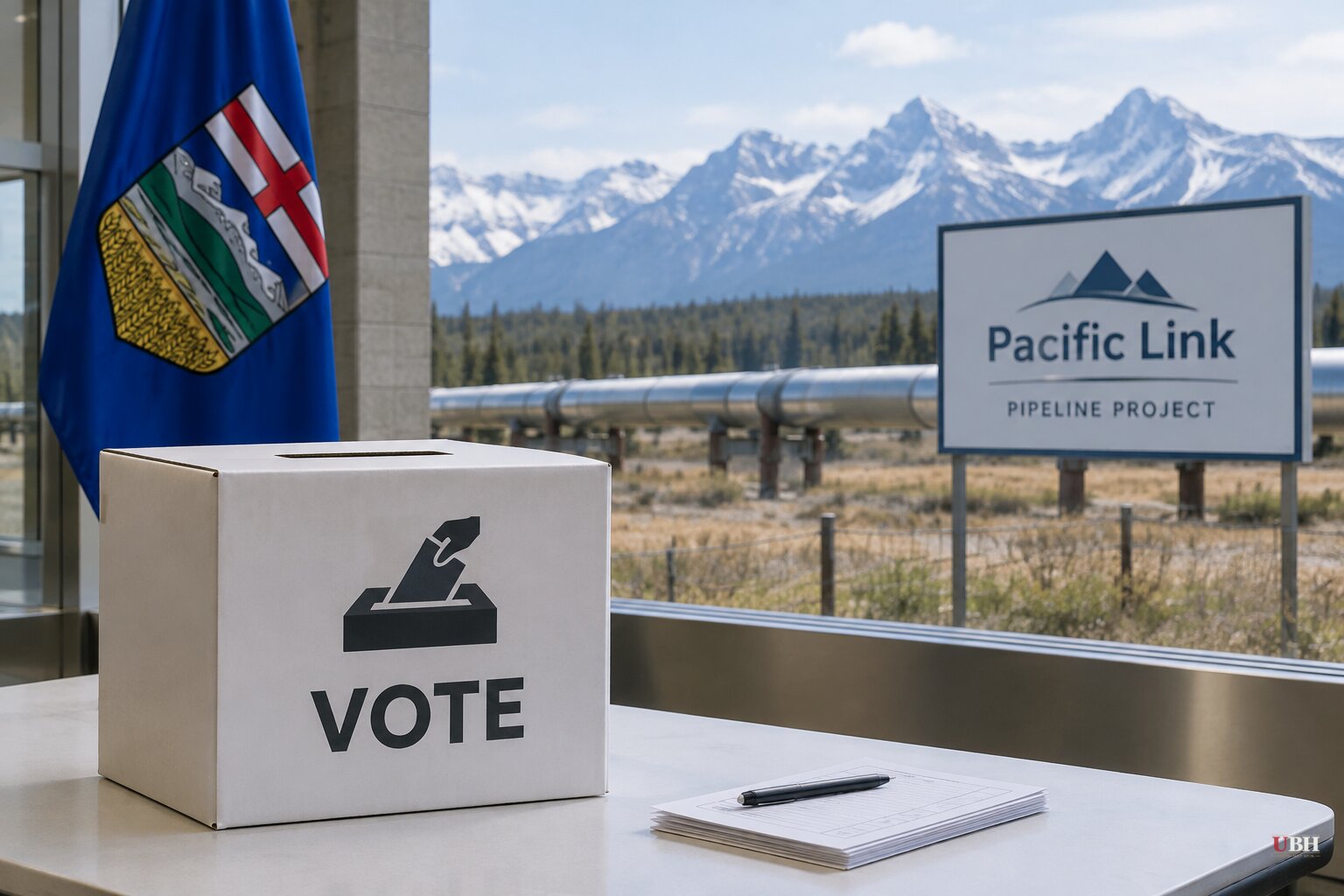
Albertans vote Monday, Oct. 19, on whether the province should stay in Canada or begin the legal process toward a future referendum on separation. The vote does not take Alberta out of Canada. It is non-binding.
Premier Danielle Smith called the vote and has said she voted to remain. A recent poll put support for starting the separation process at about 23%, which Smith called "still too high for my liking."
The pipeline announcement
On Thursday, Oct. 1, Prime Minister Mark Carney and Smith announced that the Pacific Link pipeline is a project of national interest. It is now listed on Schedule 1 of the Building Canada Act. That consolidates the approval process, environmental assessments included, and fast-tracks it.
The route starts in Bruderheim, Alberta, runs north of Edmonton and St. Albert, and ends at a marine terminal near Delta, B.C. Alberta lists the cost at an estimated $43.7 billion, with completion targeted around 2032. The line would carry up to one million additional barrels of oil a day toward Asian markets.
Alberta and federally owned Trans Mountain Corporation would each hold 45%. Indigenous communities will be offered at least 10%. Pembina Pipeline Corporation is a private investor with a 10% stake for the construction portion.
Carney estimates the project would create 140,000 jobs and add more than $20 billion a year to GDP. He also announced a carbon capture project he says would cut 16 million tons of emissions annually and create another 40,000 jobs. Those are the government's projections, not audited figures.
Pacific Link is still a proposal. Ottawa's Major Projects Office is expected to spend the next year setting conditions. Construction could begin as early as Sept. 1, 2027, if consultations, approvals and permits are done. There is no final investment decision.
What Ottawa has already conceded
Smith says the pipeline is one piece of a wider shift. She has said the Alberta-Ottawa energy agreement includes Ottawa's commitment not to proceed with the federal oil and gas emissions cap. It also covers changes to clean-electricity rules and an impact-assessment agreement meant to reduce duplication.
The tone has changed sharply. In 2025, after the Liberals won a fourth straight election under Carney, Smith said Ottawa "can't help but be fixated" on "punishing our energy sector." Now she says, "I do think Canada is working better than it ever has."
She also says a vote to stay is not an endorsement of Ottawa. "That's not really a vote that everything's hunky dory and there's nothing to work on," Smith said. "I think it's a vote of confidence that things are headed in the right direction."
Carney appeared at a Vote to Stay event in Red Deer on Oct. 16.
The separatist response
The movement is not persuaded. A separatist leader told CBC the federal moves are "political platitudes."
Alberta NDP leader Naheed Nenshi welcomed the southern route but said it is "not the pipeline Smith promised Albertans." He said Smith "insisted on a route to Prince Rupert that no one proposed and everyone knew couldn't be built," and that she had said a government-funded pipeline would be a failure. The ownership structure includes federal and provincial public stakes.
Cory Morgan, an Alberta political commentator, wrote in the Epoch Times that the announcement's timing "feels political." The deadline for it was Oct. 1, he noted, but nothing prevented an earlier announcement. He argues the pipeline may not move many votes. Some in the middle may take it as a win. Others may vote to start the process to keep leverage on Ottawa. Morgan also wrote that polls suggest the independence side is unlikely to top 50%. Even so, he says, the grievances behind the vote will remain: democratic representation, equalization and federal overreach.
How the movement grew
Separatist parties historically drew 1% or 2% of the vote, according to former Premier Jason Kenney. He told The Associated Press the Freedom Convoy and pandemic restrictions gave activists "a new cause." He said social media helped them find each other and the movement became more professional. Kenney said he was describing activists, not typical separation voters, whom he called frustrated Albertans sending Ottawa a message.
Jeff Rath, a leader of the independence movement, cited federal vaccine rules that kept unvaccinated Canadians off flights as his breaking point. "COVID was really the straw that broke the camel's back," he said.
What comes next
The ballot also carries nine government questions, which Smith has urged voters to answer to give her "a strong mandate." A Remain result would not end the argument. If the Yes-to-process side wins, the question becomes whether Alberta moves to a binding separation referendum. Either way, the Major Projects Office conditions for Pacific Link are due over the next year, ahead of the earliest possible construction start in September 2027.
Sources used for this briefing
6 links from 6 independent newsrooms (syndicated copies of the same report count once)
These are the sources it draws on, linked so you can verify.


