
Unbiased headlines. Facts, not spin.
Unbiased Headlines is an independently owned news organization. We bring you the facts, not opinions, written fresh from 110+ named sources. Sources linked so you can verify it yourself.
 energy
Notable (6/10)
Event date: October 15, 2026 ·
energy
Notable (6/10)
Event date: October 15, 2026 ·
Data Center Cooling Gains Miss Bigger Water Use at Power Plants, Researchers Say
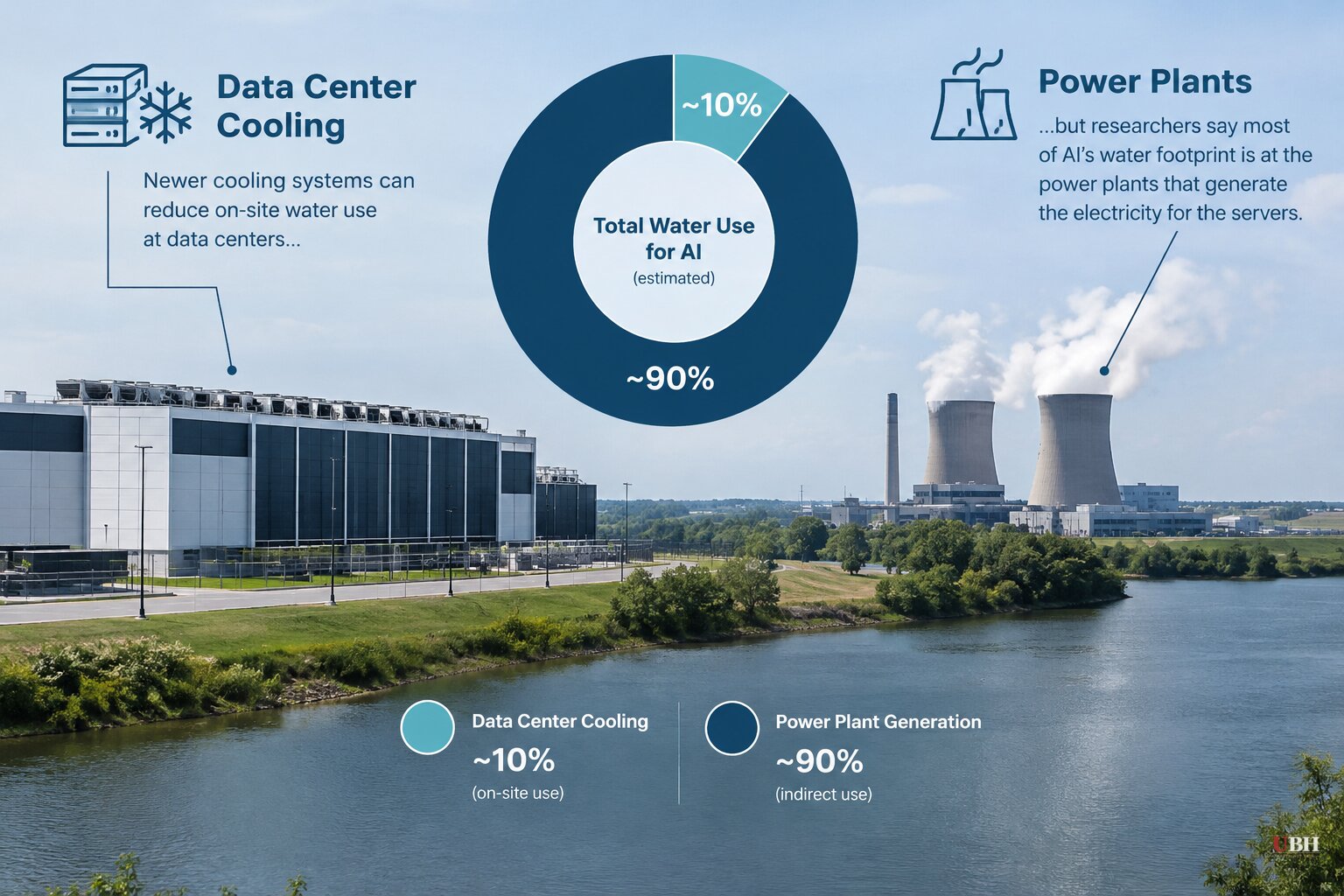
Data center developers love to talk about the water they save. In drought-stressed places like Arizona, new cooling systems cut the amount of water needed to keep AI servers from overheating.
Researchers say that is the smaller part of the ledger.
The water is used at the power plant
Fossil-fueled and nuclear plants use large volumes of water to make the steam that spins their turbines. AI data centers draw a lot of electricity from those plants. Researchers say computing-intensive AI facilities can use 10 times as much electricity as conventional ones, with most of that going to the servers.
So a data center can shrink its own water bill and still push demand up at a plant miles away.
Shaolei Ren, a professor at UC Riverside who studies data center water use, put it this way: "There has been much less attention to this indirect water usage, even though that oftentimes is significantly higher than the direct water usage and has impacts on watersheds and regional water resources."
University of Michigan researchers estimated that water used offsite would add 14 billion gallons a year to the combined consumption of three large AI data centers planned for that state.
Meta's numbers
Meta is one of the few major tech companies that discloses indirect water use. Its latest sustainability report says the company consumed about 21 billion gallons (80 billion liters) in 2024, up nearly 120% from 2021.
About 96% of that was indirect, meaning it happened at power plants. Only 4% was consumed on site, mostly at data centers.
That is one company's disclosure. It is not an industry average.
A 19-fold spread in estimates
Nobody agrees on the industry-wide total. A 2024 Lawrence Berkeley National Laboratory study put annual indirect water use by U.S. data centers at 211 billion gallons. A more recent analysis by the nonprofit Ceres suggested it could reach 4 trillion gallons.
That range is roughly the yearly household water needs of 2 million to nearly 37 million average U.S. households.
The gap exists partly because the industry has no common yardstick. Brandon Oyer, head of energy and water for Amazon Web Services, said: "We need industry alignment on one if we're going to collectively report indirect water consumption."
Amazon says water efficiency at its data centers has improved 52% since 2021, partly through cooling systems that need less water. That is the developers' core argument, and the on-site figures support it as far as they go. The research above questions how much of the total they cover.
Kerri Hickenbottom, an associate professor of engineering at the University of Arizona who researches data center water use, was blunter about the trajectory: "Demand for data centers is just skyrocketing and the truth of the matter is that the power and water facilities won't be able to keep up."
Electricity is the other half
The water question rides on the electricity question. The International Energy Agency found that electricity consumption by AI data centers surged 50% last year. Our World in Data estimates AI data centers used about 0.5% of the world's electricity in 2025 and projects 1.5% by 2030.
The load is concentrated. Nearly half of global data center electricity use is in the United States, where Lawrence Berkeley National Laboratory says data centers could account for up to 12% of consumption by 2028.
Efficiency is improving quickly, according to the IEA. A simple text query uses less electricity than a TV over the same time. Video generation can take thousands of times more.
Backlash and state enforcement
Public patience is thin. A CNN poll conducted by SSRS in September found nearly 90% of Americans are more concerned than excited about AI data centers.
According to research firm Data Center Watch, at least 45 U.S. projects valued at nearly $68 billion were blocked or delayed between April and June 2026. Local opposition has cited environmental impacts and rising electricity bills, and has produced moratoriums and other restrictions in some places.
Texas is going the enforcement route. Attorney General Ken Paxton's office said Thursday, Oct. 15, that it had sent letters to 156 data center developments across more than 30 counties, pressing them to comply with state water use reporting rules.
In Louisiana, a prediction market priced the odds of a statewide data center moratorium by the end of 2026 at 2.6%. Neither Gov. Jeff Landry nor the Legislature has announced such a measure, according to the sources reviewed.
Beijing has the same problem
The U.S. is not the only country running into this. According to commentary in The Epoch Times by James Gorrie, China has nearly one-fifth of the world's population but about 6% of global freshwater, citing China's Ministry of Water Resources. Beijing plans to expand AI data center infrastructure by roughly 2 trillion yuan ($295 billion) over five years.
A 2025 study in Applied Energy found China's "Eastern Data and Western Computing" strategy could increase water-footprint pressure in water-scarce western regions such as Gansu and Ningxia. Agriculture accounted for about 62% of China's 594.45 billion cubic meters of water use in 2025.
What comes next
The immediate test is disclosure. The Texas letters will show how many of the 156 developments can document their water use. Without an agreed method for counting power-plant water, the next round of corporate sustainability reports will keep producing numbers that cannot be compared.
Sources used for this briefing
7 links from 7 independent newsrooms (syndicated copies of the same report count once)
These are the sources it draws on, linked so you can verify.


