
Unbiased headlines. Facts, not spin.
Unbiased Headlines is an independently owned news organization. We bring you the facts, not opinions, written fresh from 110+ named sources. Sources linked so you can verify it yourself.
 energy
Major Story (7/10)
energy
Major Story (7/10)
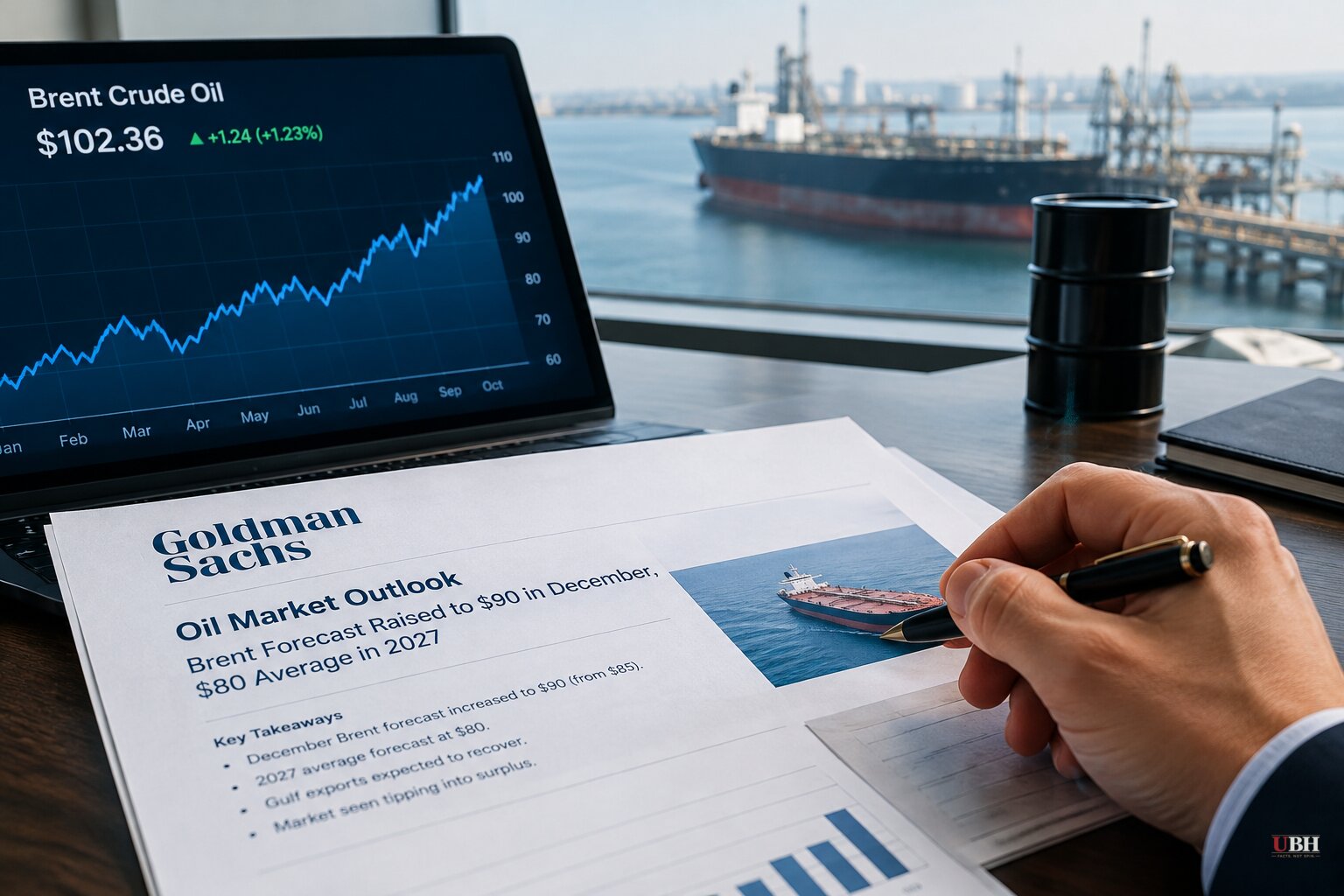
Goldman Sachs Raises December Brent Forecast to $90, Sees $80 Average in 2027
Goldman Sachs says relief at the pump and the refinery is coming, just later than anyone wants and only if the shooting doesn't get worse.
In a new report, Daan Struyven, the bank's co-head of global commodities research and head of oil research, raised the firm's December 2026 Brent forecast to $90 a barrel from $85. For 2027, Goldman expects Brent to average $80.
That is well below where crude trades today. Brent futures have recently traded above $100. Physical Brent for near-term delivery has topped $130.
The market has been swinging from shortage toward balance
Goldman puts the global supply deficit at 7.2 million barrels per day in March, a month after the conflict in Iran began. By September, demand exceeded supply by just 0.3 million barrels per day.
The bank expects the market to flip into surplus in the fourth quarter of 2026 and stay there through 2027. It credits three things: a recovery in Middle Eastern exports, higher production outside the Persian Gulf, and weaker demand.
On exports, Goldman estimates Persian Gulf shipments had climbed back to roughly their 2025 average by late September. It says exporters adapted to the conflict and expanded transportation capacity.
On demand, global consumption in the third quarter was down 3.3 million barrels per day from a year earlier. Goldman says much of the weakness sits in China, the Middle East and developed Asian economies.
The bank expects demand to recover gradually as refined products become more available and affordable. Even so, it projects demand in the fourth quarter of 2027 will still run 0.7 million barrels per day below where it would have been without the conflict. It points partly to faster electric vehicle adoption and changes in Chinese fuel consumption.
Why prices are still far above the forecast
Goldman says current crude prices carry a risk premium of about $25 a barrel. That reflects the chance of new supply disruptions and further draws on inventories if the conflict escalates.
"Physical prices remain elevated because escalation threatens supply while near-record-low global inventories fuel strong restocking demand," Struyven said.
The bank's own caveat is plain. Renewed escalation in the US-Israel-Iran conflict could keep prices elevated for longer than its base case. Its outlook depends on the pace of supply recovery, demand normalization and the risk of fresh fighting.
Brent touched $110 a barrel in the latest session, its highest since May, according to the IANS wire. That came after a 3.7% gain as hopes for near-term supply relief faded. Iran-backed Houthi forces have kept up missile and drone strikes on Saudi Arabia, and Russia and Ukraine have hit each other's energy infrastructure.
The Houthis vowed this week to keep attacking airports and oil facilities in Saudi Arabia. The Saudi-led coalition said its air defenses destroyed an incoming drone aimed at the Eastern Province. Sources told Reuters a missile strike damaged a building at Saudi Aramco's headquarters in Dhahran.
A more pessimistic read on Hormuz
Not everyone sees the supply picture as Goldman does. Joshua Busby and Greg Pollock, writing in The Conversation, say traffic through the Strait of Hormuz, the main route for Middle Eastern oil, was hovering below 15% of prewar levels. They note oil rose from about $65 a barrel before the conflict began in February 2026 to more than $100 by mid-September.
Their warning is blunt: if energy costs feel high now, "the situation may be about to get a whole lot worse."
The two accounts measure different things. Goldman tracks total Persian Gulf exports, which it says have recovered. Busby and Pollock cite traffic through one chokepoint.
The gap to close
Goldman's December target implies a drop of roughly $20 from the $110 touched in the most recent session. Its 2027 average implies a drop of about $30. The bank's case rests on exports holding at 2025 levels and inventories rebuilding without a new shock.
The next test is whether the Gulf export recovery survives continued Houthi strikes on Saudi energy sites. If it does, the $25 risk premium Goldman describes has room to shrink. If it doesn't, the $90 December number is the one most exposed to revision.
Sources used for this briefing
7 links from 6 independent newsrooms (syndicated copies of the same report count once)
These are the sources it draws on, linked so you can verify.


