
Unbiased headlines. Facts, not spin.
Unbiased Headlines is an independently owned news organization. We bring you the facts, not opinions, written fresh from 110+ named sources. Sources linked so you can verify it yourself.
 tech
Major Story (7/10)
tech
Major Story (7/10)
Morgan Stanley Estimates 32-Gigawatt U.S. Data-Center Power Shortfall Through 2028
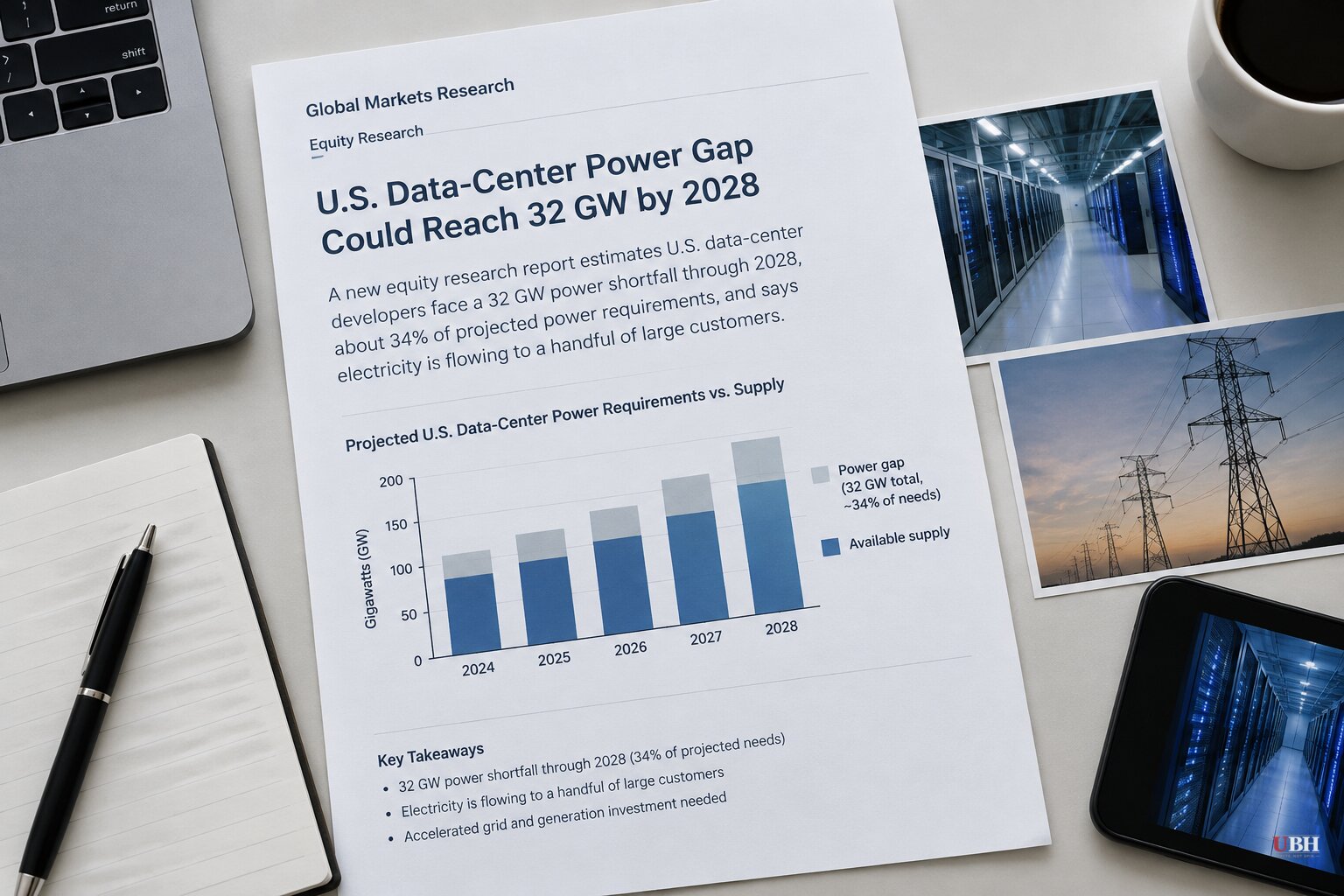
As AI investment keeps escalating, a Morgan Stanley research report detailed Oct. 17 puts a number on the next problem: plugging it all in.
The report, titled "What Does the Power Shortfall Mean for Semis?", estimates that U.S. data-center developers could face a 32-gigawatt power shortfall through 2028. That is after accounting for additional power-generation solutions. Morgan Stanley puts the gap at around 34% of projected power requirements.
A separate analysis from Weiss Ratings, citing Morgan Stanley, says U.S. data centers will need 97 GW of additional power from 2026 through 2028. The 32 GW figure remains after counting data centers already under construction, available grid capacity and "time-to-power" options such as nuclear, gas turbines and fuel cells.
Chips are no longer the only constraint
The report's central claim is that the AI race may turn on electricity, financing and data-center space, not just chip access. "Nvidia confirmed our thesis that there is not enough power to meet demand, and there are more semiconductors being built than there are places to put them," Morgan Stanley wrote.
The bank's concern for chipmakers is cancellations. "If there's chip capacity expected to come online that cannot be deployed at data centers, we could see customers push out delivery or start canceling orders," the report warned.
Power is going to the biggest balance sheets
Morgan Stanley says electricity access is increasingly favoring large companies with strong financial backing and predictable revenues. "We believe we're in an environment where data center energization is being concentrated across a handful of large, credit-worthy players," the report said.
The bank estimates major technology companies and specialist cloud providers could account for approximately 94% of global data-center capacity additions in 2026, 64% in 2027 and 57% in 2028. Companies with strong credit support and large power needs are securing power faster, which could leave smaller developers at a disadvantage.
"We believe this could potentially 'squeeze out' or put pressure on other players over time," Morgan Stanley said.
Chip leaders still expected to hit targets
Morgan Stanley expects Nvidia and Broadcom to meet their 2027 forecasts, citing their visibility into customer demand and infrastructure availability.
It sees greater risk for suppliers of memory chips, optical equipment and other supporting components if deployment slows.
The gap is not expected to close quickly. Morgan Stanley's projected cumulative U.S. data-center power shortfall could widen to 68 GW by 2029. The shortage could also encourage technology companies to expand computing infrastructure outside the United States, including in Asian markets such as India. Morgan Stanley's Asia data-center team estimates that 14 GW of demand from U.S. hyperscalers could shift to Asia through 2030, although the report does not specify India's share. "While we expect international expansion to continue, we don't see it as a solution to the US power problem," the report said.
Why the grid cannot keep pace
The Weiss Ratings analysis lays out the timing mismatch. A hyperscaler can build a standard data center in 18 to 24 months, it says. New power generation, transmission and permitting can take seven to 12 years, and interconnection queues in major markets can stretch four to seven years.
It also says lead times for large high-voltage transformers have grown from 16 to 24 weeks to three or four years. And it says advanced AI clusters can demand 40 to 100 kilowatts or more per rack, versus 10 to 15 for traditional cloud racks, with a single AI campus using anywhere from 50 megawatts to more than 1 gigawatt.
Those figures come from an investment-oriented newsletter that goes on to name stocks and an ETF to buy, so they are one analyst's framing, not government data. Still, the permitting piece of that timeline is a policy lever: approval processes sit inside those seven to 12 years.
The workarounds are already visible, according to Weiss: co-locating data centers beside nuclear plants, installing natural-gas turbines, building private microgrids, signing long-term power agreements and exploring fuel cells.
What to watch
The numbers are estimates from a single bank's research desk, and Morgan Stanley's own phrasing is conditional: "could," "potentially." The test comes with the 2027 delivery schedules. If Nvidia and Broadcom hit their forecasts as Morgan Stanley expects, the shortfall is being absorbed. If customers start pushing out deliveries or canceling orders, as the report warns, the memory and optical suppliers it flags would face the greater risk.
Sources used for this briefing
6 links from 6 independent newsrooms (syndicated copies of the same report count once)
These are the sources it draws on, linked so you can verify.


