
Unbiased headlines. Facts, not spin.
Unbiased Headlines is an independently owned news organization. We bring you the facts, not opinions, written fresh from 110+ named sources. Sources linked so you can verify it yourself.
 tech
Notable (6/10)
Event date: October 14, 2026 ·
tech
Notable (6/10)
Event date: October 14, 2026 ·
China Took 54% of New Factory Robots in 2024 While Europe Builds 19 AI Factories on Unfunded Strategy
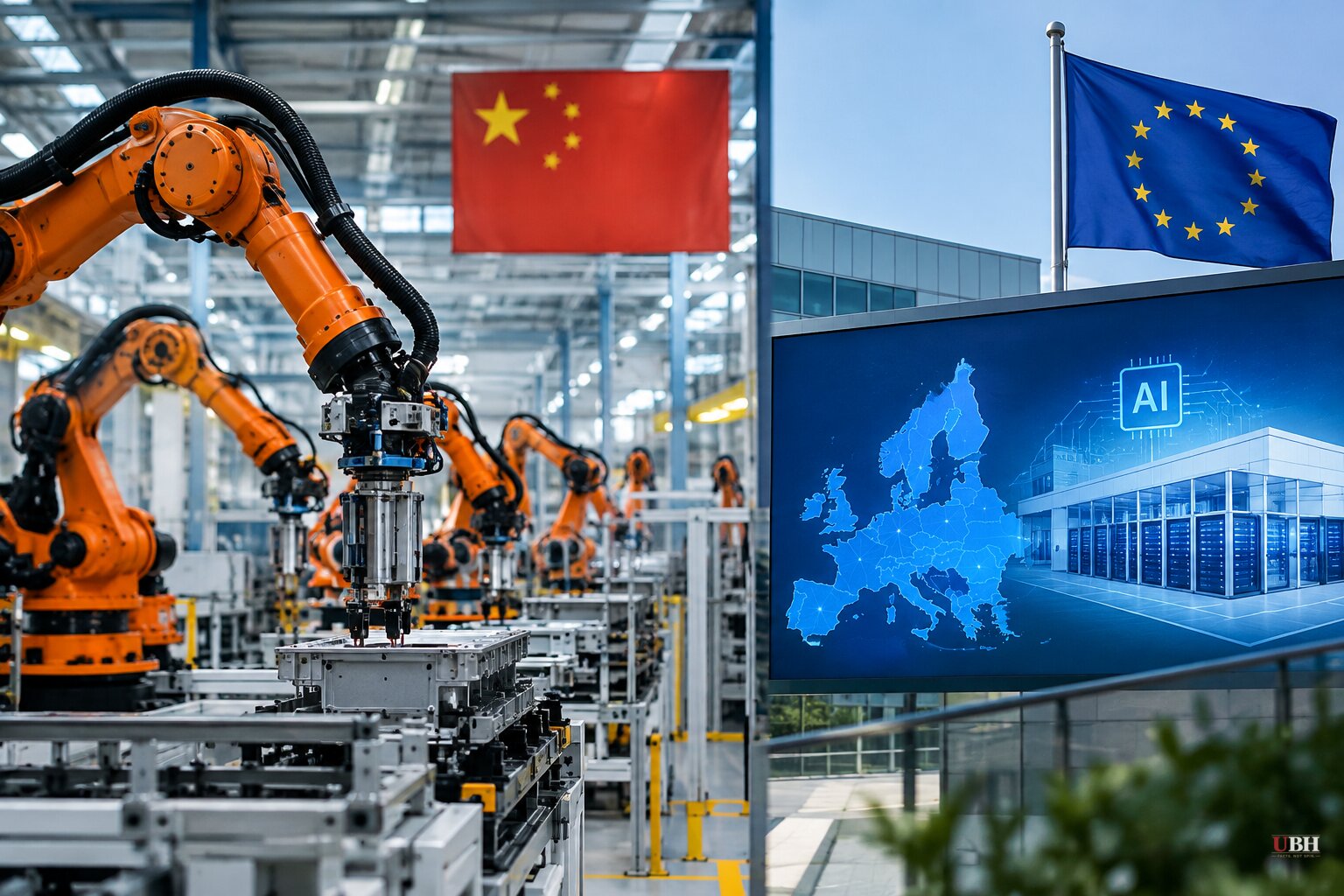
The AI race on factory floors looks nothing like the chatbot race, and the numbers favor Beijing.
China installed 295,000 industrial robots in 2024, which was 54% of the global total. Its operating stock of industrial robots now exceeds 2 million units. One country took more than half of the world's new factory robots in a single year.
Adoption of AI in Chinese manufacturing is estimated at about 67%. Chinese AI models had also closed the gap with U.S. leaders to roughly 3% on benchmarks as of September 2026, according to figures cited in Bloomberg's reporting.
Skipping a step
Zhou Yuxiang, CEO of Chinese factory-software provider Black Lake, said in an interview with the South China Morning Post published Oct. 12 that many plants are bypassing full traditional digitalization and going straight to AI agents. "Just as China skipped credit cards and jumped directly to mobile payments," he said, factories are "jumping directly to AI agents." He said the playbook is now being exported to global supply chains.
That fits Beijing's "AI plus" initiative, which includes a target of integrating AI into 90% of China's economy by 2030. It is a state target, not a market result, and nothing in the figures shows how many of those robots or agents have raised output per worker.
Europe's counter-bet
Europe cannot match Chinese robot volumes or American spending, so it is leaning on industrial expertise and proprietary factory data. Siemens, ABB and Schneider Electric are cast as the backbone of that approach.
The EU is setting up 19 AI Factories across 16 countries and has proposed larger AI Gigafactories. On June 3, 2026, the European Commission presented a Tech Sovereignty Package covering chips, cloud, software and AI, with a stated aim of tripling EU data center capacity within five to seven years.
Siemens is also opening six AI testbed scenarios in five Chinese factories, as of Oct. 12. European industrial data is being put to work inside the Chinese industrial base it is supposed to compete with.
The capacity gap
Andrea Renda, research director at the CEPS think tank, puts Europe at about 5% of the world's data center capacity. He puts the U.S. at about 75% and China at about 15%.
The four largest U.S. hyperscalers (Amazon, Alphabet, Microsoft and Meta) plan roughly $725 billion in capital spending this year, about 77% above the record $410 billion of 2025, according to cybersecurity researcher Dennis-Kenji Kipker. Europe has nothing close to that.
About 20% of companies in the EU used AI last year, and 55% of the biggest ones did. Most still use it for relatively simple tasks, according to research cited at a recent AI summit in Dublin.
EU technology chief Henna Virkkunen told that summit: "We need to make AI real for our competitiveness and for our industries." The EU has named a Siemens executive to push manufacturers to adopt the technology under a strategy called Apply AI.
Renda says that strategy has "zero" dedicated funding. "If you only build data-centre capacity, you have not done much," he told AFP, and he called for "political leadership" to remove roadblocks.
The bottleneck is power and permits
The constraint is not only money. The International Energy Agency says nearly half of U.S. data center capacity sits in five regional clusters and that data centers will drive almost half of U.S. electricity demand growth through 2030. Utilities in several states have rationed new connections, according to Kipker.
Ireland shows the problem in Europe. Prime Minister Micheál Martin told the Dublin summit, "We have been to the forefront of every tech wave over recent decades, and we will be to the forefront of this one." Yet the country's heavy reliance on U.S. tech giants runs against the EU's sovereignty push, and data center growth is straining its power grid and fueling local opposition.
Kipker, who advises executive teams on data center projects, says the binding constraint in Europe is rarely capital or demand. He says it is the years lost waiting for a grid connection or building permit, and he argues Brussels will be judged on whether its new rules shorten approvals rather than add compliance layers.
Not everyone wants to copy the leaders
Harvard economist Dani Rodrik argues Europe should not model itself on either rival. Over the past quarter-century, he writes, European labor productivity has grown only half as fast as America's. He says the Silicon Valley model does a poor job of spreading innovation through the wider economy, and that innovation does not raise productivity unless it lifts the capabilities of broad segments of society, including workers.
Rodrik acknowledges the squeeze. China's share of international patent applications rose from 3% to 33% between 2000 and 2022, while the EU's fell from 30% to 16%. The Rhine Group, formed by former ECB president Mario Draghi and other business and academic leaders, notes that only four of the world's fifty largest technology companies are European.
French economist Philippe Aghion warned that Europe is at "acute risk of marginalization." ECB president Christine Lagarde said last month that Europe must either hold back on adopting AI and forgo growth, or adopt it quickly and risk dependence. Paris-based Mistral AI unveiled a model last week that it says is on par with American rivals. Whether it is a serious competitor has not been established.
What to watch
Three numbers will show who is winning: whether China's robot installations exceed the 295,000 units of 2024, whether the EU's 19 AI Factories yield visible factory deployments, and whether Siemens, ABB and Schneider Electric turn their data into products customers pay for. Brussels has set a five-to-seven-year window to triple data center capacity. Whether grid and permitting rules move fast enough to meet it is still unanswered.
Sources used for this briefing
6 links from 6 independent newsrooms (syndicated copies of the same report count once)
These are the sources it draws on, linked so you can verify.


