
Unbiased headlines. Facts, not spin.
Unbiased Headlines is an independently owned news organization. We bring you the facts, not opinions, written fresh from 110+ named sources. Sources linked so you can verify it yourself.
 tech
Notable (6/10)
tech
Notable (6/10)
Anthropic's Jack Clark Tells IMF Meeting in Bangkok AI Could Lift US GDP to $44 Trillion by 2030
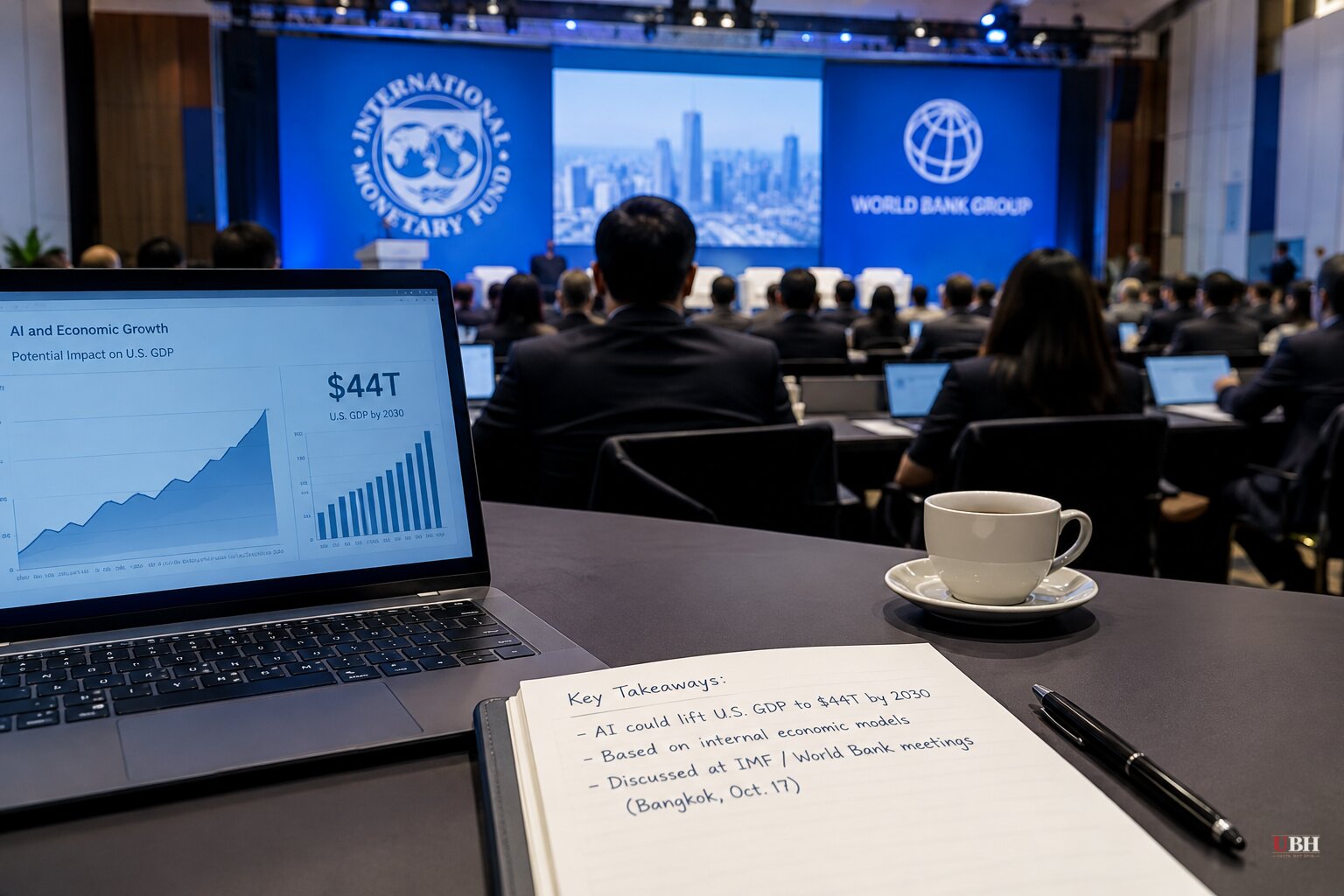
On Saturday, Oct. 17, Anthropic co-founder Jack Clark spoke at the IMF and World Bank annual meetings in Bangkok and put a very large number on the table.
Clark said one of Anthropic's internal economic models forecasts US economic output reaching $44 trillion by 2030. The US economy today sits at just over $30 trillion.
He did not oversell it. Clark said the number "sounds very outlandish."
The argument for why it could happen
Clark's case rests on the technology continuing to improve. "I know, but it's implicated by the technology continuing to get better," he said. "And if GDP were to grow this much, then economic doctrine suggests that new industries and inventions would need to have been created to power such a major economic expansion."
He said AI is vastly increasing the pace of scientific discovery. He also said rapidly improving capabilities will bring "far faster change across all fields."
Three scenarios, one of them extreme
The $44 trillion figure is the top end of a range. Crypto Briefing's account of Anthropic's economic scenarios explorer, which the company released in September, lists three paths to 2030:
- Modest: US GDP of $34.1 trillion, described as 1.6% growth.
- Substantial: $36.3 trillion, described as 8.3% growth.
- Extreme: $44.4 trillion, a 32.4% boost.
The percentages in that account are not reconciled with the dollar totals, so the growth labels should be read with care. The dollar figures are the clearer anchor.
According to that account, the extreme case assumes AI reaches high levels of autonomy and efficiency, and requires recursively self-improving AI systems to deliver the full effect. Crypto Briefing also reported that Clark has moved up his own timeline and now expects full recursive self-improvement capabilities by 2027. The outlet called that timeline the hinge between the substantial and extreme outcomes.
Not everyone is betting on the top scenario
Public expectations are far more modest than the extreme case. Crypto Briefing reported that surveys line up most closely with the substantial scenario. Respondents estimated a 10% GDP boost alongside a 5% unemployment rate.
The same account says the model points to greater displacement risk for knowledge workers. In extreme cases it anticipates a surge in unemployment. Clark's own framing concedes the tension: a jump in output this large would require new industries and inventions that do not yet exist.
The regulatory pitch
Clark paired the forecast with a call for governments to work together. International cooperation is needed, he told the room, to erect "unusual and serious rules" for the technology.
The forecast is Anthropic's own work, built by a company that develops frontier AI systems and has a direct stake in how AI is perceived and regulated. The extreme path is also the one that depends on a capability, recursive self-improvement, that the reporting describes as not yet delivered.
Clark's audience was finance ministers and central bankers, the people who would handle the fallout from an unemployment spike or a shift in tax systems. Crypto Briefing said the second thing to watch is labor data: if displacement among knowledge workers starts showing up in employment figures, the debate will move quickly from conference panels to legislation.
Sources used for this briefing
7 links from 7 independent newsrooms (syndicated copies of the same report count once)
These are the sources it draws on, linked so you can verify.


