
Unbiased headlines. Facts, not spin.
Unbiased Headlines is an independently owned news organization. We bring you the facts, not opinions, written fresh from 110+ named sources. Sources linked so you can verify it yourself.
 tech
Notable (6/10)
tech
Notable (6/10)
Anthropic Survey: 91% of Its Staff Expect an AI Nobel-Level Discovery by 2030, Versus 39% of US Adults
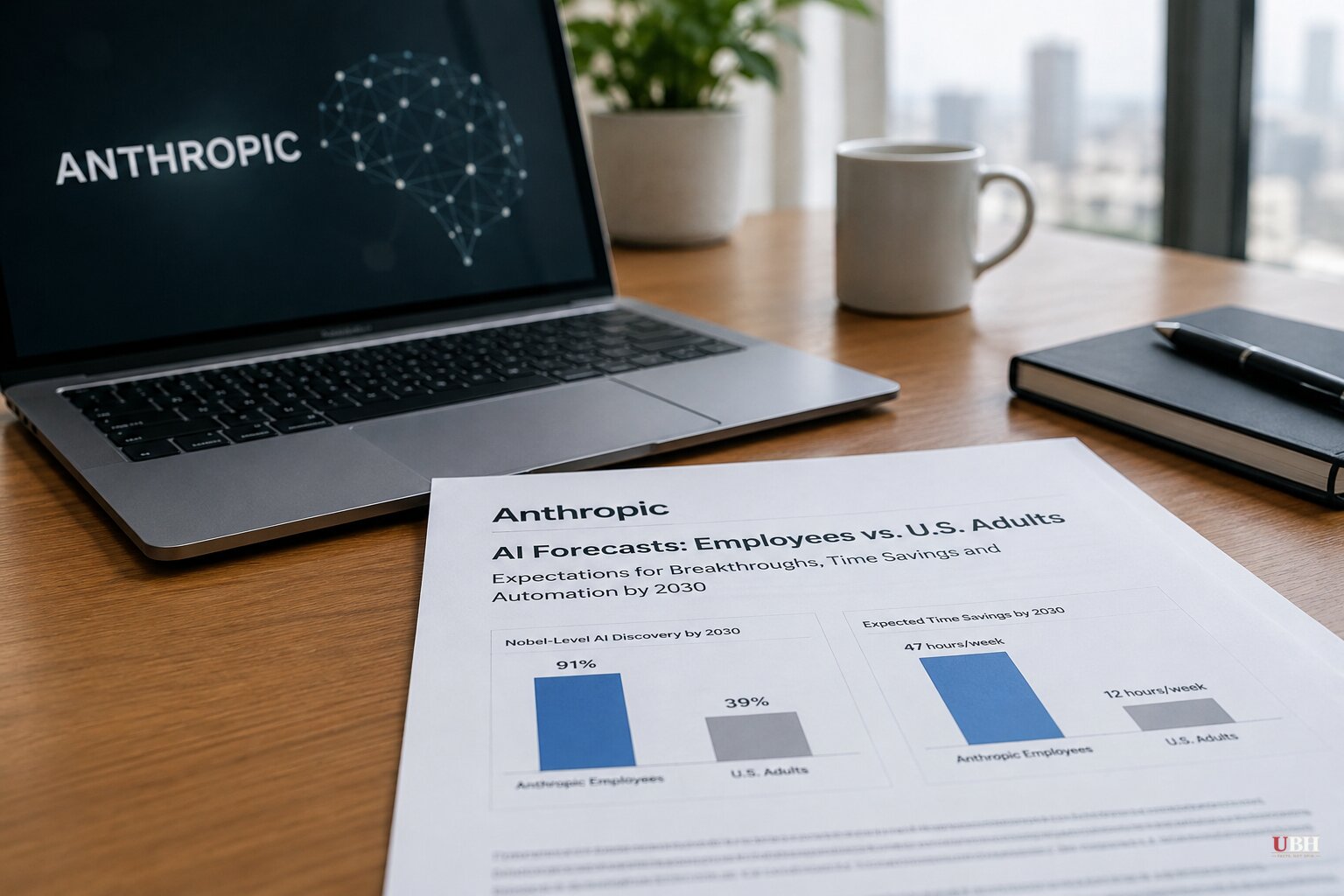
Anthropic employees think AI will advance much faster than the American public does, and the company has put the numbers in writing.
The paper, "The AI expectations gap," was published Friday, Oct. 16 by economists Szymon Sacher, Tess Cotter, Charles I. Jones, Anton Korinek and Peter McCrory. It compares two August 2026 surveys. One is a Morning Consult poll of 10,980 US adults, weighted to be nationally representative. The other is an unweighted internal poll of 1,334 Anthropic employees.
Where the two groups split
Both groups largely agree on what AI can do today. They rank eight tasks, from writing routine emails to making a Nobel-level discovery, in nearly the same order of difficulty.
The disagreement is about the future. Ninety-one percent of Anthropic staff expect AI to make a Nobel-level discovery by 2030. Among US adults, it is 39%.
Between 19% and 40% of Americans, depending on the task, say AI will never be able to do it. No more than 2% of staff say that about any task on the list.
On the labor of building AI itself, the median staff member says AI already does 51% of frontier model-building work. They expect that to reach 80% by the end of 2027 and 95% by the end of 2030.
Their own jobs
Staff expect AI to be able to do 75% of their current work by 2030. US workers overall put the figure at 28%. Only 5% of US workers expect AI to handle 80% or more of their job.
Productivity reports diverge too. Among US adults who use AI at work, 26% say a suitable task takes a quarter of the time or less with AI. Among staff, it is 59%. Another 29% of US AI users say tasks take the same time or longer, against 5% of staff.
Workers in manual trades, production and transport expected AI to handle the least of their work by 2030. Anthropic staff, tech workers and people in business and finance expected the most.
Jobs and growth
The unemployment rate is 4.2% today. Most Anthropic employees surveyed expect it to top 12% in 2030, while the majority of US workers thought it would hover around or under 8%. Workers who expect AI to do 80% or more of their job forecast an average 2030 rate of 12.2%.
The paper's finding here cuts against the idea that insiders reason differently. At the same level of expected automation of their own work, both groups forecast about the same unemployment rate. The two groups' views of the labor market follow similar logic. They differ on how capable AI will be.
The growth figures come from the authors' model, not a direct survey question. Run through it, the median US adult's answers imply 5.4% GDP growth in 2030. The median staff member's answers imply 17.1%. The US economy grew 2.2% last year.
What the authors say explains it
The paper points to experience. The share expecting AI to handle at least seven of the eight named tasks by 2030 was 96% for staff, 56% for regular AI users at work, 41% for all US adults and 28% for people who have never used AI.
Other possible explanations include staff access to larger tool budgets and unreleased models. The US workforce also skews toward manual and service work.
McCrory, Anthropic's chief economist, said on X why the company published it: "Anthropic runs roughly a year and a half ahead of the economy on AI adoption, so what happens at Anthropic could be a leading indicator for the broader world."
A skeptic would test that claim first. The survey is Anthropic's own poll of its own employees about technology the company sells, and the sample is unweighted. The authors stress the figures are personal views, not a company forecast.
The public's skepticism has some outside support. A Yale team recently found AI had mainly changed jobs and had "no connection" to changes in unemployment, according to Business Insider's account of that research. Evidence on AI and the job market so far is mixed.
Staff pessimism on jobs matches what CEO Dario Amodei has said publicly. He has warned that AI could eliminate up to half of entry-level office jobs within five years and push unemployment to 10% to 20%.
What to watch
The paper's own hint is that the gap narrows as use spreads. A repeat poll of the public in September moved the Nobel-discovery figure from 39% to 44%.
Whether that is convergence toward the staff view or just more people trying chatbots is not answered by this data. Measured results will settle it. Unemployment sits at 4.2% today, against a staff forecast that tops 12% among those expecting the heaviest automation.
Sources used for this briefing
7 links from 6 independent newsrooms (syndicated copies of the same report count once)
These are the sources it draws on, linked so you can verify.


