
Unbiased headlines. Facts, not spin.
Unbiased Headlines is an independently owned news organization. We bring you the facts, not opinions, written fresh from 110+ named sources. Sources linked so you can verify it yourself.
 tech
Major Story (7/10)
Event date: October 7, 2026 ·
tech
Major Story (7/10)
Event date: October 7, 2026 ·
SpaceX Agrees to Buy Nearly $8 Billion in Low-Band Spectrum for Starlink Mobile Carrier Plan; Deutsche Telekom CEO Pushes Back
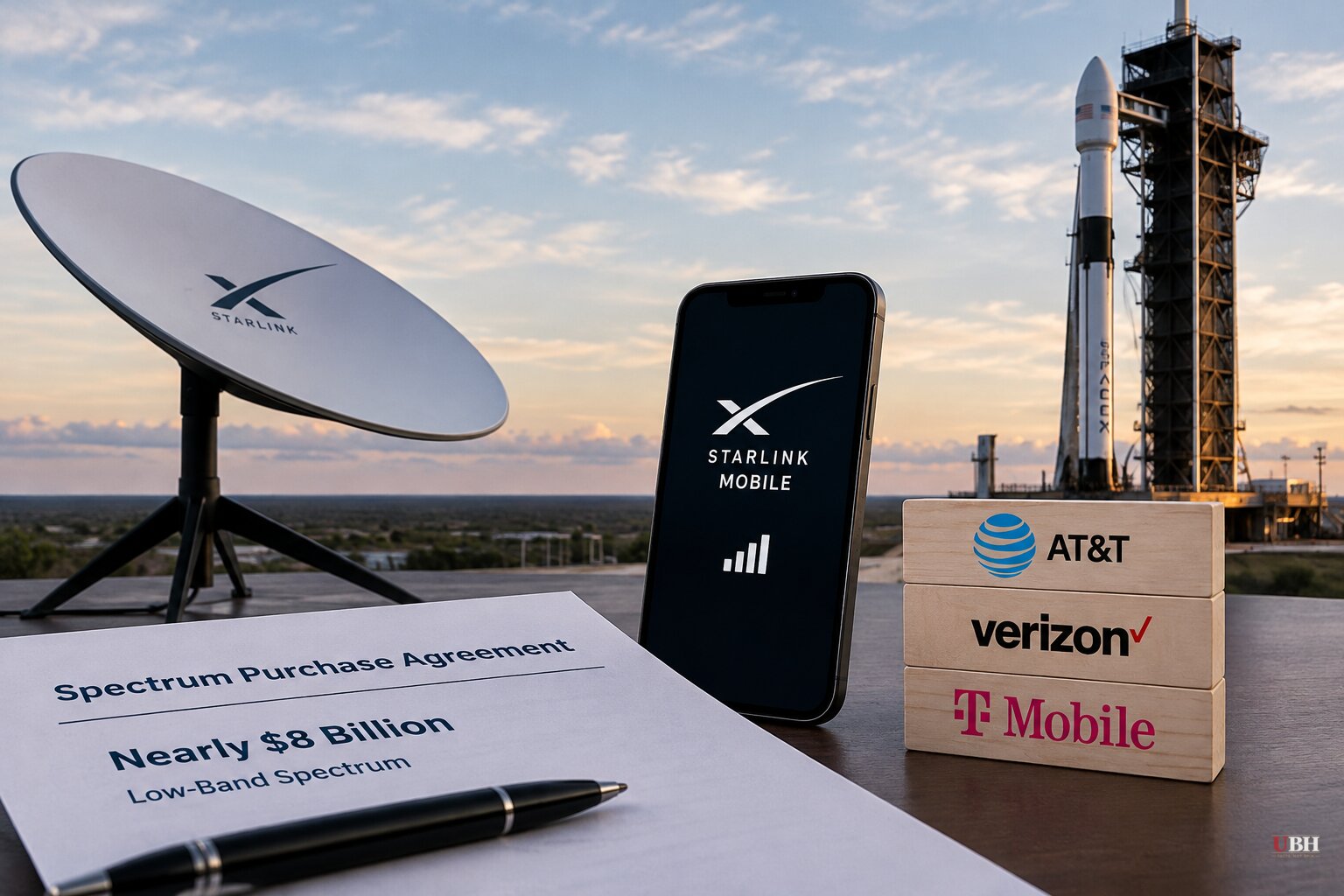
Since SpaceX announced earlier this month that it wants Starlink Mobile to become the fourth major wireless carrier in the United States, the incumbents have started answering. The plan rests on a spectrum purchase valued at nearly $8 billion, and the three big carriers are not shrugging it off.
What SpaceX is buying
SpaceX agreed to acquire an 800 MHz low-band spectrum portfolio from Grain Management, a private equity firm. The package gives Starlink Mobile up to 14 MHz of paired low-band airwaves nationwide.
Low-band spectrum carries farther and goes through walls better than the high-band spectrum carriers have promoted for 5G. It is the foundation of any national network.
This is on top of SpaceX's agreement last year to buy close to $20 billion of EchoStar spectrum. The FCC has also approved deployment of 15,000 next-generation Starlink satellites, a Very Low Earth Orbit constellation built for direct-to-device service.
SpaceX says it wants to build "the world's most advanced mobile network." It plans to combine satellites with ground-based radio equipment, including cell towers.
The stocks of AT&T, Verizon and T-Mobile all fell immediately after the announcement.
The incumbents respond
T-Mobile CTO John Saw was first. He said SpaceX will need to spend tens of billions more on spectrum and ground infrastructure.
Deutsche Telekom, T-Mobile's parent, went further in a webcast on Monday. CEO Timotheus Höttges, in remarks given in a translation, asked: "Why should I have to make calls over a satellite network when I can already get good coverage, or the best coverage, today?"
Höttges also pointed at the physical gap. "We have 85,000 mobile antennas in America. [Elon Musk] has to build those first," he said.
He began with praise. "Elon Musk is probably the greatest entrepreneur of the millennium right now," Höttges said, adding that Musk has always come up with "extremely intelligent models and ideas for disrupting the existing business model."
Then came the warning. "Before he gets there, he still has many, many large number of hurdles to overcome, and will have to spend an enormous amount of money as well," he said.
The wholesale question
Höttges also told other carriers to think twice about selling SpaceX network access. In his words, an MVNO arrangement carries "significant risks, because if the price for that access is low, you put your own retail prices under pressure."
MVNOs, he said, "only benefit you in terms of infrastructure utilization, but then hurt you with your own retail customers." He added that he does not think it would be "a good idea to court SpaceX through an MVNO arrangement now."
That stance sits awkwardly with T-Mobile's own history. It has been SpaceX's exclusive U.S. partner on the first version of Starlink Mobile, called T-Satellite. In recent months, T-Mobile has played that product down while floating the idea of partnering with other satellite providers.
The cost of going terrestrial
Reuters reported that building a true rival to the major carriers could cost more than $80 billion. It would require a terrestrial network and likely years of work.
Starlink became profitable by selling internet service in rural and sparsely populated areas, where it faced little competition, and by moving to easy-to-set-up home packages at a competitive price. Mobile is a different game. Cities are among the hardest places for mobile service, and the networks there are already dense.
SpaceX has advantages that past telecom entrants lacked. It already operates a satellite constellation that provides broadband internet to remote areas and builds and launches its own hardware. Telecom, though, has a long record of ambitious pivots that ran into the cost of building networks.
Walter Piecyk, a partner and analyst at LightShed Partners, has argued that SpaceX was heading in this direction for months. He also contends that the established carriers have fumbled their response to the threat. He made the case on The Verge's Decoder podcast, published today, Oct. 17.
What is still open
The carriers' position is clear. They say the buildout is too expensive and too slow to threaten them, though their stocks dropped on the news.
SpaceX's position is that its spectrum, satellites and launch capacity give it a different cost structure. For consumers, more competition in a market dominated by three carriers is a straightforward upside if it materializes.
The unanswered question is how SpaceX closes the gap between airwaves and towers. It has not said how much it will spend on ground infrastructure, how fast it will build, or whether it will sell wholesale access to existing carriers. Whether any major carrier takes Höttges's advice and refuses a deal will show how seriously the incumbents rate the threat.
Sources used for this briefing
7 links from 5 independent newsrooms (syndicated copies of the same report count once)
These are the sources it draws on, linked so you can verify.


