
Unbiased headlines. Facts, not spin.
Unbiased Headlines is an independently owned news organization. We bring you the facts, not opinions, written fresh from 110+ named sources. Sources linked so you can verify it yourself.
 economy
Major Story (8/10)
Event date: October 28, 2026 ·
Moody's Economist Puts Iran War Cost at $2,000 Per US Household as Kia Reports 209 Billion Won Middle East Hit
Since the U.S.-Israeli war on Iran began in late February, the damage has spread well beyond the oil patch, where energy majors are posting record quarters. Two new data points, one from Moody's Analytics and one from Kia's earnings filing today, Oct. 30, show how far it has traveled.
What the war has cost households
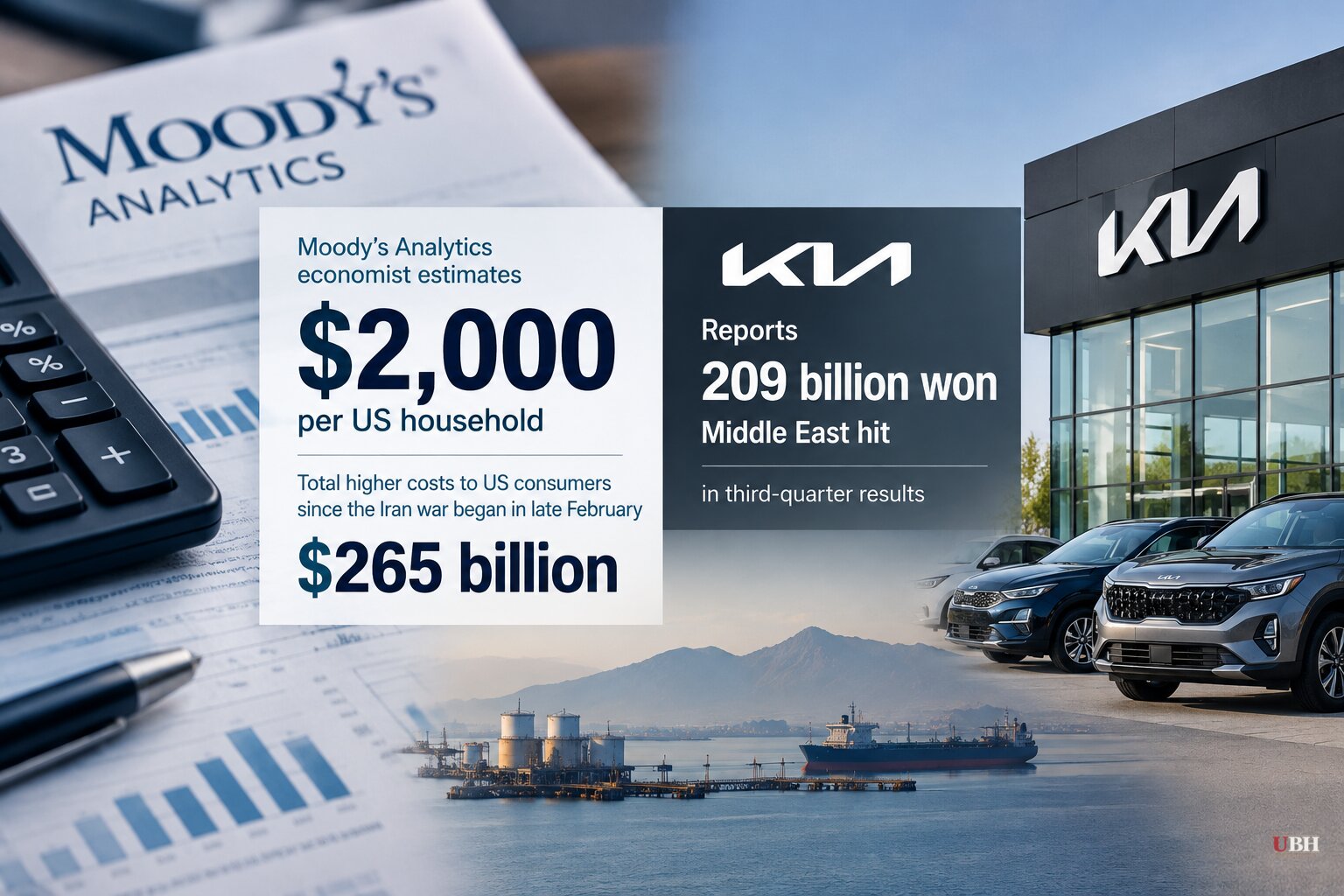
Mark Zandi, chief economist at Moody's Analytics, estimates the conflict has cost US consumers about $265 billion since it started. That works out to roughly $2,000 per average household.
Energy accounts for about $1,100 of that, including higher home heating bills. At current prices, Zandi says, the tally is growing by about $50 a week.
Gasoline averages $4.34 a gallon nationally, according to AAA, up from $2.98 before the conflict. Tuesday was the 165th day this year with the national average at or above $4. AAA has tracked this since 2000, and the prior record was 158 days in 2022.
Diesel remains near all-time highs. Mortgage rates sit around 7%, and airfares have climbed. Wage growth slowed in September to a five-year low, and real wages have fallen almost every month since the war started.
Zandi told CNN on Tuesday that "many Americans have rightly connected the dots between the Iran War and the painfully high cost of living and thus want the war to end."
The White House response
A White House spokesperson rejected the estimate, calling Zandi "a Democrat donor who is frequently wrong – including predicting multiple recessions that never happened."
Trump has argued before that higher gas and diesel prices are a small price to pay for keeping Iran from getting a nuclear weapon. At a rally in Ohio on Wednesday he said the war "was started in 1979 by Iran," and that Iran's drone production is suffering because the country "can't get electricity anymore." He also said Iran's missiles "are still there, but not much less."
Kia: tariff relief, then a bill from the Gulf
Kia reported third-quarter operating profit of 1.8183 trillion won, up 24.3% from a year earlier, on revenue of 31.5974 trillion won, up 10.1%. The operating margin was 5.8%.
Net profit fell 9.6% to 1.28 trillion won ($959.5 million), which the company blamed on unfavorable foreign exchange movements.
Part of the operating gain was a base effect of about 530 billion won from the cut in the US auto tariff from 25% to 15%. Volume added 442 billion won and the exchange rate added 529 billion won.
Against that, Kia lost about 570 billion won to higher raw material prices (368 billion won) and the aftermath of Middle East conflicts (209 billion won). Together they cut the operating margin by about 1.9 percentage points.
Incentives and price cuts to move electric vehicles in Western Europe and Korea cost another 727 billion won. Kia's sales in Africa and the Middle East fell 23%.
Senior Vice President Jung Sung-kook told an earnings call that Kia "expects a swift recovery in profitability... once external pressures, including rising raw material costs and instability in the Middle East, ease."
Fuel prices are reshaping car demand
Kia's electrified sales, covering hybrids and EVs, jumped 47% to about 300,000 units, or 36.2% of the total. Hybrids sold 172,000 units, and US hybrid sales more than doubled to 69,000. EVs sold 123,000, with 63,000 of those in Western Europe.
The company ties the shift to high global oil prices. In the fourth quarter it plans to push higher-margin hybrids in Korea and the US, including the Seltos Hybrid launch and added Telluride Hybrid capacity.
The same fuel prices are opening South Korea to Chinese brands. Petrol there has risen almost 10% since the war began. BYD sold more than 20,000 vehicles in Korea in the first nine months of the year, more than Toyota and Lexus combined, according to research firm Carisyou.
Eugene Investment & Securities analyst Lee Jae-il said Hyundai and Kia focus mainly on premium EVs and offer only a few under $30,000. "The timing has worked particularly well for BYD," he said. One BYD Dolphin buyer in Seoul paid about $18,500 after being told a Hyundai Casper EV would take more than two years to arrive.
Diplomacy has not moved
US benchmark crude, West Texas Intermediate, traded around $101.86 a barrel in early Asia trading Thursday, down 92 cents after a 3% jump Wednesday.
Iranian President Masoud Pezeshkian on Wednesday called Supreme Leader Mojtaba Khamenei's directive to end the "neither war nor peace" state an important step, according to Iran's IRNA news agency. Khamenei called the moment a "crossroads."
The positions have not shifted. Iran says the US must lift its blockade of Iranian ports before talks can begin. Washington wants Iran to make concessions on its nuclear program. Until one side gives on sequencing, Zandi's $50-a-week figure keeps running.
Sources used for this briefing
6 links from 6 independent newsrooms (syndicated copies of the same report count once)
These are the sources it draws on, linked so you can verify.


