
Unbiased headlines. Facts, not spin.
Unbiased Headlines is an independently owned news organization. We bring you the facts, not opinions, written fresh from 110+ named sources. Sources linked so you can verify it yourself.
 economy
Notable (6/10)
BYD Q3 Profit Rises 28% to ¥10.02 Billion, Short of Brokerage Estimates, as Exports Double and China Sales Fall
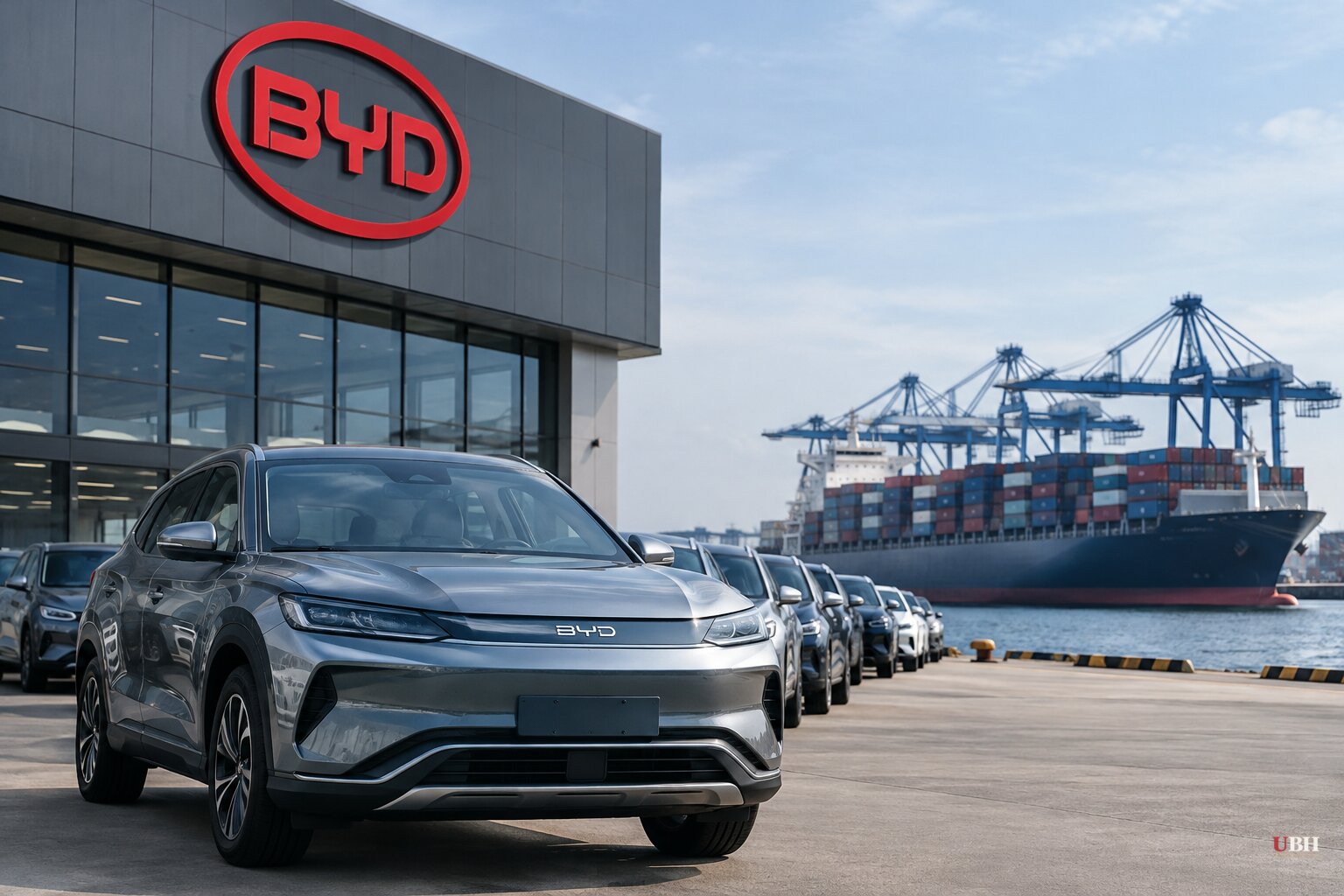
BYD's growth now comes entirely from outside China, and its latest earnings show it.
The company filed third-quarter results with the Hong Kong Stock Exchange on Thursday, Oct. 29. Net profit attributable to shareholders was ¥10.02 billion ($1.5 billion), up 28.08% from a year earlier. Revenue was ¥221.49 billion ($33.3 billion), up 13.59%.
That is BYD's first year-over-year revenue gain after four straight quarterly declines. It is also below what the market wanted. Brokerages polled by Reuters expected ¥11.4 billion to ¥12.95 billion in profit. Daiwa had forecast ¥12 billion, putting the actual number about 17% under its estimate. Daiwa still rates the stock "Buy."
The nine-month picture is flat
One good quarter does not erase a bad year. Revenue for the first nine months was ¥566.3 billion, up 0.01%. Net profit for the period fell 4.2% to ¥22.34 billion.
Q1 profit collapsed 55% to ¥4.08 billion. Q2 recovered to ¥8.24 billion. Q3 profit excluding non-recurring items was ¥8.63 billion, up 25.25%.
Full-year 2025 profit had already dropped to ¥32.62 billion from ¥40.25 billion in 2024.
Exports carry the company
BYD sold 1,323,065 vehicles in Q3, up 18.7%, according to its monthly sales filings. Exports were 550,704 units, up 137% from 232,806 a year earlier. Everything else, mostly China, fell about 12% to roughly 772,000.
Overseas sales reached roughly 1.34 million vehicles through September, up about 92%, or around 43% of total volume. Over nine months, total sales were just over 3.1 million, down 3.9%.
The pull factor is Europe. Battery-electric registrations there jumped 60% year over year in September amid record gasoline and diesel prices, and BYD's European sales more than doubled.
Rival Geely shows the same pattern. Its Q3 net profit rose 28% to ¥4.84 billion, under the ¥5.19 billion analysts expected. Revenue rose 10% to ¥98.96 billion. It sold about 812,500 vehicles, with exports more than doubling to 323,442.
Margins, inventory and cash
Gross margin calculated from BYD's income statement was about 18.0% in Q3, up from 17.6% a year ago but down from roughly 18.9% in Q2. China's price war is the drag. BYD is fighting it with cars like the new Seagull, which has 5-minute flash charging and starts under $10,000.
The balance sheet is less tidy than the headline. Inventory is up 60% since January and the cash pile has shrunk by almost half. Finance expenses were ¥7.37 billion over nine months, against a ¥2.94 billion gain a year earlier. BYD blames exchange losses.
Asset impairment losses rose 68% to ¥2.71 billion. BYD says that is mostly inventory write-downs tied to its larger inventory.
BYD is also hiring again. Chairman Wang Chuanfu said Wednesday at the China Society of Automotive Engineers conference that the company employs more than 1.02 million people, about 150,000 more than at the start of 2026. Year-end 2025 headcount was about 869,600 after layoffs that mainly hit production roles. Wang credits vertical integration of batteries, chips and motors. Headcount is rising while total vehicle sales are falling.
Credits, tariffs and the trade fight
Critics of BYD's expansion point to the policy machinery behind it. Alex Newman, in an Epoch Times commentary, calls emissions credit systems "a mechanism to transfer wealth" to Beijing's champions. He cites Australian Financial Review reporting that BYD imported nearly 51,000 cars in the year to September 2025 but sold just under 38,000, which he says lets it stockpile "lucrative carbon credits."
He also cites Nissan's October 2025 announcement that it formed a pool with BYD for its European fleet emissions, with a spokesman saying BYD was chosen "due to the availability of credits." Newman writes that European carmakers "could be forced to pay hundreds of millions of euros" to Chinese rivals, a line he attributes to the Financial Times. BYD's own filings, as relayed in these results, do not address credit revenue.
The EU has already put extra tariffs on Chinese-made battery-electric vehicles. It is considering measures to restrict fast-growing Chinese hybrid imports.
BYD's answer is to build locally. Its Hungarian factory is expected to start mass production before the end of 2026. Geely is working with Ford on manufacturing in Spain.
Home is the other problem. Oilprice.com reports weaker consumer confidence and reduced government EV subsidies in China are squeezing demand there.
BYD has not announced how it plans to work down the inventory. Whether Hungarian output arrives before Brussels moves on hybrids will shape the next report.
Sources used for this briefing
7 links from 7 independent newsrooms (syndicated copies of the same report count once)
These are the sources it draws on, linked so you can verify.


