
Unbiased headlines. Facts, not spin.
Unbiased Headlines is an independently owned news organization. We bring you the facts, not opinions, written fresh from 110+ named sources. Sources linked so you can verify it yourself.
 economy
Major Story (8/10)
Event date: October 20, 2026 ·
France's 10-Year Yield Passes 5% and Its Spread Over Germany Tops 170 Basis Points as Debt Reaches 119% of GDP
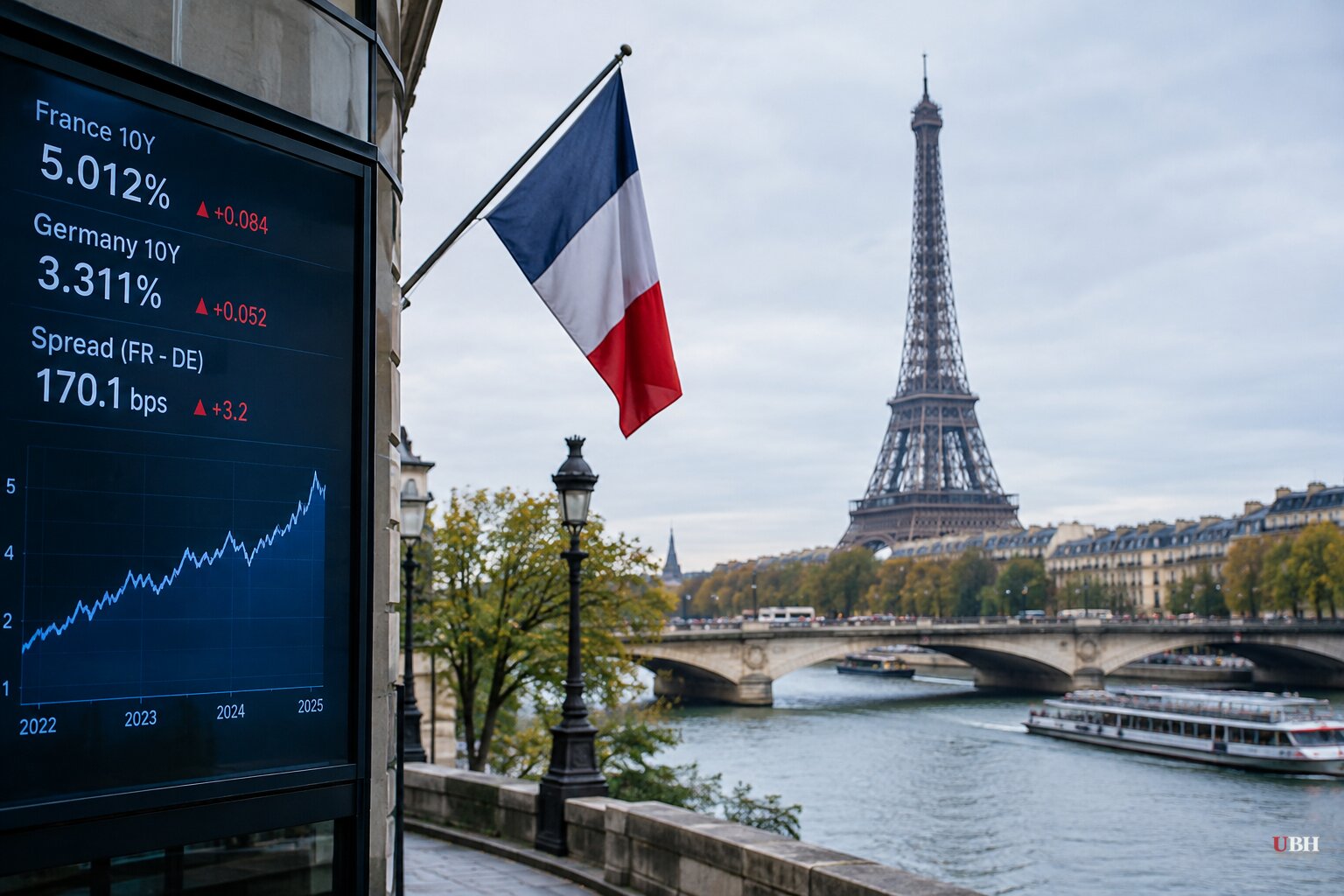
Since French street unrest escalated this month, the bond market has delivered its own verdict on Paris. Investors are demanding the highest price for lending to France in decades.
The yield on France's benchmark 10-year bond rose above 5% for the first time since 2002 and then moved sharply higher, according to CNBC's market reporting. The spread between French and German 10-year yields passed 170 basis points on a Thursday, the widest since the euro zone debt crisis of the early 2010s. The cost of insuring French government debt against default, measured by credit default swaps, is also the highest since that period. The euro has fallen almost 5% against the dollar since January.
The numbers behind the sell-off
France's statistics agency INSEE said on September 29 that general government debt stood at 3.5955 trillion euros at the end of the second quarter. That is 119.0% of GDP, up from 117.5% the prior quarter.
The government warned three weeks ago that the budget would again exceed European Union spending limits. It said debt is expected to reach nearly 122% of GDP, a record, according to AP.
The annual deficit is about 5.4% of GDP, per CNN, or roughly 163 billion euros, per former Rep. Ken Buck. Growth is the other half of the problem. The government has cut its 2026 forecast to roughly half a percent.
Prime Minister Sébastien Lecornu has proposed a budget with about 54 billion euros in savings from lower spending and higher revenue, according to Buck. Many in France question whether it can clear political opposition.
Economists on how bad it is
Carsten Brzeski, ING's chief euro zone economist, said "We are deep into French crisis territory." He also said "France is not Greece," and that there is no risk of an imminent liquidity problem for the government.
Gilbert Cette, an economics professor at Neoma Business School in Paris, called the debt "enormous." He said "France's entire economic policy is constrained by such a sizable debt level."
Paul Krugman wrote on October 8 that a slowdown in bond purchases raises "the specter that the government will be forced into default." He said France "may have crossed the line from too big to fail to too big to save." That is one economist's warning. It is not a forecast from any French official or the ECB.
Is the U.S. next?
The IMF reported last week that the G7 economies' average 10-year yield has risen more than a full percentage point since February. That is the highest in nearly 20 years. CNN, citing the IMF, reports G7 public debt is projected to collectively exceed economic output by the end of the decade, the first time since World War II. CNN attributes part of the damage to the Iran war.
Buck, writing in the Epoch Times, argues that the U.S. is walking the same path. He says France's bond panic has already pushed American borrowing costs to a 24-year high. The U.S. just closed its books on a roughly $2 trillion deficit, and its public debt of about $32 trillion is roughly equal to annual GDP, according to CNN.
The case against the comparison comes from CNN's own analysis. It says France's safety net takes a much larger share of government spending than America's, that contagion risk across Europe is low, and that the U.S. "faces no imminent danger of becoming the next France." CNN also cautions that "similarities can be superficial."
Both sides have a point on the arithmetic. The U.S. has a bigger deficit problem in dollars and a debt load heading the same direction. France has less room for error, because of its slower growth, taxes that are among the highest in Europe and weaker political footing.
Street unrest meets the balance sheet
The unrest began with student school blockades over class sizes, school conditions and the cost of living. It escalated to violence in several cities, including the burning of Limoges' town hall tower and a break-in at Marseille's city hall, according to Fox News reporting. The Louvre closed on Monday citing a "student social movement."
One Fox News commentator blames decades of generous public benefits and argues that migrant-background rioters and foreign influence have added fuel. President Emmanuel Macron has said French citizens carried out the violence.
The protesters' demands run in the opposite direction from the bond market's. Students, retirees and workers want more state spending. Investors want less borrowing. Any government that tries to cut will face those same streets.
Macron is nearing the end of his nearly decade-long tenure, and the state of French finances is expected to be a central issue in the race to succeed him next spring. The first test comes sooner. Lecornu must pass his 54-billion-euro budget through a divided legislature while yields sit above 5%. Whether he can do so is still unresolved.
Sources used for this briefing
6 links from 6 independent newsrooms (syndicated copies of the same report count once)
These are the sources it draws on, linked so you can verify.


