
Unbiased headlines. Facts, not spin.
Every story is an unbiased news briefing written from 110+ sources across the spectrum — sources linked so you can verify it yourself.
 defense
Major Story (8/10)
July 5, 2026 at 03:08 PM
defense
Major Story (8/10)
July 5, 2026 at 03:08 PM
Mojtaba Khamenei Still Invisible at His Father's Funeral as Iran's Leadership Fractures Openly
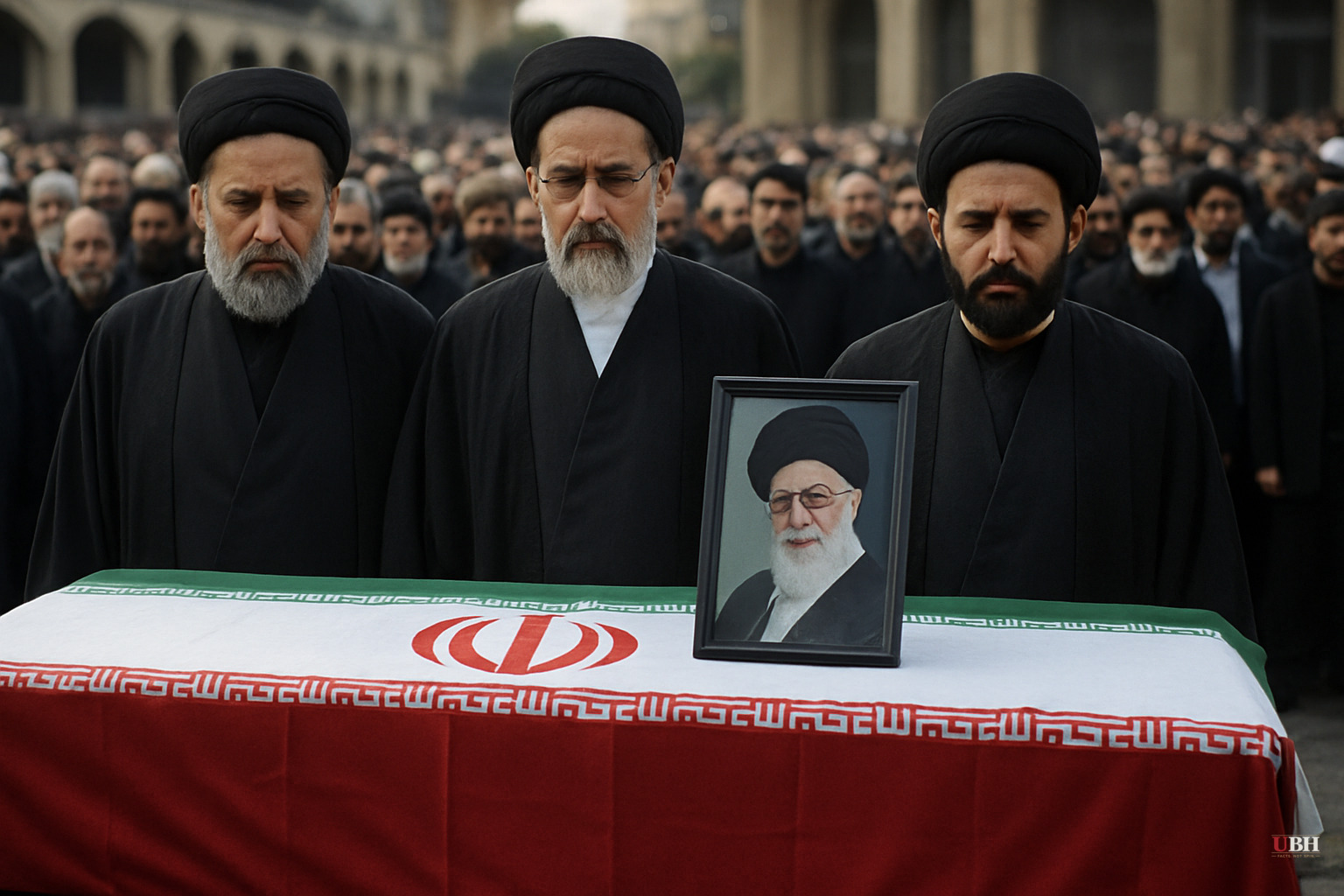
Since Ali Khamenei was killed in the opening U.S.-Israeli airstrike on February 28, Iran's new supreme leader has not appeared in public once — and Sunday's funeral offered no exception.
Sons Mostafa, Meysam, and Masoud Khamenei prayed beside their father's coffin at Tehran's Imam Khomeini Grand Mosalla on Sunday, according to CNBC. Mojtaba, appointed supreme leader roughly ten days after his father's death, was again absent. According to Reuters, cited by CNBC, Mojtaba suffered facial disfigurement and significant injuries to one or both legs in the February 28 attack. He also did not attend his wife's funeral last Thursday, according to The Guardian.
One mourner captured the public frustration plainly. "Until the last moment, before the prayer began, I kept telling those around me that I hoped Mojtaba himself would come," a young woman told the semi-official Tasnim news agency. "That was our only wish."
Iran's government designed this week of ceremonies deliberately. Coffins were displayed under glass outdoors, processions are traveling to Shia religious sites in neighboring Iraq, and the Iranian metro system logged 7 million trips from Saturday evening alone, according to CNBC. The imagery is calibrated: flags, red banners symbolizing vengeance, crowds beating their chests in the Shia mourning tradition.
The most inflammatory moment came during a poetry recitation before Sunday's funeral prayers. Poet Mohammad Rasouli said, according to The Guardian: "From now on the shroud is our garment. I swear by your blood; Trump's murder is our responsibility." He continued: "Why is the most bastard man in the world still alive? The world is no longer a good place for Trump. Why should we not kill the man who killed our imam?"
The Guardian reported the remark was scripted and authorized. Most in the crowd cheered. Iran's ambassador to Armenia, Khalil Shirgholami, posted on X: "You can kill people, but you can't kill ideals."
President Donald Trump told Axios that peace talks have been paused for a week because of the funeral. That is a significant operational pause in negotiations over a permanent end to a war that has already reshaped the Persian Gulf.
Critics who dismiss the funeral as pure theater are missing something real. Khamenei's family, including his daughter-in-law and a 14-month-old granddaughter, were killed alongside him. The small size of the infant's coffin, noted by The Guardian, is not propaganda. These are genuine losses inside one family, compounded by a nation that has buried thousands since February. Iranian President Masoud Pezeshkian wept openly at the ceremony, according to CNBC. Whatever else is happening politically, the grief is not entirely manufactured, and underestimating its motivational power would be a mistake.
Beneath the pageantry, Iran's institutions are fighting each other in public.
On June 27, 63 of 84 Assembly of Experts members bypassed standard protocols to issue a declaration calling the assassination of Trump and Israeli Prime Minister Benjamin Netanyahu a religious duty, according to the National Council of Resistance of Iran. They also demanded nuclear negotiations be halted immediately.
The regime's own Secretariat of the Assembly of Experts publicly reprimanded the signatories the next day, calling the declaration "unusual and uncustomary," according to the NCRI. President Pezeshkian traveled to Qom on June 28 to consult with influential clerics, seeking religious cover to protect his negotiating team from the hardline revolt.
The rupture goes deeper. Parliament member Mahmoud Nabaviyan disclosed on Iranian state media that during a Supreme National Security Council session on a Swiss diplomatic memorandum, 12 of 13 council members voted against Mojtaba Khamenei's explicit preferences. Mojtaba was reportedly forced to walk back his own position, stating, according to the NCRI: "In principle, I had another opinion." Nabaviyan publicly asked why officials "refused to turn the steering wheel back" on diplomatic concessions.
The NCRI is an opposition group with its own political interests and should be read as an interested source. But the specific details it cites — named council members, vote tallies, publicly reported statements on state media — are specific enough that the broad pattern of elite fracture is corroborated by what PBS and CNBC independently describe as a "shaky ceasefire" and a government straining to manage the aftermath of a war it is simultaneously calling a victory.
Iran's top negotiator used the funeral proceedings to warn France and the United Kingdom against launching joint patrols in the Strait of Hormuz, according to PBS. A fifth of global oil and natural gas once passed through that waterway in peacetime. The warning signals that Tehran is still using the strait as leverage even while its internal leadership is visibly fractured.
The unresolved question as of July 5 is straightforward: whether Mojtaba Khamenei is physically capable of governing. He has not appeared publicly, issued an audio message, or attended his own wife's funeral in three months. When peace talks resume after the funeral week ends, Washington will be negotiating with a government whose new supreme leader is invisible, whose security council has defied him on at least one key vote, and whose legislature has been suspended for four months.
Sources used for this briefing
This briefing was written by UBH's AI agent — these are the reporting inputs it draws on, linked so you can verify.


