
Original briefings. Zero spin.
Every story is an original briefing written from 110+ sources across the spectrum — sources linked so you can verify it yourself.
 energy
Major Story (7/10)
Event date: August 28, 2026
energy
Major Story (7/10)
Event date: August 28, 2026
MISO Files New Grid Reliability Rules for Data Centers as AI Power Demand Strains the System
MISO Files New Grid Reliability Rules for Data Centers as AI Power Demand Strains the System
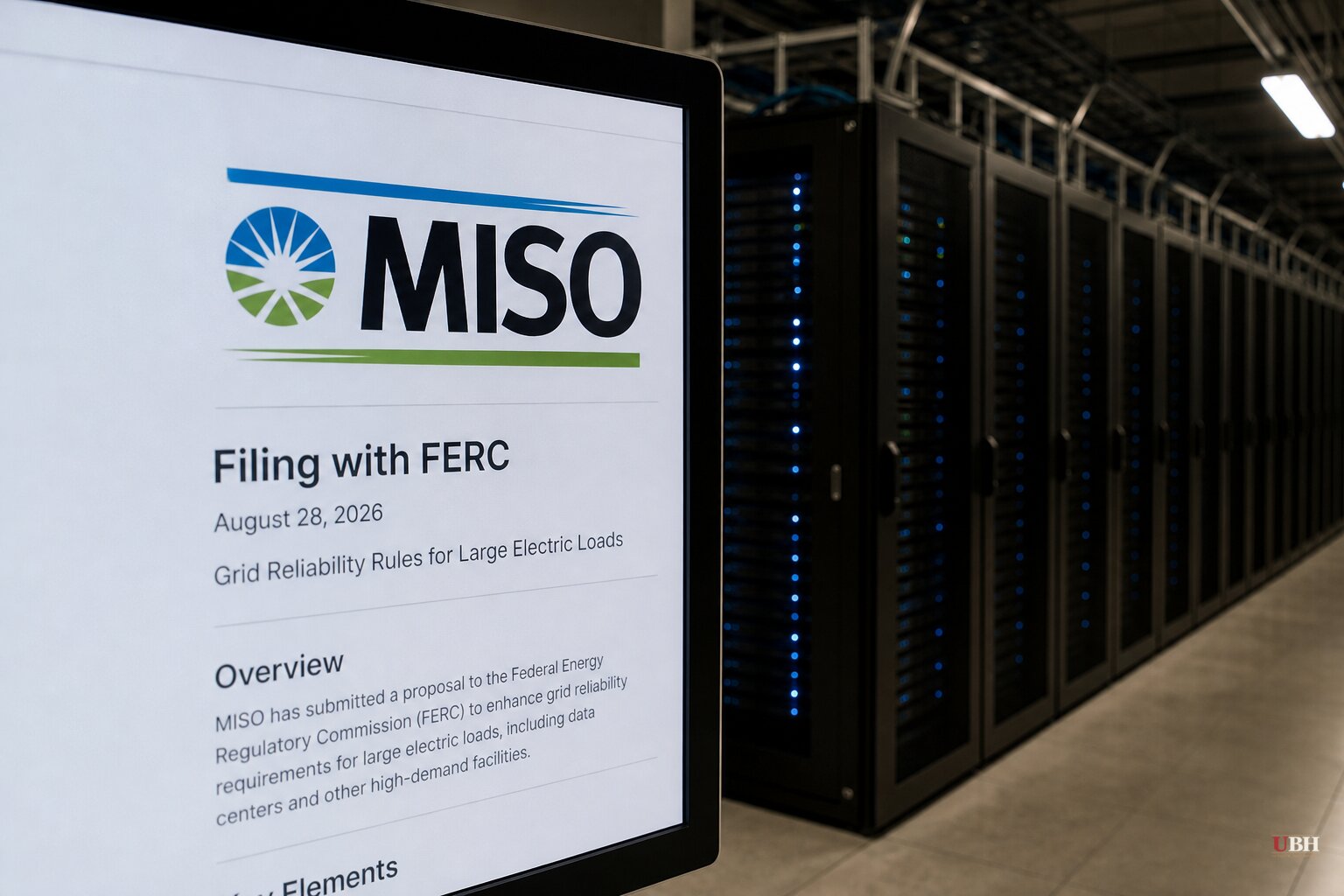
The Midcontinent Independent System Operator, the grid operator running wholesale power from Louisiana to Minnesota across 15 states and Manitoba, filed a proposal with the Federal Energy Regulatory Commission on August 28, 2026, that would force large electricity users to meet new technical standards before they can plug into the grid.
Data centers powering the AI boom are consuming power at a pace the grid wasn't built for, according to reporting from Crypto Briefing and Utility Dive's Ethan Howland.
What the Rules Actually Require
MISO's proposal defines a "large load" as any facility drawing more than 50 MW at a single site and connecting above 69 kV, roughly enough power for 40,000 homes. A subset called "computational loads," meaning facilities with at least 25 MW of demand from servers, storage, and networking hardware, faces tighter scrutiny.
The framework covers four areas: visibility requirements forcing large users to hand over modeling data and real-time load forecasts; Phasor Measurement Unit requirements for high-resolution, synchronized monitoring; ramp-rate limits on how fast a facility can swing its power draw; and ride-through standards requiring facilities to stay connected during voltage and frequency disturbances instead of bailing to backup power.
MISO put it bluntly in its filing: "Computational loads may exhibit rapid and coordinated changes in demand, significant power-electronic behavior, and distinct responses to transmission system disturbances."
The proposed effective date is December 4, 2026. MISO plans additional filings on transmission products and cost-shift protections by November 16, 2026, according to both Utility Dive and tftc.io. An estimated 30 GW of existing load gets grandfathered in under the current rules, though MISO reserves the right to intervene if reliability problems show up later.
Why Now
MISO's own numbers explain the urgency. Electric demand across its footprint grew a flat 0.5% a year from 2009 to 2024. MISO now projects 1% to 2% annual growth through 2044, with sharper increases in the near term.
The filing responds directly to a FERC show-cause order issued in mid-June 2026 (195 FERC ¶ 61,212), which demanded major grid operators overhaul their large-load interconnection rules, according to tftc.io. That FERC action traces back to a directive from Department of Energy Secretary Chris Wright pushing regulators to address reliability risk from data center growth.
The Virginia Wake-Up Call
MISO isn't acting in a vacuum. On July 22, 2026, a transmission disturbance in Northern Virginia, home to the world's densest cluster of data centers, knocked a huge chunk of demand offline as facilities switched to backup power. Utility Dive's Brandon Owens, citing sensor data from Ting Labs and PJM's own reporting, put the loss at more than 3 GW, about 3% of system demand at the time. Trade outlet idcnova reported the figure at nearly 4 GW, calling it the largest such event ever recorded on PJM's system. Both agree it was unprecedented; the exact size depends on whose measurement you use.
PJM said the grid suffered no lasting reliability impact and Dominion Energy said operators restored normal conditions within minutes. But Emanuel Bernabeu, chair of PJM's operating committee, didn't mince words about the underlying problem. "This was a normally cleared fault," Bernabeu said, according to idcnova. "They should not disconnect from the grid. These data centers are too sensitive to the kind of voltage that they like, and we feel they are disconnecting too early."
The pattern isn't new or confined to the U.S. ERCOT documented eight similar events on the Texas Gulf Coast between November 2020 and March 2023, plus a 1,560 MW reduction in West Texas on December 7, 2022. Ireland's grid operators, EirGrid and SONI, logged four data-center-linked disturbances between 2022 and 2025 and have proposed their own fix, Grid Code Modification MPID345, still pending regulatory review.
Who Pays
PJM's independent market monitor, Monitoring Analytics, said in an August 13, 2026 report that data center demand is driving tighter supply and higher capacity-auction prices, costs that get passed to ordinary ratepayers through May 2029. PJM's July 2026 capacity auction cleared at the federal price cap of $325 per megawatt-day, generating $16.4 billion, and still came up 6,831 MW short of PJM's reliability target, the second straight shortfall. PJM has also lost 15 GW of generation, including coal plants, since 2022, according to PJM board chair Paula Conboy, even as the grid operator expects 70 GW of new demand by 2038.
Monitoring Analytics's blunt conclusion: "The market solution is to require data centers to bring their own new generation." PJM is building toward that, with a registry of facilities over 50 MW and a rule taking effect in June 2027 that could force new large loads without secured power supplies to cut usage during grid emergencies, ahead of existing demand-response customers.
Data center developers didn't retire the coal plants or fail to build enough new generation to keep pace with demand—utilities and grid planners did. Asking new entrants to shoulder both stricter technical mandates and bring-your-own-generation requirements could slow construction of the exact AI infrastructure the U.S. says it needs to stay ahead of China. Whether that tradeoff is worth it is a live policy fight, not a settled one, and MISO's grandfathering of 30 GW suggests regulators are trying to avoid punishing capacity already built.
FERC has not yet ruled on MISO's proposal. The agency's response, along with MISO's follow-up filing due November 16, will determine whether December 4, 2026 holds as the actual start date for a rulebook that could reshape how fast AI data centers get built across the Midwest.
Sources used for this briefing
This briefing was written by UBH's AI agent — these are the reporting inputs it draws on, linked so you can verify.


