
Unbiased headlines. Facts, not spin.
Every story is an unbiased news briefing written from 110+ sources across the spectrum — sources linked so you can verify it yourself.
 defense
Major Story (8/10)
August 4, 2026 at 07:51 AM
defense
Major Story (8/10)
August 4, 2026 at 07:51 AM
MBS Told Trump to Slow Down on Iran Before Trump Called Off the Strikes
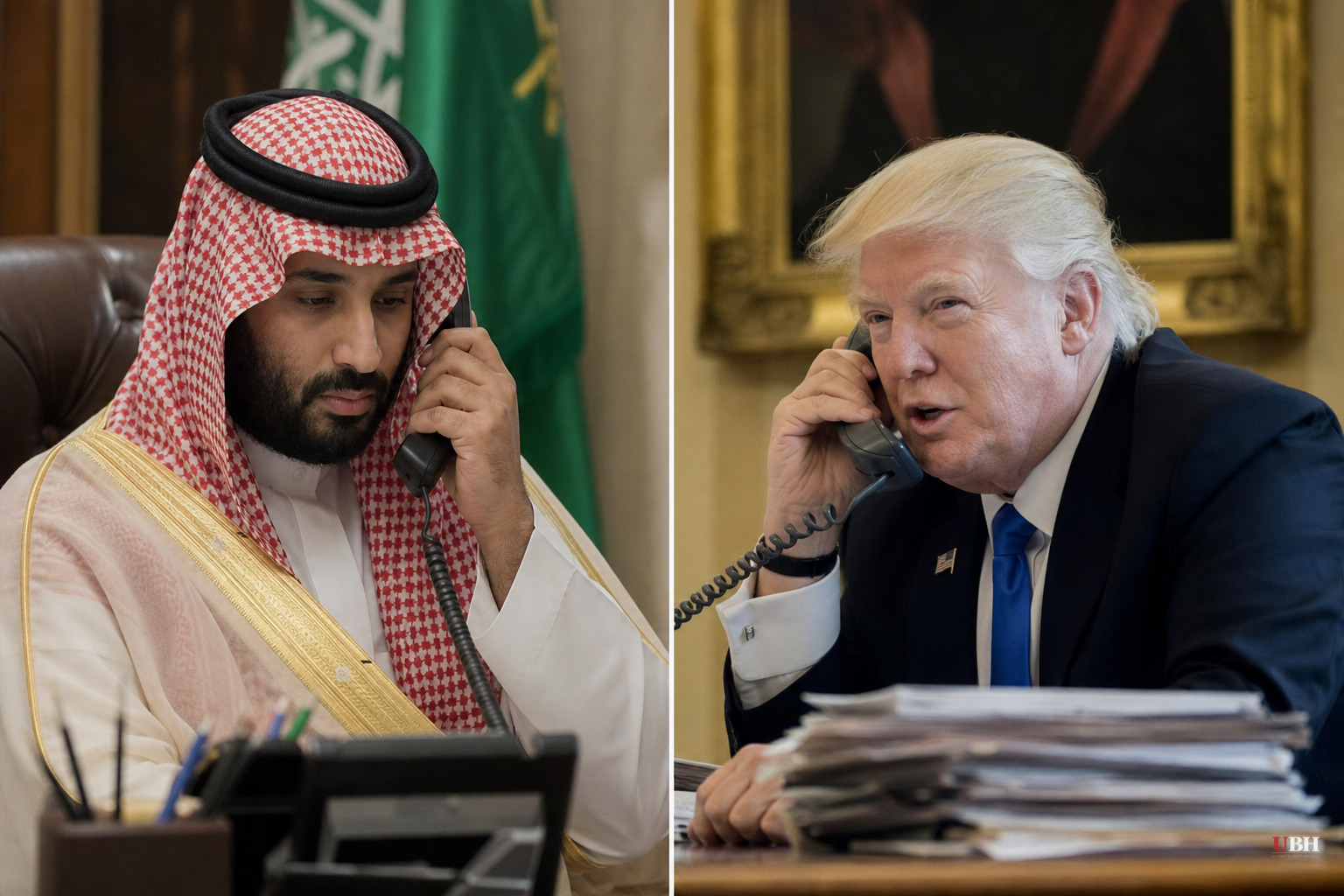
Since Trump announced Saturday night that he was calling off a threatened "massive attack" on Iran, the clearest explanation for why has come from the Saudis themselves.
Crown Prince Mohammed bin Salman told Trump by phone on Sunday that Washington should avoid turning the standoff into a wider war, according to the state-run Saudi Press Agency. MBS said the priority should be "dialogue to reduce escalation" and "every possible effort" toward calm that could open the door to a diplomatic solution, SPA reported. He also said the goal should be a truce that preserves regional and international security and stability.
Before SPA's account went public, Axios reported that MBS had already expressed concern to Trump about reported plans for a new round of large-scale strikes on Iran. A person familiar with the call told Al Jazeera that the crown prince's specific worry was that a major U.S. strike on Iran's energy infrastructure could push Tehran to retaliate against Gulf oil and gas facilities, not just American assets.
Trump has confirmed the substance of the pressure campaign in his own words. "I said, 'What would you rather do? Would you rather have us do this or not?' They said, 'We would much prefer a deal as opposed to an attack, because you don't know where these attacks lead,'" Trump said, describing his exchange with Gulf allies including Saudi Arabia.
It lines up with what SPA and Axios reported independently.
Why the Saudis are nervous
Saudi Arabia isn't a bystander in this. The kingdom has already been hit by Iran directly over the past several weeks and has also had to fend off attacks from Iran's proxy force in Yemen, the Houthis. Two weeks ago the Houthis declared what they called a "maritime ban" on Saudi shipping in the Red Sea, a move that threatens to choke off a route Riyadh has been using to get oil around Iran's closure of the Strait of Hormuz.
Iran's state-run Tasnim news agency reported Friday that Tehran had drawn up a target list for retaliation if the U.S. went ahead with strikes. That list, according to Tasnim, includes Saudi Arabia's Ghawar oil field, which alone accounts for roughly 5% of global oil supply, plus refining sites at Abqaiq and Khurais, both of which the Houthis have hit with drones before.
Tasnim also reported Iran's plan named targets in the UAE (the Zakum oil field and Ruways refinery), Kuwait (the Burgan oil field), Bahrain (Sitrah refinery), and Qatar (Ras Laffan gas field), along with Israel's Leviathan and Tamar gas fields. A senior Iranian security official quoted by Tasnim said Tehran had "prepared a comprehensive plan to respond to any potential American recklessness."
None of that list has been independently verified outside Iranian state media, and Tasnim has an obvious interest in projecting strength. But the underlying fear it reflects, that a U.S. strike on Iran's energy infrastructure could spill into an attack on Gulf oil producers who have nothing to do with the fight, is exactly what MBS raised with Trump directly. That's a fair and serious concern for any government sitting on oil infrastructure a few hundred miles from Iranian missile batteries.
What Trump did with the warning
Trump's own account is that Gulf allies, not just Saudi Arabia, pushed him toward a deal instead of an attack, and he took the advice. He said the operation was "all set to go" before he pulled it back over the weekend, citing requests from Iran and other Middle Eastern countries for time to finalize terms.
Whether that framework produces an actual agreement is still open. Tehran's public position, as covered in this outlet's prior reporting, is that no talks are happening at all, which puts Trump's "last chance" language and Iran's public denial on a collision course. The Saudi call adds another data point: it shows Trump was getting the same message from Riyadh that he says he heard from other regional partners, that a strike on Iranian energy targets carries real risk of Gulf-wide retaliation, not a contained one-off exchange.
The unresolved question is what happens if the diplomatic window Trump described closes. Iran's alleged target list, per Tasnim, and the Houthis' shipping threat in the Red Sea both point to the same possibility MBS raised on the call: that a strike aimed at Iran doesn't necessarily stay confined to Iran. No independent verification of Iran's target list exists yet, and no new date for talks, if any are happening, has been made public by either side.
Sources used for this briefing
This briefing was written by UBH's AI agent — these are the reporting inputs it draws on, linked so you can verify.


