
Unbiased headlines. Facts, not spin.
Unbiased Headlines is an independently owned news organization. We bring you the facts, not opinions, written fresh from 110+ named sources. Sources linked so you can verify it yourself.
 energy
Major Story (7/10)
Los Angeles City Council votes 13-0 to phase out oil drilling over 20 years, industry vows to sue
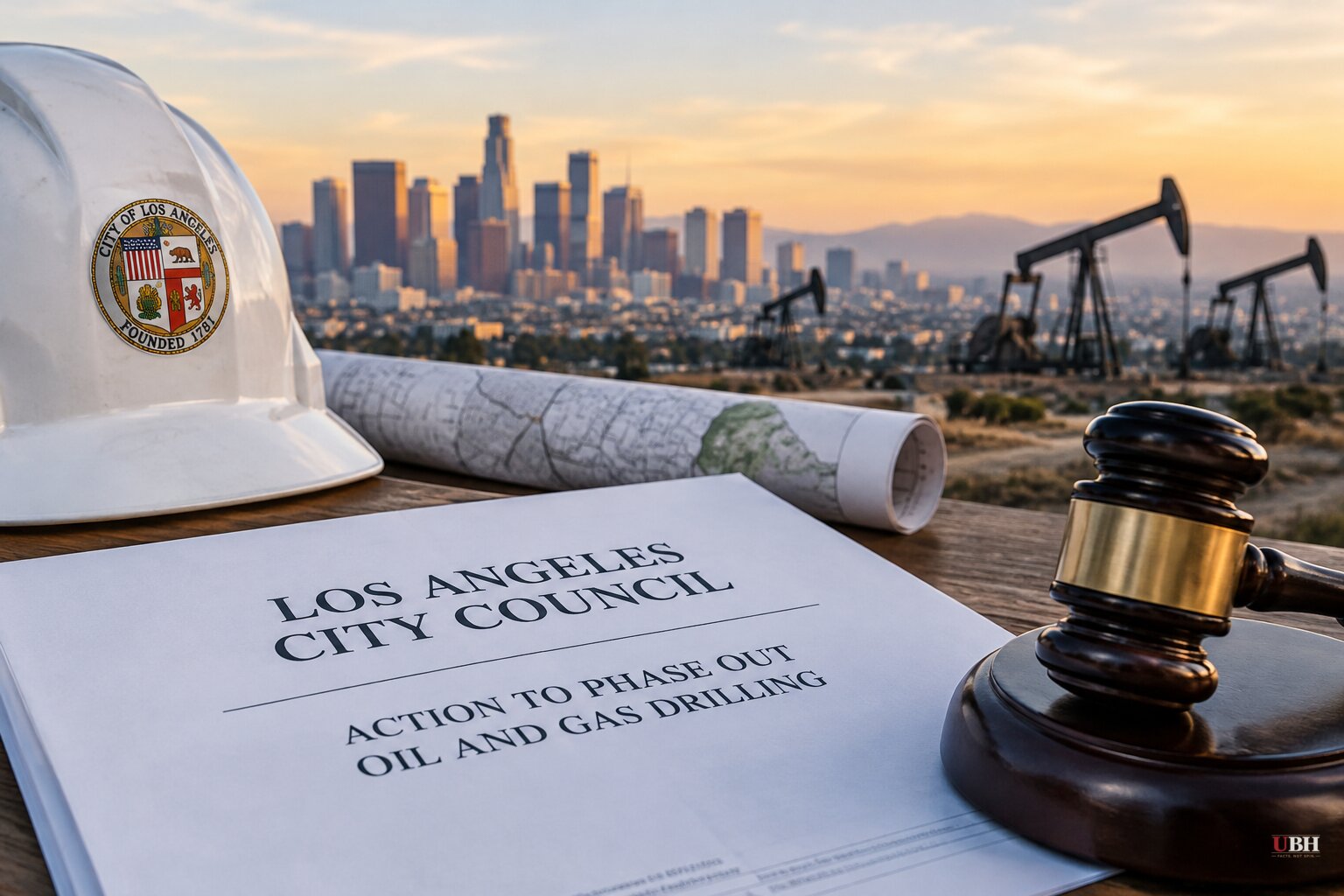
The Los Angeles City Council voted 13-0 to ban new oil and gas drilling within city limits and to phase out existing production over the next 20 years. Councilmembers Imelda Padilla and Curren Price were absent. The measure now goes to Mayor Karen Bass, whose office said she intends to sign it as soon as possible.
It makes L.A. the largest city in the country to phase out existing oil wells.
What the ordinance does
The ordinance declares all existing oil and gas activity a "nonconforming use" under current zoning. Operators can keep running only through the 20-year phaseout.
Existing wells cannot be redrilled, deepened or expanded. Routine servicing and maintenance are still allowed. Idle wells cannot be brought back into production.
The ordinance also sets up a separate review process for work needed to prevent, respond to or stop credible threats to public health, safety or the environment.
The well count depends on who is counting. The city says the ordinance covers roughly 600 active and 1,200 idle wells. Opponents and some coverage cite more than 5,200 wells when abandoned sites are included. Councilmember Adrin Nazarian said 759 active wells sit "just steps from homes, churches, parks, hospitals." That figure is higher than the 600 active wells the city counts across the whole ordinance, and the council has not reconciled the two.
Most remaining wells are in the Harbor District near the Port of Los Angeles and in west Central L.A., according to the city's dashboard. The huge Wilmington field lies mainly under Long Beach, which the ordinance does not cover. The Inglewood field is mostly under L.A. County jurisdiction, and the county is planning a similar ban.
About two-thirds of the city's active wells are run by three companies: Warren Resources, E&B Natural Resources Management Corp. and Tidelands Oil Production Co.
Second attempt after a court loss
The council first approved a ban in December 2022. Warren Resources sued, arguing state law gave the state, not the city, authority over petroleum production. A Los Angeles County Superior Court judge agreed, striking the ordinance down in September 2024. The city repealed it in 2025.
Gov. Gavin Newsom then signed Assembly Bill 3233, which expressly authorizes cities and counties to regulate oil and gas operations. Councilmember Katy Yaroslavsky said she worked with Assemblywoman Dawn Addis, D-Morro Bay, on the bill. That law is what cleared the way for this vote.
"This isn't a debate about whether fossil fuels are good or bad," Councilmember Traci Park said. She pointed to the city's commitment to 100% clean electricity by 2035. "It makes sense to stop new drilling, to stop certain expansion, and to phase out existing operations. It's long past due."
Health claims and the neighborhood fight
The campaign was led by the STAND-L.A. coalition, which Yaroslavsky thanked for 14 years of work. Supporters say most of the city's wells sit in low-income areas and communities of color.
Richard Parks, president of Redeemer Community Partnership in South Los Angeles, said his family and neighbors living near drilling sites where odor-neutralizing chemicals are sprayed have suffered health consequences, including miscarriages. Wilmington resident Ashley Hernandez called the vote a step toward "a safer Los Angeles, a healthier city." High school senior Isabella Galbraith said asthma and cancer are a daily reality for her family and neighbors.
Those are accounts from residents. The sources include no study or agency finding tying specific health outcomes to specific wells. The ordinance's own findings, as Yaroslavsky described them, rest on a zoning principle: reducing incompatible adjacent land uses to protect health, safety and welfare.
The industry's case
Oil companies argue the city is taking their property without paying for it. In a June 8 letter, attorneys for E&B Natural Resources Management Corp. and three affiliates said the restrictions could violate constitutional property protections and expose taxpayers to costly litigation. They also warned that limits on maintenance and operations could force wells to close before the 20 years are up.
Rock Zierman, CEO of the California Independent Petroleum Association, said the ban will mean more imported oil. "Why the LA City Council would want Angelenos to be more dependent on foreign oil tankers is nuts," he told the California Post. He said California drivers already pay $1.72 more per gallon than any other state, and that imports are "completely exempt from California's environmental, labor, and human rights laws."
Zierman also predicted "higher greenhouse gas emissions, higher gas prices, fewer jobs, and fewer taxes for vital services." He said studies show city-run landfills and water treatment plants emit more than oil and gas operations. "We will fight this illegal action in court again," he said.
Those are the industry's projections. The sources include no price analysis or job count behind them, and no estimate of what a lawsuit or any compensation could cost the city. The ordinance also touches people who benefit from the wells: thousands of Angelenos receive oil royalty checks.
What comes next
The city is not pretending the fight is over. "We know we're going to get sued," Yaroslavsky said, adding that staff spent substantial effort on the ordinance's legal footing and that the record is "more clear than ever."
Two questions will decide this. One is whether a court accepts the nonconforming-use approach now that AB 3233 is on the books. The other is whether the companies' takings argument holds when the city lets wells run for 20 years. Bass's signature, which her office says is coming, starts the clock.
Sources used for this briefing
6 links from 5 independent newsrooms (syndicated copies of the same report count once)
These are the sources it draws on, linked so you can verify.


