
Unbiased headlines. Facts, not spin.
Unbiased Headlines is an independently owned news organization. We bring you the facts, not opinions, written fresh from 110+ named sources. Sources linked so you can verify it yourself.
 energy
Major Story (8/10)
Event date: October 27, 2026 ·
Brent Settles at $113.88 and WTI Under $100 as Oman Outlines Hormuz Arrangement and Regional Talks Continue
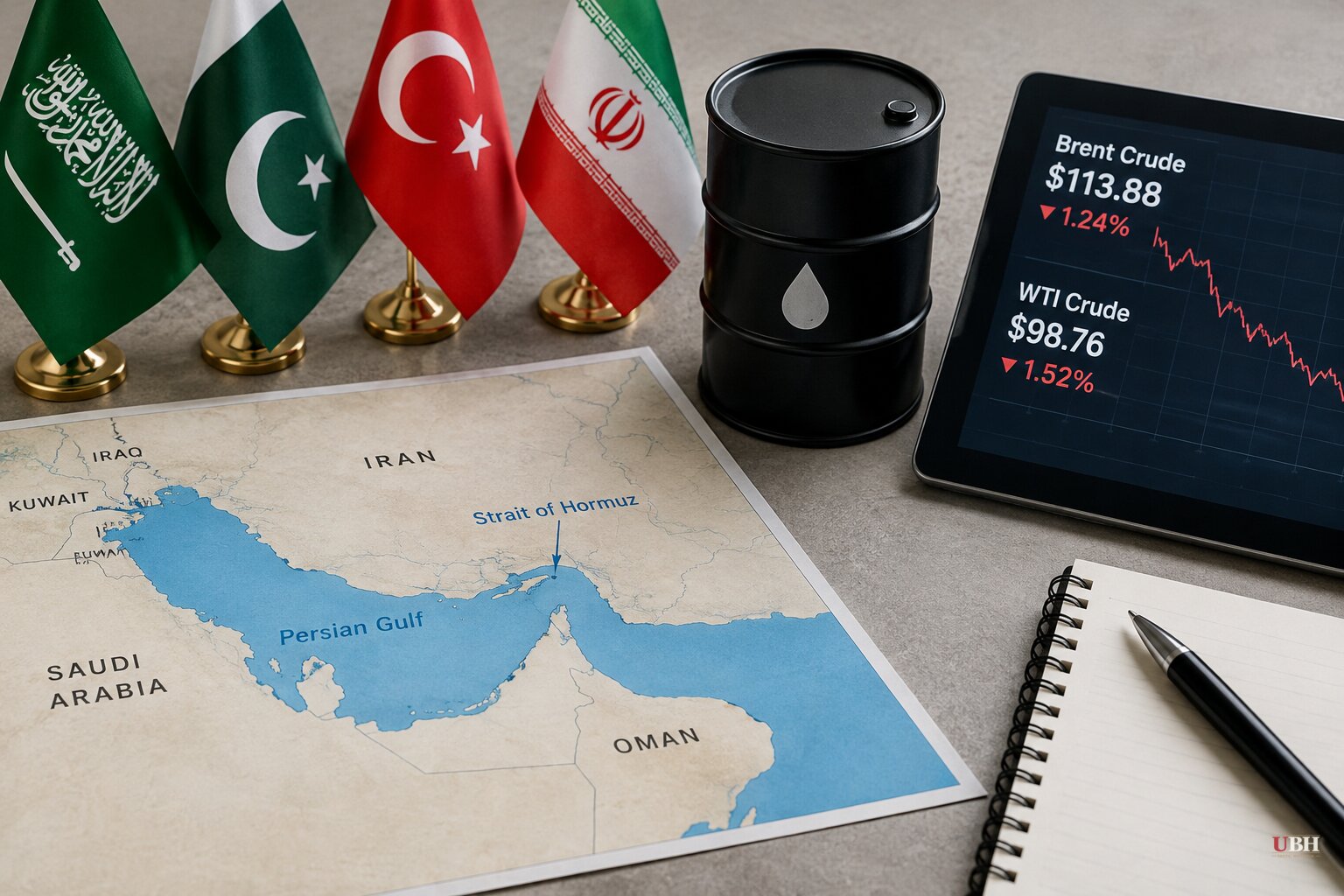
Since U.S. and Israeli strikes on Iran began on Feb. 28, oil has swung with every diplomatic headline. This week it swung down. December Brent futures settled Tuesday at $113.88 a barrel, down 1.7%. December West Texas Intermediate fell 1.8% to $99.90, slipping back under $100. Gasoline and diesel futures dropped close to 3%.
Bloomberg price quotes had WTI back near $102 and Brent toward $114 on Wednesday, Oct. 28, as traders weighed the Wall Street Journal's report that Vice President JD Vance reached out to Mohsen Rezaei, secretary of Iran's top security body.
Monday's 6% drop did not hold
Brent fell more than 6% early Monday, from about $117.4 at Friday's close to roughly $110, as mediators headed for Tehran. That drop was largely reversed. Brent touched $117 again on Monday, according to Reuters reporting carried by Arab News.
Fox News reported that Brent settled at $116.72 on Friday after briefly topping $117. Euronews described Friday's close as Brent's highest since March 19, about 2% under the $119.5 peak hit in early March. Before the war, Brent traded around $72.
What the diplomacy produced
Senior officials from Saudi Arabia, Pakistan and Turkey met Iranian counterparts in Tehran on Monday. A joint statement said the countries agreed to keep talking on regional peace and security. Saudi Arabia's Foreign Ministry said the visit was part of efforts to reduce tensions and support mediation by Qatar and Pakistan. It called for opening channels of negotiation to prevent a return to military escalation.
Oman said discussions with Iran had produced an outline for a temporary arrangement to restore free navigation through the Strait of Hormuz, although political obstacles remain. Omani Foreign Minister Badr Albusaidi said in a speech at the University of Cambridge that implementing it would require compromises by both Washington and Tehran.
Iran is still promoting its proposal that would end the war and fully reopen the strait within a week if the U.S. meets several conditions, including ending the U.S. blockade of Iranian ports. Trump rejected that seven-day proposal, though both sides have acknowledged that indirect discussions have continued. Those conditions echo the ones in the deal Washington and Tehran signed in June, which fell apart within days.
Iranian Supreme Leader Mojtaba Khamenei reiterated Iran's conditions for ending the war with the U.S. during a meeting with his security chief, according to a Telegram statement from his office. The semi-official Tasnim news agency reported that Russian President Vladimir Putin and Iranian President Masoud Pezeshkian met Tuesday. The report said U.S. actions necessitate expanding "cooperation among sanctioned nations."
Rafael Grossi, director general of the International Atomic Energy Agency, told the U.N. General Assembly on Friday that the agency has completed much of the preparation needed to verify Iran's nuclear activities if Washington and Tehran reach a diplomatic agreement. No agreement authorizing inspections has been announced.
Hormuz flows: Trump and the data
At a campaign event in Port Huron, Michigan, Trump claimed that "oil coming out of the Strait of Hormuz is now topping what it was before the war." The ship-tracking firm Kpler found that Gulf crude exports excluding Iran returned to prewar levels in September. But around 40% of those exports now bypass the strait through pipelines, compared with 17% before the conflict.
ANZ Research said Gulf crude exports fell for a fourth straight week and flows through Hormuz were about 60% of their normal level. Data from a Washington-based think tank show October has been the worst month for attacks on commercial shipping in the Strait and nearby waterways among the maritime security incidents it has tracked since 2017.
On Thursday, Oct. 22, Iranian state television, citing the Revolutionary Guard navy, said seven tankers caught fire or were damaged overnight after being hit by Iran or striking naval mines. The United Kingdom Maritime Trade Operations, a British military monitor, did not report those incidents. Monitors have noted reluctance by some shippers to report incidents. The Guard navy again threatened to strike U.S. military bases in the region if the U.S. keeps helping guide commercial ships through the strait.
Houthis, Saudi Arabia and the U.S. buildup
Yemen's Houthis said they struck Saudi airports and energy sites again over the weekend. Riyadh reported shooting down further missiles and drones. A person with knowledge of the matter said Saudi Arabia contained a fire near Ras Tanura, its biggest export terminal.
The U.S. is sending a third aircraft carrier and thousands more troops to the region, joining the largest force of American warships and aircraft in the Middle East in decades.
Two elections, two clocks
Israel voted Tuesday. Prime Minister Benjamin Netanyahu, who launched the war with Trump, has pledged to topple Iran's regime. Opposition leader Gadi Eisenkot says Iran's nuclear program must be stopped but calls regime change "not an achievable goal." Robert Yawger of Mizuho Securities USA said: "If Netanyahu loses, it makes it difficult for Trump to go it alone, assuming Eisenkot is not willing to jump in." He called the vote "a warm-up vote for the US midterms."
Those midterms are Nov. 3. Voter anger over the war and energy prices is a live issue. In a Fox News interview Sunday, Trump framed the choice this way: "do I make a deal with them, or do I finish them off?" He has also raised the possibility of additional strikes after the election, though no new military operation has been announced.
Market analysts see a split. Yawger said the pullback was likely influenced by profit-taking after speculative investors had been loading up long positions. Dennis Kissler of BOK Financial said the prospect of peace is keeping some downside pressure on prices near term, but "the facts remain of tight global supplies, and the increasing U.S. military presence in the Persian Gulf."
What to watch next: whether Washington answers Oman's navigation outline before Nov. 3, and whether Iran's seven-day Hormuz proposal comes back to the table.
Sources used for this briefing
7 links from 7 independent newsrooms (syndicated copies of the same report count once)
These are the sources it draws on, linked so you can verify.


