
Unbiased headlines. Facts, not spin.
Unbiased Headlines is an independently owned news organization. We bring you the facts, not opinions, written fresh from 110+ named sources. Sources linked so you can verify it yourself.
 energy
Major Story (8/10)
Event date: October 23, 2026 ·
UBS Sees Brent Near $110 at Year-End as Gulf Oil Flows Recover but Shipping Attacks Keep Delivered Crude Costly
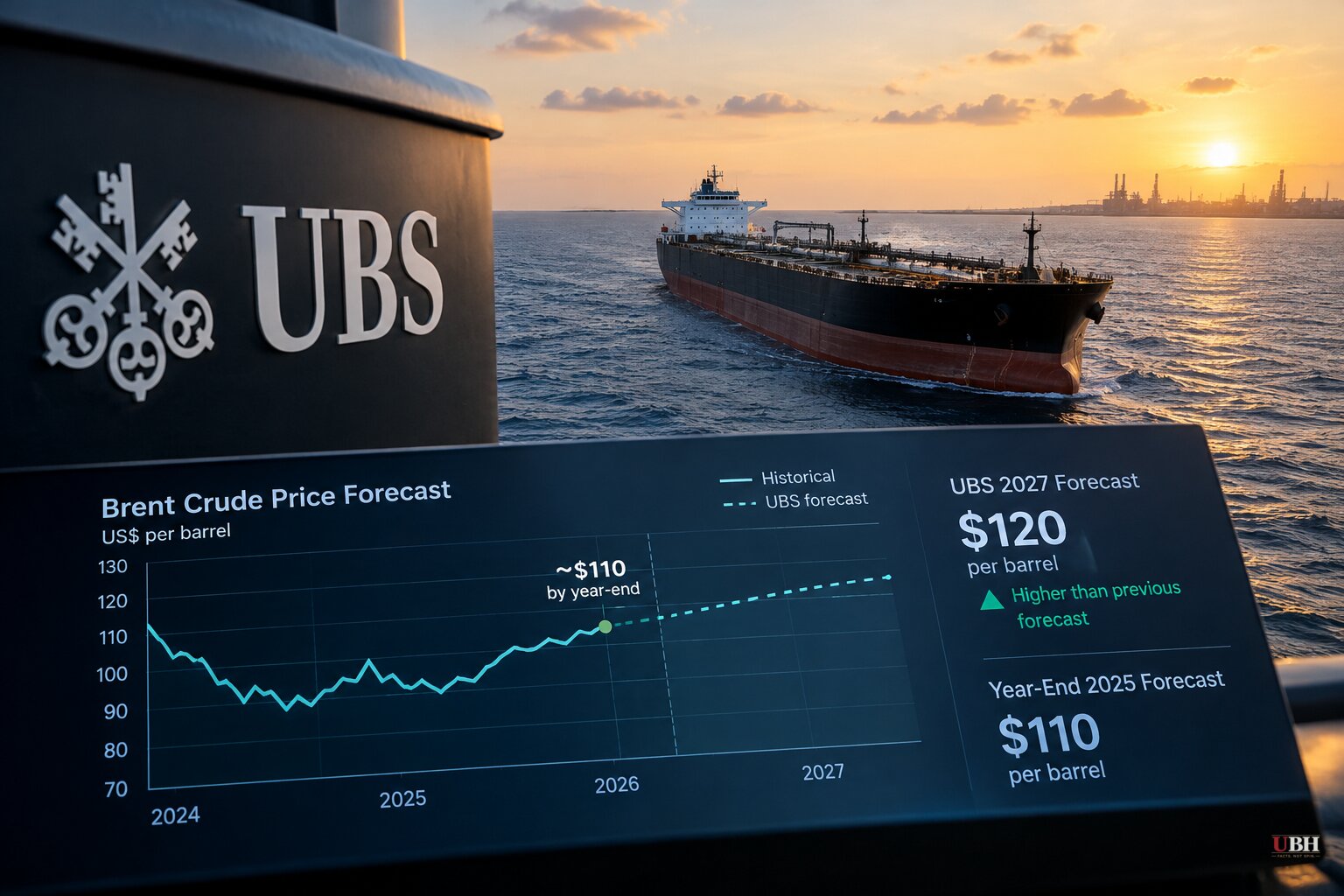
UBS put a year-end target of about $110 a barrel on Brent crude on Wednesday, Oct. 28, and lifted its 2027 forecasts across the board. Its March 2027 call rose to $95 from $90, June to $90 from $85, and September to $85 from $80.
The target sits below where oil trades now. Brent eased about 0.5% to roughly $115 on Tuesday, its second straight daily decline, while U.S. crude slipped about 0.4% to around $101. Brent is still up about 91% this year and U.S. crude about 78%.
Barrels are back, ships are not
UBS's argument is that the oil is flowing again but getting more expensive to move. Citing Petro-Logistics data, the bank said combined crude flows through the Strait of Hormuz and bypass pipelines ran above 17.3 million barrels per day in September and close to 18.8 million in the first three weeks of October. The January-February average before the war was 19.9 million.
Other trackers measure more broadly and show a fuller recovery. Kpler put total Middle East oil exports, including the Red Sea and Gulf of Oman routes, at 24.5 million bpd for the week ending Oct. 18. That compares with a 24.4 million bpd average on Feb. 22, a week before the U.S.-Israel conflict with Iran began. Kpler's total excludes Iranian exports, which have fallen to near zero under the U.S. blockade. Vortexa's estimate was lower, at about 18 million bpd.
The gap between oil moved and ships moving it is wide. Kpler counted about 20 ships completing the Hormuz transit over ten days, against more than 100 a day before the war. CENTCOM said Tuesday that about 400 merchant ships passed through the strait over the previous week. Many vessels run with transponders off to avoid Iranian targeting, which makes counts unreliable. Bloomberg News reported that large tankers are moving in convoys and transferring cargo ship-to-ship after exiting, which would let high volumes move with fewer transits.
The IRGC insists the strait is closed. CENTCOM insists it is open. CENTCOM also said 138 commercial vessels have been redirected by U.S. forces enforcing the blockade on Iran.
Why UBS says prices stay high
UBS counted at least 30 attacks on ships in and around the strait in October, the highest monthly total on record. That pushes freight rates up and tanker availability down. UBS said the oil balance now depends on whether there is enough affordable shipping capacity as well as on how many barrels are produced.
The bank also pointed to depleted global inventories. Pledged strategic reserve releases are largely complete, and Chinese buying has returned. In UBS's reading, the market has lost two of its main shock absorbers and is more exposed to any new disruption around Hormuz.
The recent record of attacks is specific. Five ships were damaged on Oct. 11, four of them in the strait and one off Oman. Three container ships were struck in the strait on Oct. 13, and one sank. Saudi Aramco was attacked the same day, and authorities have not said who was responsible. Saudi Arabia has faced deadly attacks from Iran-backed Houthi militants in recent weeks, and the kingdom cancelled its flagship Future Investment Initiative conference a week before it was due to open.
The IEA's warning
A recovery in volumes does not mean a return to normal, according to International Energy Agency chief Fatih Birol. Speaking Tuesday at the Financial Times Energy Transition Summit in London, he said: "I don't see any credible pathway that 2027 will be a year of normalisation." The strait has been closed once, he said, and "it can be closed again."
Birol called it "myopic" to judge the crisis by crude prices alone. "We don't use crude oil, we use products," he said, noting that diesel prices have doubled from prewar levels, largely because of the Iran war and partly because of attacks on Russian refineries. Diesel demand typically rises in the coming season, he added, and many large refineries have planned maintenance.
The pump numbers back him up. Regular gasoline averaged $4.30 a gallon nationally on Oct. 17, according to AAA, against $3.05 a year earlier. Diesel stood at $6.17 on Oct. 12, per Federal Reserve Bank of St. Louis data, up from $3.45 in January. Energy Secretary Chris Wright has announced an emergency fuel exchange that he said is meant to "help maintain refinery operations, limit disruptions to fuel supplies."
What could move the price
The market has priced in a risk premium, according to ING commodities strategists Warren Patterson and Ewa Manthey. They wrote on Oct. 16 that a full removal of that premium would require "some kind of agreement between the U.S. and Iran."
No such agreement exists. IAEA Director General Rafael Grossi told the U.N. General Assembly on Friday that the agency has completed much of the preparation to verify Iran's nuclear activities if Washington and Tehran strike a deal. He expressed optimism about mediation by Pakistan, Qatar, Oman and Egypt. No agreement authorizing inspections has been announced.
President Trump has raised the possibility of further strikes on Iran after the November midterm elections, though no new operation has been announced. Iran has issued public threats against Washington in what CNN described as an apparent bid to deter a resumption of fighting. Russian President Vladimir Putin is due to host Iranian President Masoud Pezeshkian in Moscow next week.
Brent settled at $116.72 on Friday, Oct. 23, and U.S. crude at $103.27. The next test is whether Brent falls toward UBS's $110 mark by December, or whether the attacks, a Fed decision that traders are awaiting, and a possible post-election strike on Iran push it the other way.
Sources used for this briefing
7 links from 7 independent newsrooms (syndicated copies of the same report count once)
These are the sources it draws on, linked so you can verify.


