
Unbiased headlines. Facts, not spin.
Unbiased Headlines is an independently owned news organization. We bring you the facts, not opinions, written fresh from 110+ named sources. Sources linked so you can verify it yourself.
 energy
Major Story (7/10)
Event date: October 24, 2026 ·
EU Paid €9.9 Billion More a Month for Oil in Q2 While Volumes Barely Moved
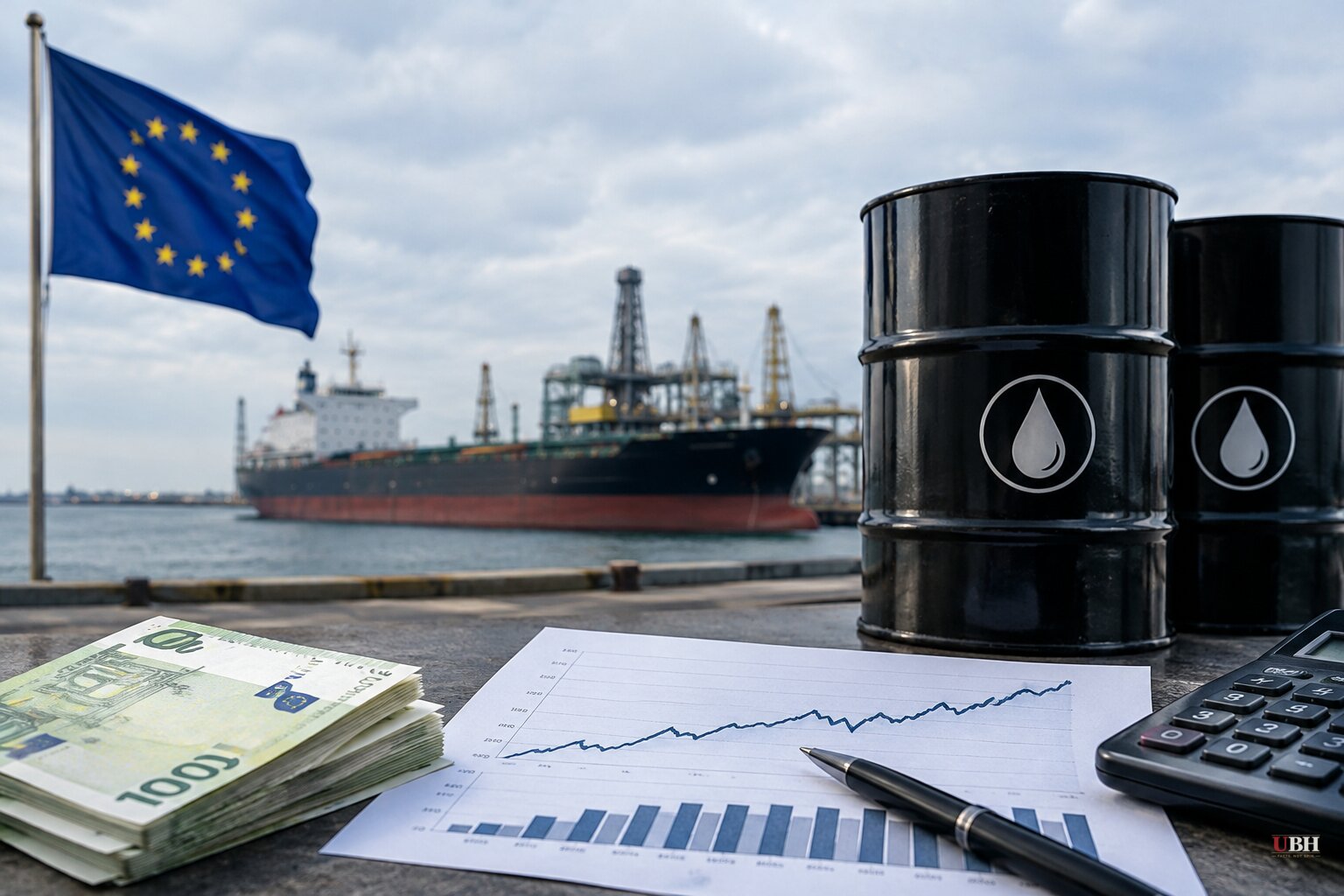
The EU is paying far more for the same amount of oil.
In the second quarter of 2026, the bloc spent an average of €27.6 billion a month on petroleum oil imports. That is up 55.8% from €17.7 billion a month in 2025. Volumes rose only 1.2%, from 36.3 million tonnes a month to 36.7 million. The extra cost works out to about €9.9 billion a month.
The price per tonne shows it. Europe paid €750 per tonne in the second quarter, up from €487 on average in 2025 and €435 at the end of last year. That is just €2 below the second-quarter 2022 peak.
Why the bill jumped
The driver is crude. Prof. Xiaoyi Mu of the University of Dundee said the second-quarter Brent average was 49.5% above the 2025 average, a rise of $34 a barrel. He noted that around 20 million barrels a day of oil and products, roughly 20% of global consumption, moved through the Strait of Hormuz in 2025. "When nearly 20% of world supply is cut, the price must rise to balance the market," he said.
Szymon Kardas, a senior policy fellow at the European Council on Foreign Relations, pointed to the war between the U.S., Israel and Iran. Tanker traffic through Hormuz, he said, sometimes returns to pre-war levels and then falls again.
Wolfgang Eichhammer of the Institute for European Energy and Climate Policy agreed that Middle East tensions had the biggest effect. He added that strong global demand played a role, with Europe bidding against Asian buyers, notably China.
Europe is exposed because it imports most of what it burns. Kardas put the EU's dependence on outside oil at 90 to 95%. Eurostat's figure for 2024 was 96.6%.
Oil accounts for almost all of the rise in the EU's energy import bill. In the second quarter, the EU spent €115.6 billion on energy imports, up from €81.4 billion a year earlier. Petroleum oils accounted for €32.4 billion of the €34.2 billion increase, or 95%.
Gas and storage
Oil is only part of it. European Commission President Ursula von der Leyen said on Oct. 16 that dependence on imported fossil fuels has added €106 billion ($119 billion) to the bloc's costs without delivering any additional energy. She said gas prices have risen by around 140% since late February and diesel prices have doubled.
Wholesale gas briefly touched €100 per megawatt-hour on Wednesday, Oct. 28, for the first time since December 2022. Prices are now trading at around triple pre-Iran-war levels. EU storage stands at 75% of available capacity, against 83% a year ago. OilPrice reports that Germany, which has Europe's largest storage capacity, is roughly half full and is expected to miss its official 80% storage target this year.
What Brussels is doing
EU energy ministers meet today, Oct. 29, to discuss energy security ahead of the heating season. Energy Commissioner Dan Jorgensen told reporters Wednesday: "We are in a very serious situation now. It does not look like we have a security of supply issue but I would warn against neglecting that." He said affordability is just as urgent, because available supply means little to households and businesses that cannot pay for it.
The menu in front of ministers is mostly short-term:
- Von der Leyen announced the release of 100 million barrels of oil and diesel over the next four months, managed by the International Energy Agency.
- The temporary state aid framework introduced in February is being extended in scope and duration.
- The methane regulation on energy imports is being postponed by one year.
- The Commission opened talks with European refineries on Wednesday on boosting output, including possibly easing some technical fuel specifications.
- Ministers will discuss a Commission proposal to cut electricity bills through tax and grid-fee reforms, such as taxing electricity at a lower rate than gas.
Separately, Western powers agreed this month to accelerate the release of more than 400 million barrels of emergency oil stocks after U.S. pressure.
Von der Leyen's longer-term answer is to replace imported fossil fuels with electricity produced in Europe, including nuclear power and renewables. European Council President Antonio Costa said the bloc is paying the price of its dependence on fossil fuels and the absence of a fully integrated single energy market.
The sanctions argument
Not everyone accepts that the Iran war is the whole story. Mike Fredenburg, writing in a commentary for The Epoch Times, argues that U.S. and European sanctions on Russian oil have been "an unmitigated disaster for Europe." In his telling, they made the continent more reliant on Middle Eastern supply and handed Iran and the Houthis leverage over the energy market.
Fredenburg points to the pre-2022 picture. Russia supplied nearly half of the EU's natural gas imports, and more than half of the diesel used in Northwest Europe came from Russia. Europe banned most Russian oil product shipments starting in early 2023, and buyers turned to the Middle East, India and the United States. U.S. crude oil exports to Europe now run about 1.5 million to 1.8 million barrels a day, he writes.
That is an opinion piece, and the Commission has not adopted the view. The cost figures above come from Euronews's analysis of trade data and from Commission statements. Fredenburg's dispute is with the policy choice behind them.
What comes next
Experts do not expect oil import costs to fall soon. Mu said costs would remain high "as we don't see a practical way of ending the conflict," and that higher shipping and insurance costs might not yet be fully reflected in the second-quarter bill but could push up costs in the third and fourth quarters. Kardas expected conflict-linked costs to "persist in the coming months and may well continue into 2027."
OilPrice reports that Houthi attacks in the Red Sea and against pipelines continue, and projects restrictions on global oil trade well into 2027. Total extra energy costs since 2022 have passed €900 billion, according to that outlet, even as total demand has fallen.
The 100-million-barrel release covers the next four months. Costa has scheduled an informal leaders' meeting in Alden Biesen, Belgium, for February 2027.
Ministers are not expected to resolve the structural question today: how a bloc that imports nearly all its oil keeps paying €750 a tonne.
Sources used for this briefing
7 links from 6 independent newsrooms (syndicated copies of the same report count once)
These are the sources it draws on, linked so you can verify.


