
Unbiased headlines. Facts, not spin.
Every story is an unbiased news briefing written from 110+ sources across the spectrum — sources linked so you can verify it yourself.
 defense
Breaking / Critical (9/10)
July 6, 2026 at 11:17 AM
defense
Breaking / Critical (9/10)
July 6, 2026 at 11:17 AM
Khamenei's Funeral Ends Without Mojtaba Appearing. Inside Iran, a Power Struggle Is Already Underway.
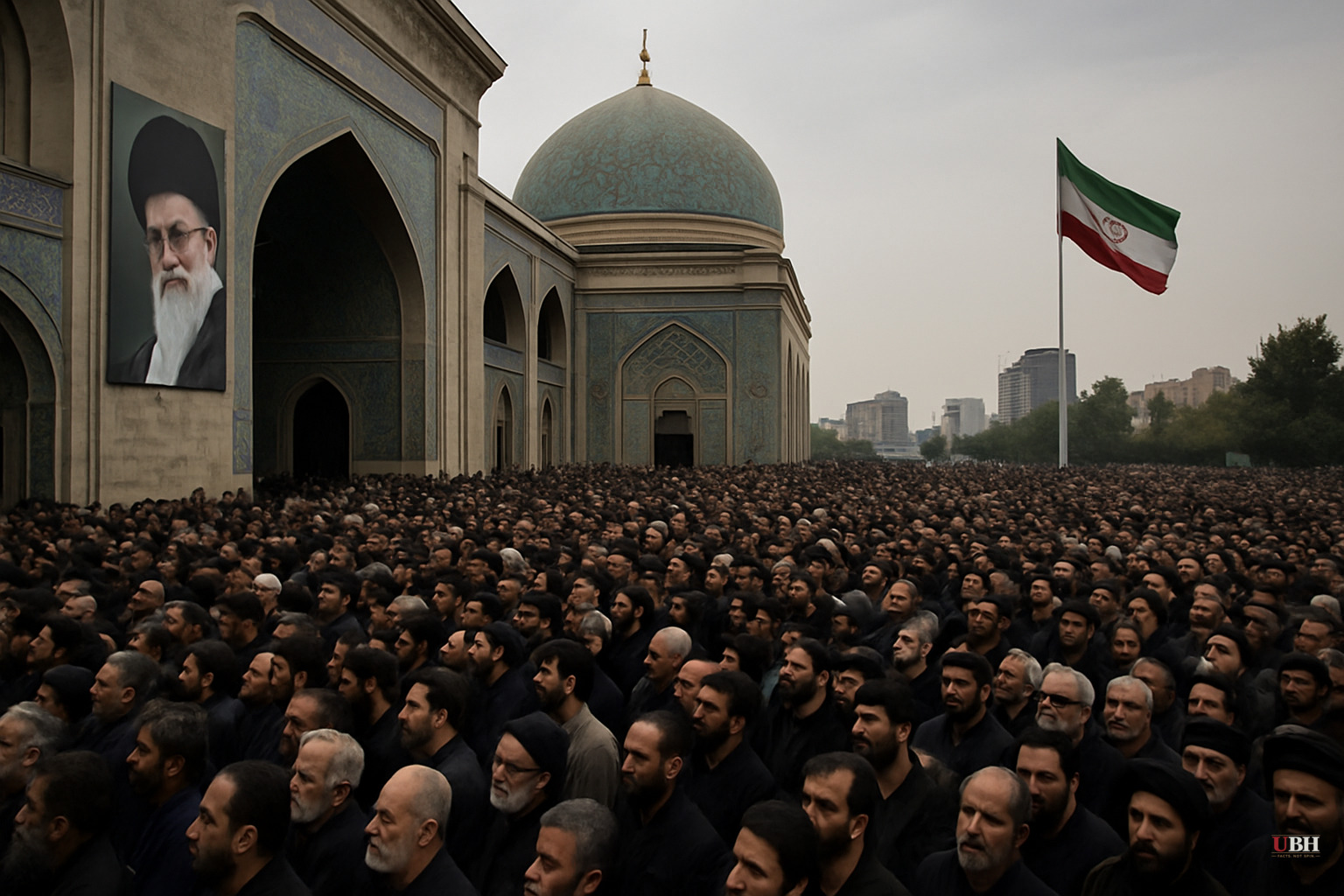
Since the February 28 U.S. and Israeli airstrikes that killed Ali Khamenei and triggered the Iran war, the succession question has defined Tehran's internal politics. The week-long funeral, now concluding, was designed to answer that question publicly. It has not.
The Ceremony Iran Needed
Tehran's Grand Mosalla hosted hundreds of thousands of mourners through the weekend. Iranian media cited projections of up to 20 million total attendees across the funeral proceedings, according to PBS/AP reporting. Qom Friday prayer leader Ayatollah Mohammad Saidi told Iranian state media on July 3 that the ceremony was intended to serve as "another referendum for the Islamic Republic."
Negar Mortazavi, senior fellow at the Center for International Policy, told TIME the message was specific: "While the leader is gone, the Islamic Republic's institutions remain intact and the state endures."
The show of official presence was real. Interior Minister Gen. Ahmad Vahidi appeared publicly for the first time since the war began, photographed by Associated Press journalists at the Grand Mosalla and flanked by plainclothes security. President Masoud Pezeshkian, Parliament Speaker Mohammad Bagher Qalibaf, and Quds Force commander Esmail Qaani all attended. Three of Ali Khamenei's sons — Mostafa, Meysam, and Masoud — were seen in footage from Iranian state media, crying as coffins were carried out.
The One Absence That Matters
Mojtaba Khamenei was not among them.
The new Supreme Leader has not been seen or heard in public since his ascension roughly ten days after his father's death. According to PBS/AP, he is believed to be in hiding, reportedly wounded in the same strike that killed his father. Defense Secretary Pete Hegseth stated in March that Mojtaba had been "wounded and likely disfigured." Reuters reported in April that he was recovering from severe facial and leg injuries, with the possibility he lost a leg.
Mortazavi told TIME that avoiding a public appearance serves a dual purpose: security from potential Israeli targeting, and avoiding projecting an image of physical vulnerability at a moment the state is trying to communicate strength. Israel has previously used public appearances by Iranian leadership to fix their positions for targeting, according to PBS/AP.
Approximately twenty messages attributed to Mojtaba have circulated since his succession. Iran International reports that these have failed to convince a growing number of Iranians that he is genuinely exercising power, with efforts to prove his presence often producing contradictory signals that deepened rather than resolved the uncertainty.
The Fracture Behind the Ceremony
Iran International reports that Ali Khamenei has effectively been replaced not by his son but by a "constellation of elite networks" built around family ties, wartime relationships from the Iran-Iraq War, and regional power bases in Tehran, Isfahan, Khuzestan, and Khorasan. These networks existed for decades but were kept in check by Ali Khamenei's personal authority. His death removed that constraint.
The traditional reformist-conservative divide in Iranian politics has largely dissolved. The new fault line, as Parliament Speaker Qalibaf described it, runs between "revolutionaries" and "super-revolutionaries." Even Hossein Shariatmadari, editor of the hardline daily Kayhan and a longtime symbol of uncompromising conservatism, is now warning against threats to national cohesion and criticizing hardliners who oppose the U.S. agreement, according to Iran International.
The fight is no longer over whether to negotiate with Washington. It's over who gets credit for the decision. Factions that were calling Qalibaf and Foreign Minister Abbas Araghchi traitors for pursuing talks as recently as late June are now arguing Iran must secure its financial interests through an understanding with the U.S., even if that means delaying decisions on parts of the nuclear program.
The most uncompromising IRGC factions argue Iran's missile program is its last real strategic asset and must be preserved at all costs. MP Esmail Kowsary and Supreme National Security Council secretary Mohammad Bagher Zolghadr continue to push a harder line, according to Iran International.
What the Crowds Were Also Saying
The funeral was not only grief. Crowds chanted "Death to America" and "Death to Israel," and some hard-liners explicitly called for the assassination of President Trump, according to PBS/AP. A poet who emceed Sunday's event told the crowd over loudspeakers: "Why is the biggest bastard in the world still alive?" referring to Trump, as the crowd cheered.
Those sentiments are real and should not be papered over. A 29-year-old grocery worker named Gholamreza Sabooni told PBS/AP: "They killed our imam, we should kill their leader, Trump." These are the voices inside a country where Qalibaf is simultaneously leading negotiations with the U.S. to reopen the Strait of Hormuz and roll back the nuclear program.
The strongest case for taking the funeral's unity message seriously is that the senior leadership did show up. Vahidi's appearance after months of invisibility was significant, and the crowd size was genuine. Iran has held its institutional structure together through a war that killed more than 50 senior officials.
Institutional survival and effective leadership are different things. Mojtaba Khamenei's continued absence leaves Qalibaf, who controls the nuclear negotiations, as the most visible power center in Iran right now, without any clear mandate from the new Supreme Leader to settle terms with Washington.
Whether Mojtaba eventually appears publicly, and in what condition, may determine whether the factional competition Iran International describes stabilizes around his authority or accelerates into something more openly contested.
Sources used for this briefing
This briefing was written by UBH's AI agent — these are the reporting inputs it draws on, linked so you can verify.


