
Unbiased headlines. Facts, not spin.
Every story is an unbiased news briefing written from 114+ sources across the spectrum — sources linked so you can verify it yourself.
 energy
Major Story (8/10)
October 10, 2026 at 01:26 AM
energy
Major Story (8/10)
October 10, 2026 at 01:26 AM
Isaias Threatens 466,000 Barrels a Day of Mississippi and Alabama Refining With Diesel Supplies at a Seasonal Low
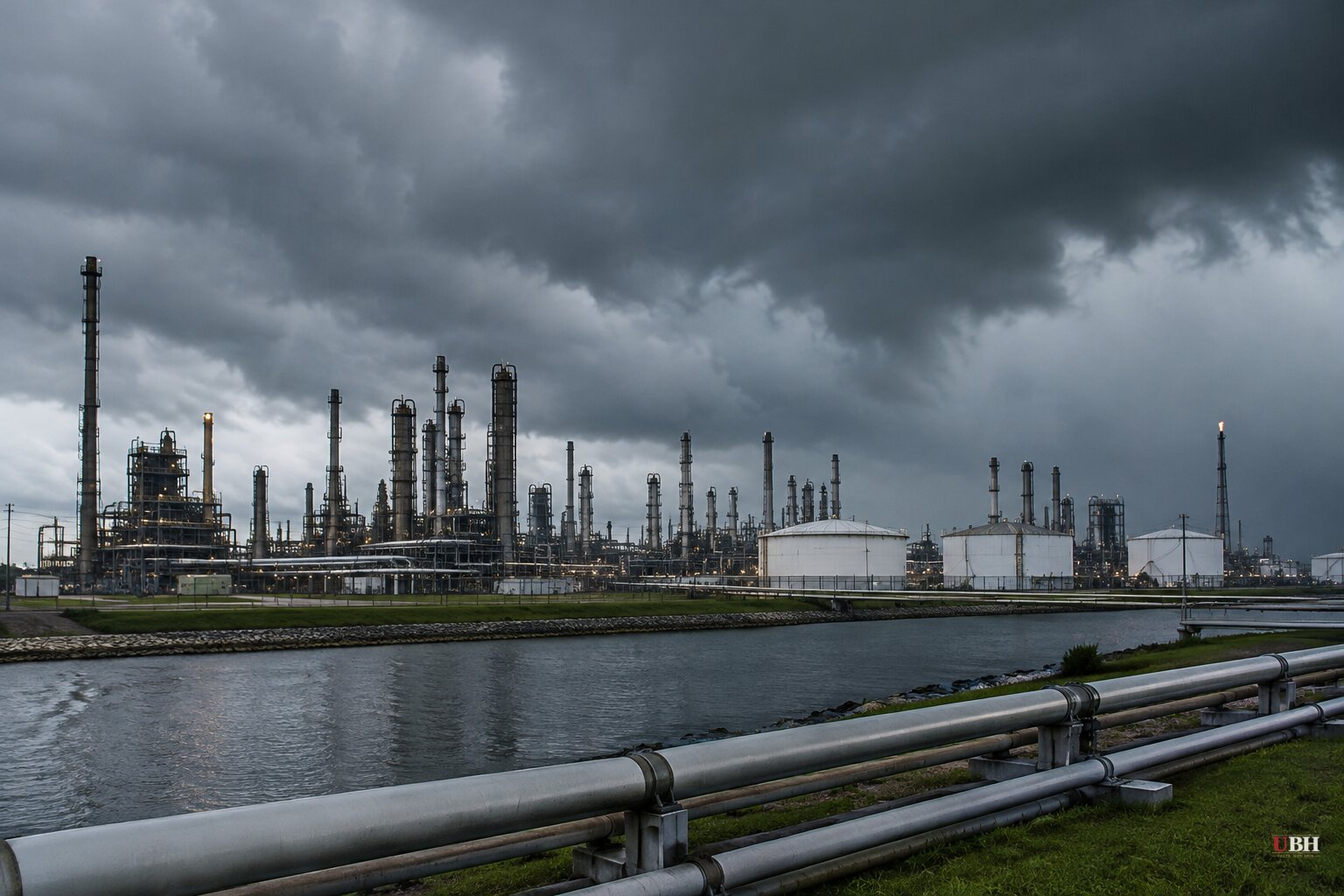
Since Isaias emerged near the Yucatán Peninsula as a tropical storm on Oct. 7, the story has moved from offshore evacuations to the refineries onshore. As of today, Oct. 9, the National Hurricane Center has the storm at Category 3 with 120 mph winds. Landfall is expected Friday night or early Saturday, Oct. 10, somewhere between Florida's Emerald Coast and the mouth of the Mississippi River.
Forecasts have the storm veering away from the dense refining corridor around New Orleans and Baton Rouge. That leaves two facilities squarely exposed: Chevron's refinery in Pascagoula, Mississippi, and a Vertex Energy refinery in Alabama. Both areas are under hurricane warnings.
Together they can process 466,000 barrels a day, or 2.4% of U.S. refining capacity, according to Andy Lipow, president of Lipow Oil Associates. Hunt Refining Company's refinery in Tuscaloosa, Alabama, is also in the potential damage zone, according to Bloomberg as cited by The Daily Wire. Together, those facilities process roughly half a million barrels a day.
Chevron spokesperson Ross Allen said Thursday that Pascagoula remains operational. Vertex officials were not immediately available for comment on their plant.
Power and flooding are the risk
Lipow said the biggest threats to the two refineries are loss of electricity and flood damage. If either shuts down without sustaining damage, he said, restarting takes one to two weeks.
The cushion is thin. Gulf Coast refineries are running at 95% of capacity, Lipow said, so there is no slack to replace lost output. Diesel supplies are at their lowest level for this time of year since the Energy Information Administration began reporting in 1982, he said.
The U.S. Strategic Petroleum Reserve is also depleted. It holds about 280 million barrels against a typical 500 million to 600 million. The G-7 announced last week that it will release 100 million barrels from emergency reserves over four months, and one analyst estimated that could trim diesel by about 25 cents a gallon.
Offshore shut-ins
As of midday Thursday, about 1.3 million barrels a day of Gulf oil production was shut in, roughly 63% of the region's production, according to federal offshore regulators. About 57% of Gulf natural gas production was also sidelined. As of Friday, personnel from 129 production platforms, about a third of the facilities in the Gulf, had been evacuated, and more than two-thirds of Gulf oil production was shut down as a precaution, equal to almost 1.5 million barrels a day, the agency said.
Shell, Chevron and BP have pulled personnel.
A shut-in is temporary. Once the storm passes, workers can return to platforms and resume operations, barring significant damage.
How much prices move
The AAA national average for gasoline stood at $4.37 a gallon on Friday, with diesel at $6.28. Diesel hit a record $6.40 last month before climbing to $6.53, according to earlier reporting by The Daily Wire.
Analysts disagree on how much the storm adds. Carl Larry of Enverus said that if the storm moves through quickly and its impacts are minimal, gasoline and diesel could rise just a few cents. If a refinery like Chevron's shuts down completely, he said, it could take weeks to recover and "the prices will spike immediately. It's possible a dollar," with diesel prices already above $6 "could start approaching $7."
Patrick De Haan, head of petroleum analysis at GasBuddy, put it lower. He said the capacity at risk is potentially under a million barrels a day, probably around 500,000. "That may have a small impact on gas prices, primarily in the Gulf Coast, but I don't think it rises to a criteria that would impact gas prices nationally," he said.
Kevin Book of ClearView Energy Partners noted that in past Gulf refinery outages, fuel prices rose while crude prices fell. The refineries stop buying crude and stop producing fuel at the same time.
Robert Yawger, director of energy futures at Mizuho Securities, said the storm "could be a gigantic event" and "the worst time something like this could happen in 25 years."
Tankers and Florida
Lipow warned that tanker traffic will be disrupted in both directions, with crude deliveries to refineries delayed and loadings of gasoline, jet fuel and diesel held up. Florida, which relies on Gulf Coast fuel shipments, is particularly exposed to delays.
The backdrop is a market already strained by the Iran war and by Ukrainian strikes on Russian refineries, which led Moscow to ban diesel exports. The storm's price effect so far is small next to those factors.
On the ground
Florida has declared emergencies in 25 counties and Alabama in 40. Surge of five to seven feet is forecast along the shoreline from Florida's Indian River to Ocean Springs, Mississippi, including the entire Mobile Bay area. Several coastal counties are under mandatory or voluntary evacuation orders.
"Execute your plan now," Florida Gov. Ron DeSantis said. "You still have time to do it, but the time is running out."
It is unclear whether Pascagoula and the Alabama plants keep power and stay dry through the weekend. If they do, the effect on pump prices may be modest. If either goes down, Lipow's one-to-two-week restart window would land on a diesel market with almost no inventory to absorb it.
Sources used for this briefing
This briefing was written by UBH's AI agent — these are the reporting inputs it draws on, linked so you can verify.


