
Unbiased headlines. Facts, not spin.
Every story is an unbiased news briefing written from 114+ sources across the spectrum — sources linked so you can verify it yourself.
 energy
Major Story (8/10)
October 9, 2026 at 08:42 PM
energy
Major Story (8/10)
October 9, 2026 at 08:42 PM
Isaias Strengthens to Category 3 as Gulf Oil Shut-Ins Reach 63% and Gas Holds Near $4.36
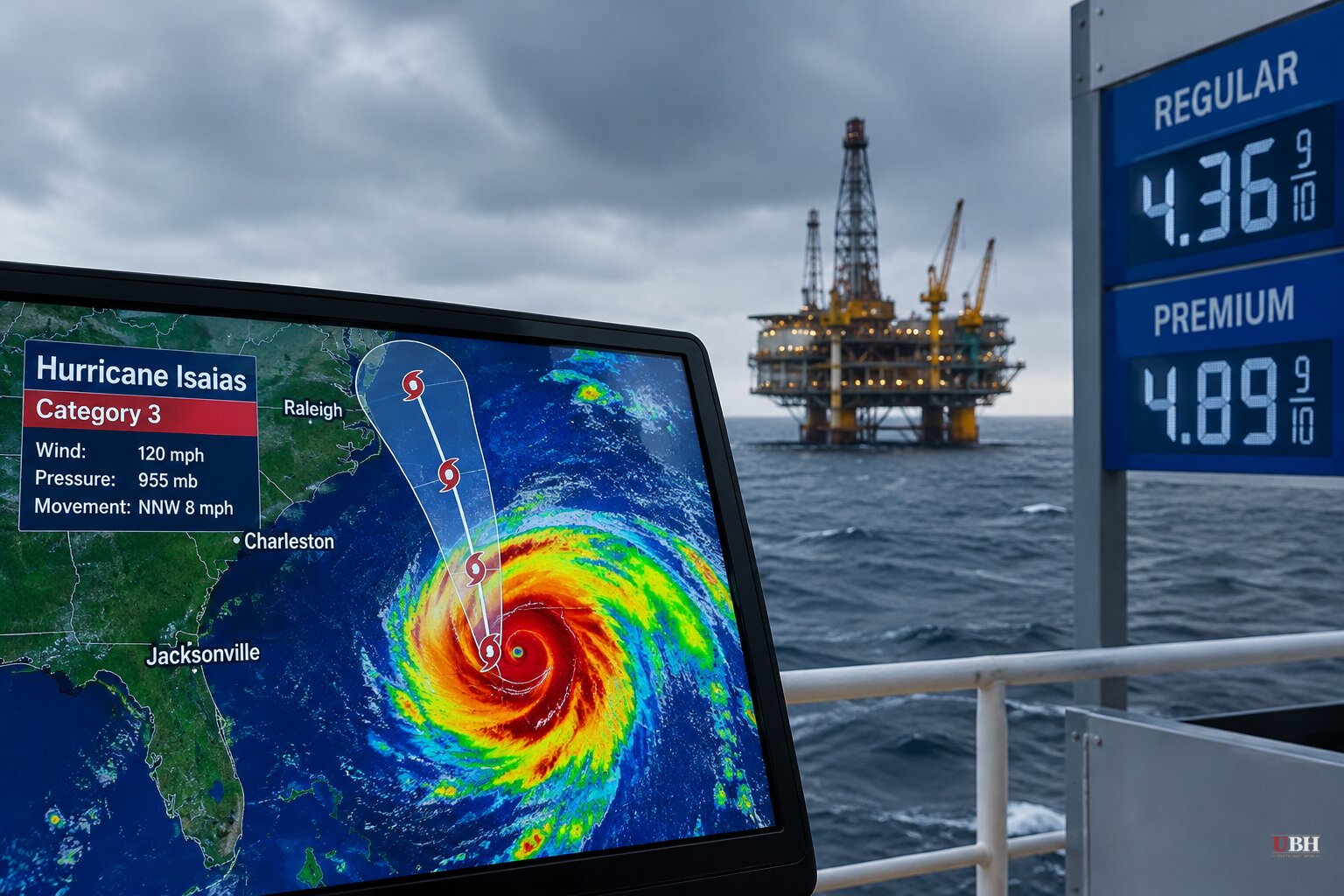
Since Isaias became the first hurricane of the Atlantic season on Wednesday night, it has moved from a 110 mph storm to a major one. The National Hurricane Center said Friday, Oct. 9, that Isaias is a Category 3 with maximum sustained winds of 120 mph, about 240 miles south of Pensacola, Florida. Landfall is expected in Florida, Alabama or Mississippi within 24 hours.
The fuel market it is heading into is already stretched.
A storm meets an already tight fuel market
As of Thursday, Oct. 8, about 63% of Gulf of Mexico oil production was shut in, roughly 1.3 million barrels a day, according to the Marine Minerals Administration. About 57% of gas production was also suspended. On Wednesday the figures were 25% and 16%, so the shut-ins more than doubled in a day.
Operators evacuated 121 production platforms, or 32.61% of the 371 manned installations in U.S. Gulf waters. BP said it completed evacuations and suspended production at its Na Kika and Thunder Horse platforms. Shell and Chevron announced reductions Wednesday.
A forecast model from consultancy Earth Science Associates projects about 9 million barrels of lost output over the storm's duration. That compares with 7.1 million barrels lost to Tropical Storm Bertha in July. The model names BP, Chevron, Eni, Murphy Oil and Shell as the most exposed producers.
Refineries in the potential path
Forecasters expect landfall east of New Orleans, which could spare the biggest refining complexes a direct hit. Wind damage and flooding are still risks. Bloomberg reported that Chevron's Pascagoula, Mississippi, refinery, Vertex Energy's Mobile, Alabama, refinery and Hunt Refining's Tuscaloosa, Alabama, refinery sit in the likely impact zone. Together they process roughly 500,000 barrels a day.
Robert Yawger, director of energy futures at Mizuho Securities, told CNN the storm "could be a gigantic event." He added: "It's the worst time something like this could happen in 25 years."
The National Hurricane Center warned of "a life-threatening storm surge" from the mouth of the Mississippi River to Suwannee, Florida. Mandatory evacuations are in place in multiple Florida counties, and states of emergency cover parts of Alabama, Florida and Georgia. Florida Gov. Ron DeSantis said, "We know that this is going to be a major event in one way or another." Homeland Security Secretary Markwayne Mullin said federal authorities are coordinating with state and local governments.
President Donald Trump is scheduled to attend Saturday's Georgia-Alabama football game in Tuscaloosa. He said this week he will "let the hurricane determine" his travel plans.
The Dallas Fed's refining warning
Pump prices were high before the storm formed. AAA put the national average at about $4.36 a gallon on Oct. 8, down roughly 5 cents on the week but up from about $3.12 a year ago. This is the first October the national average has topped $4. Diesel averaged $6.28 a gallon, below the record above $6.40 set last month.
A report published Oct. 8 by Dallas Fed analysts Jesse Thompson and Garrett Golding says the problem goes beyond crude. Refinery damage, shipping constraints and export restrictions have sidelined as much as 10% of global refining capacity. That has pushed the gap between crude and wholesale gasoline, diesel and jet fuel "well beyond normal." Those gaps, called crack spreads, now exceed levels reached after Russia's 2022 invasion of Ukraine.
The analysts rejected the idea that gouging explains the spread. The pricing reflects "acute, multifaceted supply constraints in the global market for refined fuels rather than retailer or distributor markup," they wrote. "The global economy is wrestling with a refining shock in addition to an oil price shock."
The capacity problem predates the Iran war. China and the Middle East added 4.4 million barrels a day of refining capacity between 2019 and 2025, while Europe and North America lost 2.1 million as older plants closed. Preliminary International Energy Agency data cited by the Dallas Fed show Iranian strikes and disrupted tanker traffic cut Gulf refinery processing by 2 million barrels a day from February levels. Ukrainian drone strikes on Russian refineries have continued, and Moscow has restricted fuel exports. China also curtailed processing and exports for a time.
The Dallas Fed analysts warned that pump pressure could persist even after shipping through the Strait of Hormuz returns to normal. Emergency crude releases help but cannot fully replace damaged refineries or fix shipping bottlenecks, they said.
Little cushion left
U.S. refineries are already running at maximum capacity, according to The Daily Wire. The Strategic Petroleum Reserve holds about 280 million barrels, against a typical 500 million to 600 million. G-7 countries announced last week that they will release 100 million barrels from emergency reserves over four months.
Florida has no crude refineries or interstate petroleum product pipelines and depends on fuel arriving by ship. Port Tampa Bay handles nearly 15 million tons of petroleum products a year. Tampa is hundreds of miles from the storm's expected track, but a prolonged disruption to Gulf shipping would reach the state's fuel supply.
No one has said how long Gulf production will stay offline. That depends on where Isaias comes ashore late Friday or early Saturday, and on whether the Pascagoula, Mobile and Tuscaloosa refineries take damage.
Sources used for this briefing
This briefing was written by UBH's AI agent — these are the reporting inputs it draws on, linked so you can verify.


