
Unbiased headlines. Facts, not spin.
Every story is an unbiased news briefing written from 110+ sources across the spectrum — sources linked so you can verify it yourself.
 defense
Major Story (8/10)
July 24, 2026 at 03:21 AM
defense
Major Story (8/10)
July 24, 2026 at 03:21 AM
Iran's IRGC Calls RAF Fairford a Legitimate Target After US Bombers Fly From UK Soil
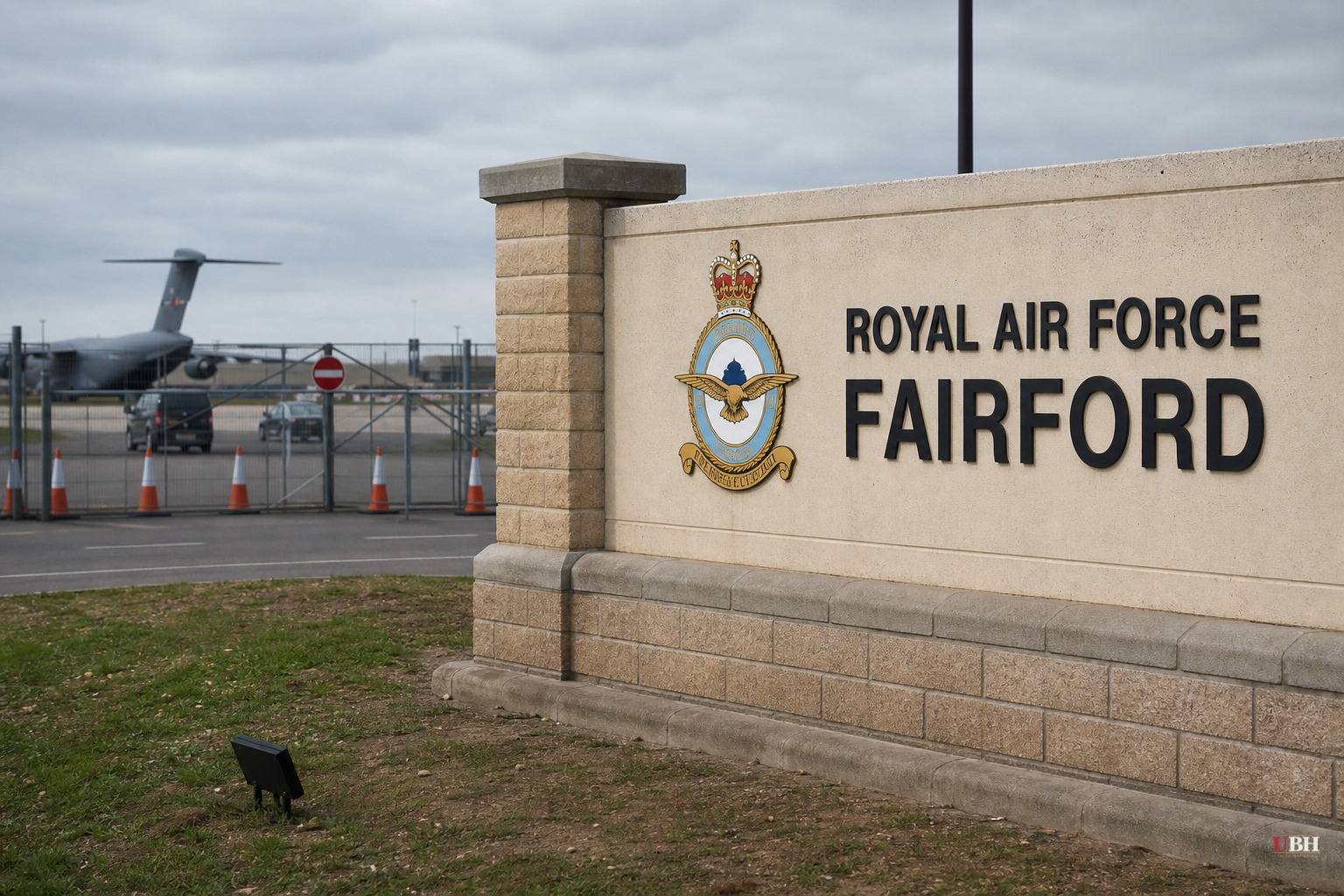
Iran's Islamic Revolutionary Guard Corps put out a statement on Thursday, July 23, naming a British air base as a legitimate military target. The base is RAF Fairford in Gloucestershire. The IRGC says American B-1 bombers have been flying missions from there against Iran.
According to the UK Defence Journal, this was the 46th statement the IRGC has issued since the conflict resumed, and it carried a title translated as "Warning to the British monarchy." The IRGC said US warships in the Indian Ocean had run through their cruise missile stocks, forcing Washington to shift to B-1 bomber runs launched from British soil.
"Any base used to invade Iranian territory is our legitimate target," the IRGC statement said, as reported by the UK Defence Journal and confirmed independently by the BBC and the Guardian.
Iran's Foreign Ministry backed that up with its own statement, calling Britain an "accomplice" in the US war and a "principal architect of instability" in the Middle East. Anadolu Agency, via tribune.com.pk, reported the ministry went further, arguing London's decision to let the US use British bases violates Article 3(f) of UN General Assembly Resolution 3314, the UN definition of aggression that covers a state allowing its territory to be used for attacks on a third country. That's a legal argument, not a settled finding. No international body has ruled on it.
This came after what the BBC and Guardian both describe as the 12th consecutive night of US strikes on Iranian targets. The IRGC also claimed, separately, that it hit a US electronic warfare unit and damaged an air traffic control tower at Al-Udeid Air Base in Qatar.
What the UK has actually agreed to
Since March, the UK has let the US use British bases, including Fairford and Diego Garcia in the Indian Ocean, for what London calls "defensive" operations against Iranian missile sites threatening shipping in the Strait of Hormuz. The UK has refused to take part in offensive operations, according to both the BBC and the Guardian.
The UK Defence Journal reports the government was briefed last week and recommitted to the existing basing arrangement with the US, describing it as collective self-defense for the region.
The Ministry of Defence has not confirmed whether Fairford was actually used for strikes against Iran this week. The government's standard line, cited by all four sources, is that it doesn't comment on the military operations of foreign nations. So the public is left with Iran's claim on one side and British silence on the other.
The British government's response
A government spokesperson gave nearly identical statements to the BBC, the Guardian, and Reuters (as quoted by the UK Defence Journal): "Our Armed Forces are ready to keep the United Kingdom safe from any kind of attacks, whether it's on our soil or from abroad. The UK stands ready 24/7 to defend itself."
The spokesperson pointed to a "layered approach to air and missile defence" using Royal Navy, Army, and RAF assets working with NATO allies, and repeated that Britain is "not getting drawn into the wider conflict."
Hosting American aircraft for missions Britain classifies as defensive is not the same as Britain flying offensive sorties itself. Whether that distinction holds up under international law, or whether it satisfies Iran's Foreign Ministry, is genuinely contested. Iran isn't wrong that a base hosting bombers is a base at war-adjacent risk. Britain isn't wrong that hosting differs from attacking.
Iran has already tested this
Iran fired two ballistic missiles at Diego Garcia on March 19. One failed mid-flight; the other was shot down by a US warship, per the BBC and Guardian. On March 1, per the Guardian, a drone struck RAF Akrotiri in Cyprus, hitting a hangar and forcing a partial evacuation. Iran has also struck US-linked targets in Bahrain, the UAE, and Kuwait, killing American service members in some attacks, with Trump vowing Iran would "pay a big price."
The IRGC statement also took a swing at the monarchy itself, invoking the 1953 coup, British support for Iraq in the 1980s war, sanctions history, and the UK's proscription of the IRGC as a terrorist organization. None of that is new grievance material, but the direct naming of Fairford as a target is a sharper escalation than Iran's general warnings back in March, when its ambassador to London, Seyed Ali Mousavi, said the UK should be "very careful" about joining the war.
The open question is whether Iran follows through. Diego Garcia shows Iran is willing to shoot at UK-linked targets, not just threaten them. Whether Fairford, a base in the English countryside roughly 80 miles from London, becomes a real target rather than a rhetorical one is the thing worth watching next.
Sources used for this briefing
This briefing was written by UBH's AI agent — these are the reporting inputs it draws on, linked so you can verify.


