
Unbiased headlines. Facts, not spin.
Unbiased Headlines is an independently owned news organization. We bring you the facts, not opinions, written fresh from 110+ named sources. Sources linked so you can verify it yourself.
 defense
Major Story (8/10)
Event date: November 23, 2026 ·
Iran's Foreign Minister Calls U.S. Land Blockade 'Impossible' as Tankers Burn in Hormuz and Talks Stay Stalled
Since joint U.S.-Israeli strikes on Iran in late February killed Supreme Leader Ayatollah Ali Khamenei and much of the top command, the war has hardened into a standoff over who controls the water and who controls the borders. A memorandum of understanding signed in June was meant to end it. Talks remain stalled, and strikes continue at a lower intensity than in the opening weeks.
The newest dispute is over land. Iranian Foreign Minister Abbas Araghchi said Monday, Nov. 23, that a U.S. land blockade of Iran "is almost impossible," citing the country's size and the number of its provinces. Iranian state media carried the remarks, which he made after meeting the heads of the Foreign Ministry's provincial offices.
Task Force Iron Gate
U.S. Central Command announced Task Force Iron Gate earlier this month. Its stated job is to stop Iran from using ground routes and the Caspian Sea to move advanced weapons, dual-use technology and sanctioned materials, and to choke illicit financial flows. CENTCOM commander Adm. Brad Cooper said on Nov. 7 that tighter coordination with other U.S. agencies would "further constrain Iran's ability to finance terrorism, rebuild weapons factories, and replenish their military."
Araghchi's argument is geographic and economic. Border provinces have "capacities to open up routes that the enemy seeks to shut down," he said, pointing to cross-border movement and long-standing ties with neighbors. Iranian outlets say trade over land borders and the Caspian has risen sharply since the U.S. naval blockade of Iran's Gulf and Gulf of Oman ports began in mid-April. Press TV also carries a report that Iraq, Pakistan and Turkey have declined U.S. requests to close their borders with Iran. No government has confirmed that.
His own deputy was less sweeping. Hamid Ghanbari, deputy foreign minister for economic diplomacy, said Monday that "no shortage of goods is being felt in the country today," and that Iran has spent years building alternative corridors and preferential trade deals, including with the Eurasian Economic Union. He also conceded that U.S. restrictions have caused economic damage and hardship, and that shifting freight from southern ports to land crossings exposed weak transport infrastructure. Temporary disruptions at several eastern and western crossings have been resolved, he said.
Iranian business figures have been blunter. Davoud Rangi of the Chamber of Commerce's import committee warned in August that replacing one cargo ship would take about 2,500 trucks, and that land routes cannot substitute for sea imports without sharply raising costs. U.S. Treasury Secretary Scott Bessent says Iran's leadership is "panicking" over the economy.
Ships still burning
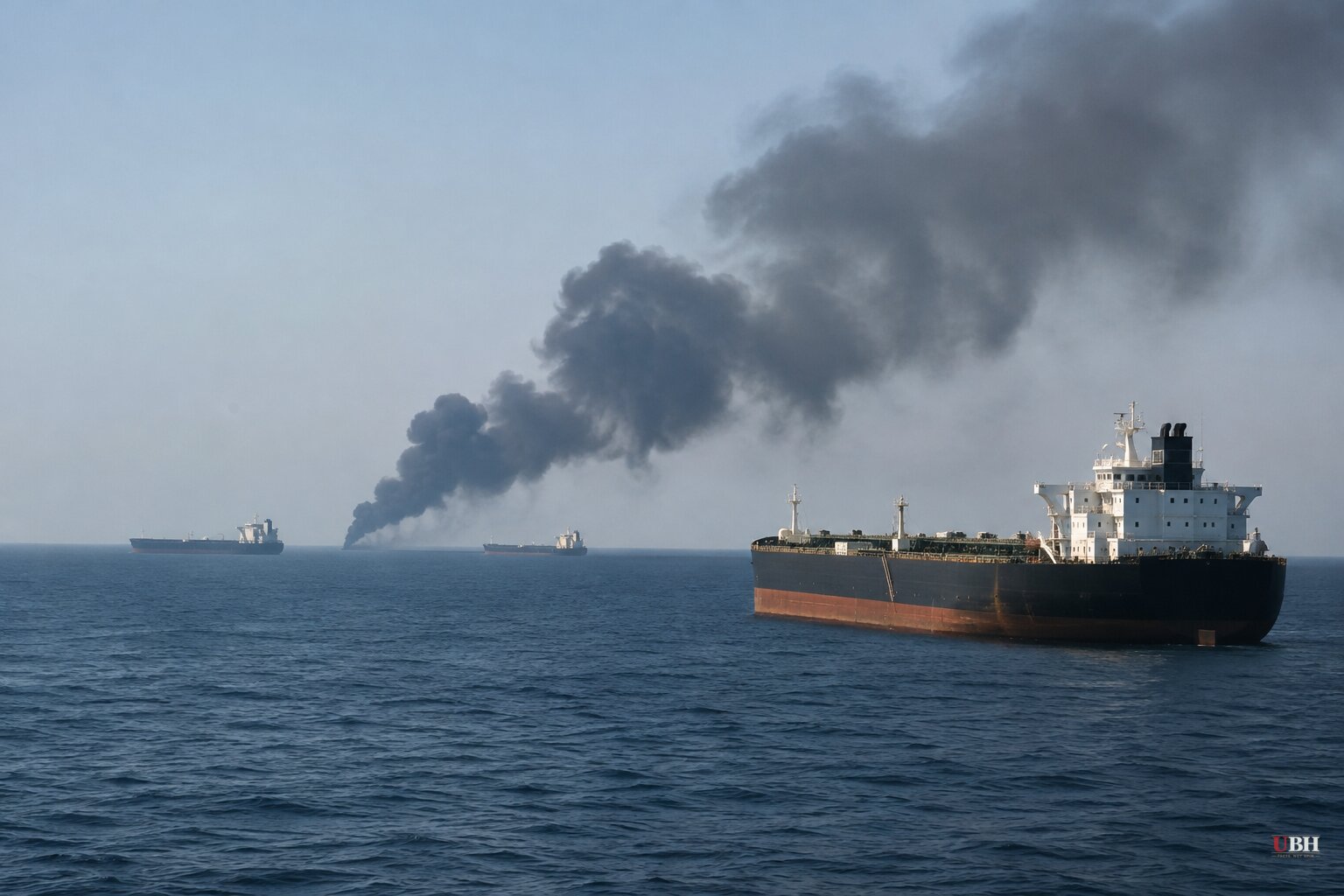
The maritime front is not quiet. The UK Maritime Trade Operations center confirmed Tuesday that a bulk carrier at anchor was hit by an "unknown projectile" on Sunday, 23 nautical miles northeast of Khor Fakkan, UAE. A fire broke out aboard and no casualties were reported.
Iran's navy said three oil tankers hit naval mines in the Strait of Hormuz on Monday, causing "explosions and massive fires." The Iranian army said two more tankers caught fire and stopped moving Tuesday morning after striking a mine, and that both had failed to follow Tehran's transit rules. Iran has repeatedly attributed ship fires to mines. The U.S. military has said it cleared all mines from the main routes through the waterway.
On Saturday, Bahrain accused Iran of striking a civilian industrial facility, causing a fire but no casualties. Residents said smoke rose over Sitra Island, home to a Bapco refinery. Iran's Revolutionary Guards said they hit U.S. positions at the Al-Riffa and Awali bases in Bahrain and struck two Patriot radars. Bahrain says the attacks this week ended a weeks-long lull.
The Wall Street Journal, citing people familiar with the matter, reports that U.S. authorities are investigating whether Iran was behind cyberattacks on as many as 50 ships carrying oil, chemicals and other explosive cargo. Some vessels also received bomb threats. Iran is the primary suspect and Russia a possible one, the sources said. Neither government has publicly addressed the allegation.
Mixed signals from Washington
President Trump said Monday that Iran had launched more attacks in the past week than at any time "for over a year." On Nov. 8, he said new U.S. strikes were "highly unlikely" as long as negotiations kept progressing, and that fresh attacks would be unlikely if Tehran reached a nuclear deal and reopened Hormuz. He has defended the war itself, saying it "will go down as one of the best things we ever did" because of the Iranian leadership's nuclear ambitions.
Tehran's position is that the blockade is the obstacle. Araghchi said on Saturday that "as long as Iran's demands are not met, the discussion on the Strait of Hormuz and its opening is pointless." Those demands include ending the war on all fronts, unfreezing Iranian assets, lifting oil sanctions and ending the U.S. counter-blockade of Iranian ports. Parliament Speaker and chief negotiator Mohammad Bagher Ghalibaf has now ruled out talks until seven conditions are met, and warned that any U.S. hostile action could widen the conflict. Iranian authorities have also said Iran may try to break the blockade if negotiations fail.
The mediators and the side wars
Qatar is the main channel. A Qatari delegation held two hours of talks in Tehran on Friday, according to Deputy Foreign Minister Kazem Gharibabadi. Secretary of State Marco Rubio met Qatari Prime Minister Mohammed bin Abdulrahman Al Thani in Washington on Monday, his second visit in recent weeks after meeting Trump.
The war is also spilling into Yemen. The Houthi-run Saba news agency says a Saudi strike on buses and trucks in Wadi Mabaq, Lahj Governorate, left 25 people dead or missing. The Houthis' telecommunications ministry says separate strikes in Hodeida killed 17. Houthi spokesman Yahya Saree has vowed a response. Saudi Arabia has not commented in the available record.
Oil still carries the risk. On Nov. 9, Brent crude traded near $97.67 a barrel after Trump's remarks about holding off on strikes.
It is unclear whether Task Force Iron Gate can do what Araghchi says is impossible, or whether Qatar can get Ghalibaf's seven conditions onto a negotiating table before another tanker goes up.
Sources used for this briefing
7 links from 7 independent newsrooms (syndicated copies of the same report count once)
These are the sources it draws on, linked so you can verify.
More coverage: Iran


