
Unbiased headlines. Facts, not spin.
Unbiased Headlines is an independently owned news organization. We bring you the facts, not opinions, written fresh from 110+ named sources. Sources linked so you can verify it yourself.
 defense
Notable (5/10)
Event date: November 21, 2026 ·
Austria's Foreign Ministry says intruders viewed staff contact details on an externally run website
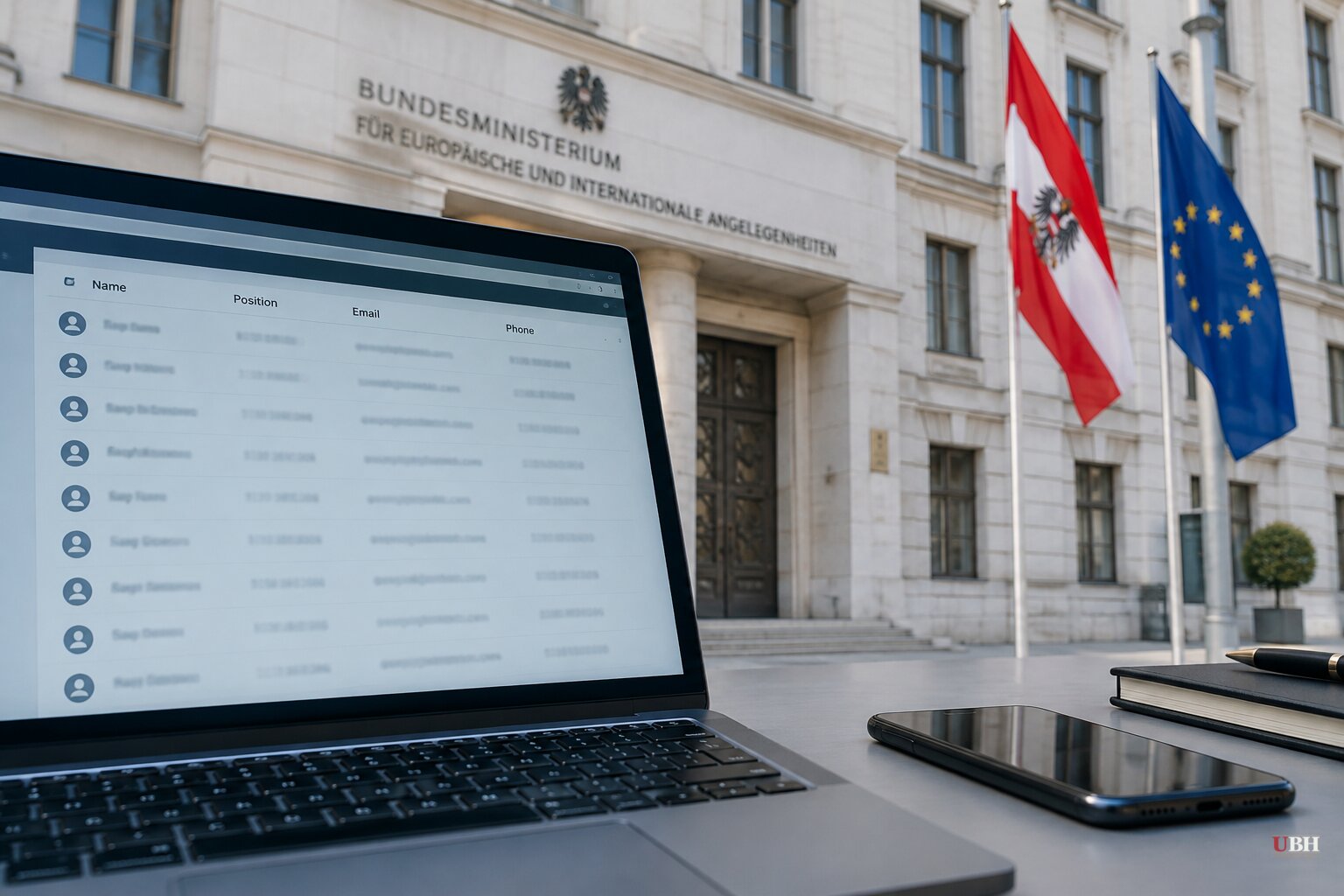
Austria's Foreign Ministry says someone broke into one of its websites on Nov. 12 and 13 and looked at the names and work contact details of its employees. The ministry disclosed the breach on Friday, Nov. 20, about a week after it happened.
The site was operated by an external service provider, not run in-house. The ministry says it detected the intrusion on Nov. 13 and that government staff stopped it immediately.
What the ministry has confirmed
A team of cybersecurity experts investigated and found that the intruders viewed records listing names and professional contact details. Those records cover staff at ministry headquarters in Vienna and at Austrian diplomatic missions abroad.
The ministry says no personal information belonging to members of the public was affected. It says it reported the incident to Austria's Federal Office for Cyber Security and the Data Protection Authority, and it has ordered additional technical security checks.
The ministry says it is taking the incident "very seriously." It also says its systems operate under strict security regulations and continuous monitoring.
What it has not said
The ministry has not said how many records were viewed. It has not said whether the attackers copied anything or how they got in. It has not named the vulnerability or technique used.
A spokesperson told Recorded Future News: "For security reasons, we do not disclose details of specific technical vulnerabilities or security measures. The incident has not been attributed to any particular actor."
That leaves a basic gap. "Viewed" and "stolen" are different claims, and the ministry has addressed only the first.
The Microsoft outage
The intrusion overlapped with a global Microsoft outage that disrupted several of the company's services for roughly 24 hours. Microsoft blamed a software bug and infrastructure failures.
The ministry itself pointed to the timing in its statement. Austrian authorities have not established any connection between the two events. Two things happening on the same days is not evidence that one caused the other.
A ministry with a track record
This is not the ministry's first brush with hackers. A cyberattack ran for several weeks across late 2019 and early 2020. Austria's National Security Council called it a targeted intelligence-gathering operation. In July 2026, Vienna publicly attributed that attack to Russia.
The ministry also dealt with phishing-related attacks in April 2022.
Relations with Moscow have worsened this fall. In October, Vienna expelled four Russian diplomats, bringing the total declared persona non grata since 2020 to 18. Last week a Russian drone strike damaged the Austrian Embassy in Kyiv.
Daniel Roethlin, the embassy's chargé d'affaires, said the blast came around 4:30 p.m. during opening hours, with about 10 people inside. No one was hurt, but windows and vehicles were damaged. Austria called the strike "unacceptable" and "a violation of international law." Foreign Minister Beate Meinl-Reisinger summoned Russia's ambassador in Vienna.
None of that is proof of who hit the website. There is no public evidence linking Russia to this breach, and the ministry has attributed it to no one. Moscow has repeatedly denied involvement in cyberattacks against European countries.
Another incident under investigation
Austrian intelligence services have separately said they are investigating a security incident involving employee user accounts at the Federal Computing Centre (BRZ), the agency that manages sensitive state IT infrastructure. No source has tied that incident to the Foreign Ministry breach.
Why contact lists matter
A list of diplomats' names and work contacts sounds minor. It is not nothing. SC Media's analysis of the breach flags the risk that attackers can use seemingly low-value contact data to set up phishing or social engineering campaigns against the people on the list.
The external-provider angle is the other pressure point. The ministry says its own systems are tightly controlled, yet the weak spot was a site run by an outside vendor. The ministry has not said who the provider is or what security requirements it was held to.
The next answers have to come from the investigation. The ministry has not set a date for further findings, and it has not said whether it will publish the number of records viewed or tell affected staff directly.
Until it does, the central question stays open: did someone simply look at the diplomats' data, or walk away with it?
Sources used for this briefing
7 links from 7 independent newsrooms (syndicated copies of the same report count once)
These are the sources it draws on, linked so you can verify.


