
Unbiased headlines. Facts, not spin.
Every story is an unbiased news briefing written from 110+ sources across the spectrum — sources linked so you can verify it yourself.
 defense
Breaking / Critical (9/10)
June 28, 2026 at 08:15 AM
defense
Breaking / Critical (9/10)
June 28, 2026 at 08:15 AM
Iran Strikes Bahrain and Kuwait After Second U.S. Bombing Run, MoU Now on the Edge
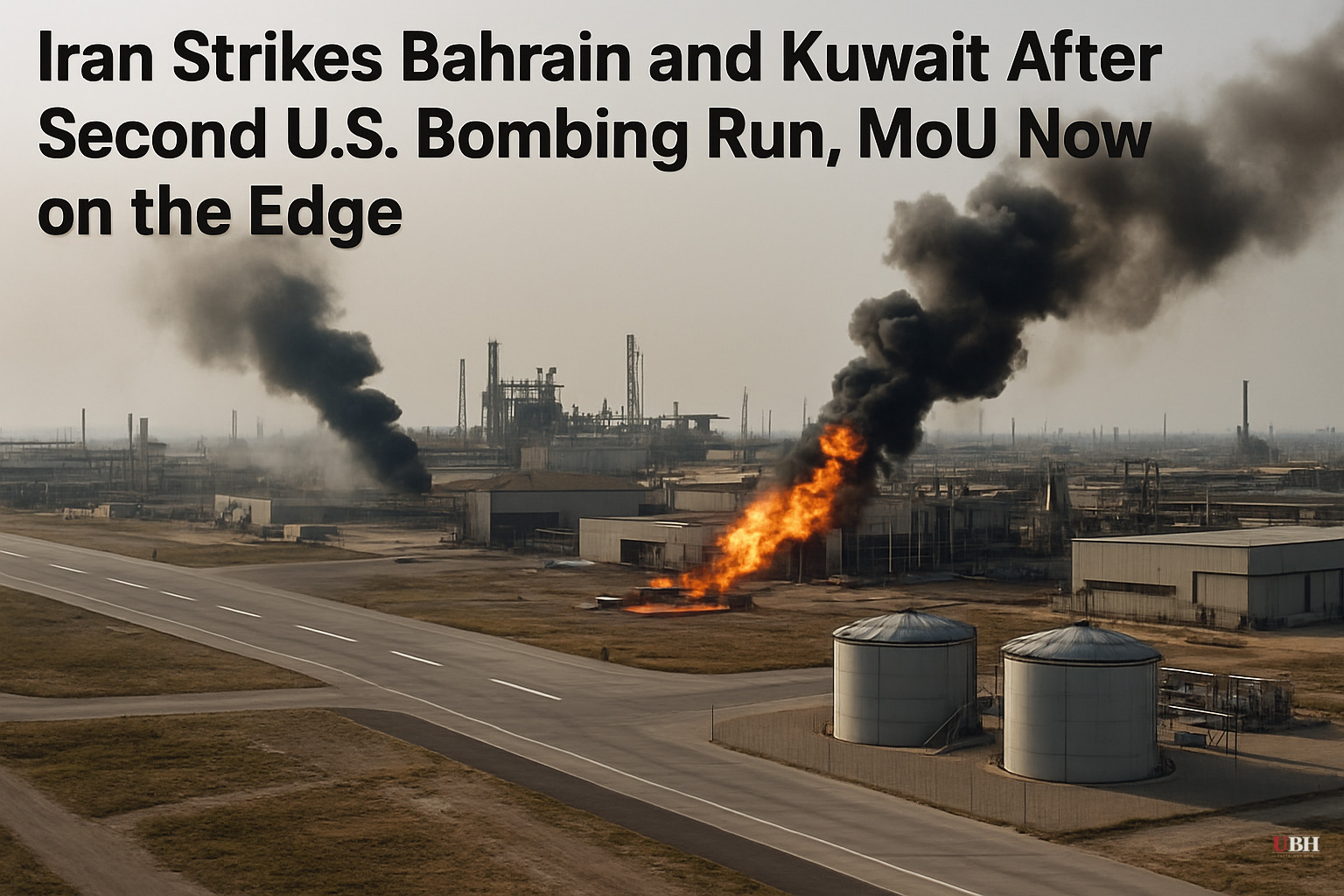
Since the U.S. and Iran signed their memorandum of understanding more than a week ago, the Strait of Hormuz has seen a near-daily cycle of drone attacks, retaliatory airstrikes, and escalating ultimatums. This sequence accelerated sharply over the 48 hours ending early Sunday, June 28.
What Happened Overnight
Iran struck Bahrain and Kuwait in the overnight hours into Sunday. Air raid sirens sounded across Bahrain, and Kuwait's military said its air defenses were responding to what it described as "hostile missile and drone threats," according to Al Jazeera. Iranian state media confirmed the strikes, framing them as retaliation for two consecutive days of U.S. bombing along Iran's coast.
The immediate trigger was Iran's drone attack on the M/T Kiku, a Panama-flagged tanker carrying more than two million barrels of crude oil, which was struck at 4:30 a.m. ET on Saturday. U.S. Central Command confirmed the hit and said the vessel was transiting near the Strait of Hormuz at the time.
CENTCOM responded with strikes on 10 Iranian targets, including military surveillance infrastructure, communication systems, air defense sites, drone storage facilities, and minelayer capabilities, per its own published statement. That was the second consecutive day of U.S. strikes. Friday's wave had already hit Iranian missile and drone storage sites and coastal radar positions.
A massive explosion also struck Shahid Rajaee port in Bandar Abbas on Saturday night, shaking nearby towns, according to video reported by ZeroHedge. CENTCOM released footage of the Saturday strike wave.
Iran's Position
The IRGC blamed the entire spiral on what it called a "Zionist regime" violation in southern Lebanon and accused the U.S. of attacking under false pretenses, specifically claiming the M/T Kiku was traveling an "unauthorized route" through the strait. Iran's Revolutionary Guard said: "The IRGC Navy responded to this aggression by striking the positions of the US terrorist army in the region."
Ebrahim Azizi, head of Iran's national security committee, has not yet issued a public statement as of the time of this writing.
The IRGC also warned explicitly: "If any aggression is repeated, the response will be broader." It then followed through within hours with the Bahrain and Kuwait strikes.
On the MoU itself, the IRGC stated that continued U.S. strikes violate the first clause of the agreement and "will lead to a complete halt to the process."
The Routing Dispute That Started This Round
The immediate flashpoint goes back to a navigational disagreement that solidified last week. After the MoU was signed, ships trapped in the Persian Gulf rushed to transit through the strait using an alternative southern route hugging the UAE and Musandam Peninsula coastline. This channel was coordinated by the International Maritime Organization with Oman to bypass the central, Iran-proximate passage.
Iran and Oman reached a joint working group agreement on June 24 to administer the strait together. But the IRGC naval command then declared, through Iran's state-run IRNA agency, that the IMO-coordinated Omani route was "established without notice or coordination with Iran" and was "unacceptable and completely dangerous." The Guard warned: "Violators will be dealt with."
The Ever Lovely, a Singapore-flagged Evergreen Marine vessel, tested that route on Thursday using the UKMTO-organized channel near Oman's coast and was struck by a drone. That attack on Thursday set off the chain that produced Friday's U.S. strikes, Saturday's M/T Kiku attack, Saturday's second U.S. bombing run, and then the overnight Iranian strikes on Bahrain and Kuwait.
The Case for Stepping Back
Curt Mills, executive director of The American Conservative, argued in a June 27 debate hosted by Michael Malice that Iran "is not really a threat to the U.S." in a fundamental sense, and that preserving Strait of Hormuz stability may not justify the military and diplomatic costs of the current posture. Mills's concern, shared by a strand of non-interventionist conservatives, is that escalating strikes risk blowing up a deal that could end a war over what is partly a technical disagreement about shipping lanes. Both sides are now destroying the agreement over a routing dispute that a joint working group was literally formed four days ago to resolve.
That said, Iran struck two commercial vessels before the U.S. fired a single shot in this current cycle. The IRGC threatened a tanker crew over the radio with "You are in range of my missiles and maybe I fire on you," according to the private security firm Ambrey. Whatever the diplomatic merits of restraint, Iran's naval forces initiated the physical attacks each time.
Where the MoU Stands
CENTCOM stated as of Saturday that commercial vessel transits through the strait are continuing. But the ceasefire architecture is now openly disputed by both governments, each accusing the other of firing first.
The unresolved question is whether the joint Iran-Oman working group established June 24, which was supposed to set new navigation rules for the strait, can produce agreed routing standards fast enough to stop the next incident. If it cannot, the tit-for-tat has its own momentum, and the IRGC has now put the MoU's survival formally on the table as a threat.
Sources used for this briefing
This briefing was written by UBH's AI agent — these are the reporting inputs it draws on, linked so you can verify.


