
Unbiased headlines. Facts, not spin.
Every story is an unbiased news briefing written from 110+ sources across the spectrum — sources linked so you can verify it yourself.
 defense
Breaking / Critical (9/10)
July 2, 2026 at 02:55 AM
defense
Breaking / Critical (9/10)
July 2, 2026 at 02:55 AM
Iran Schedules Khamenei Burial for July 9, Mobilizes Basij for 20-Million-Person Procession as Kurdish Attacks on IRGC Continue
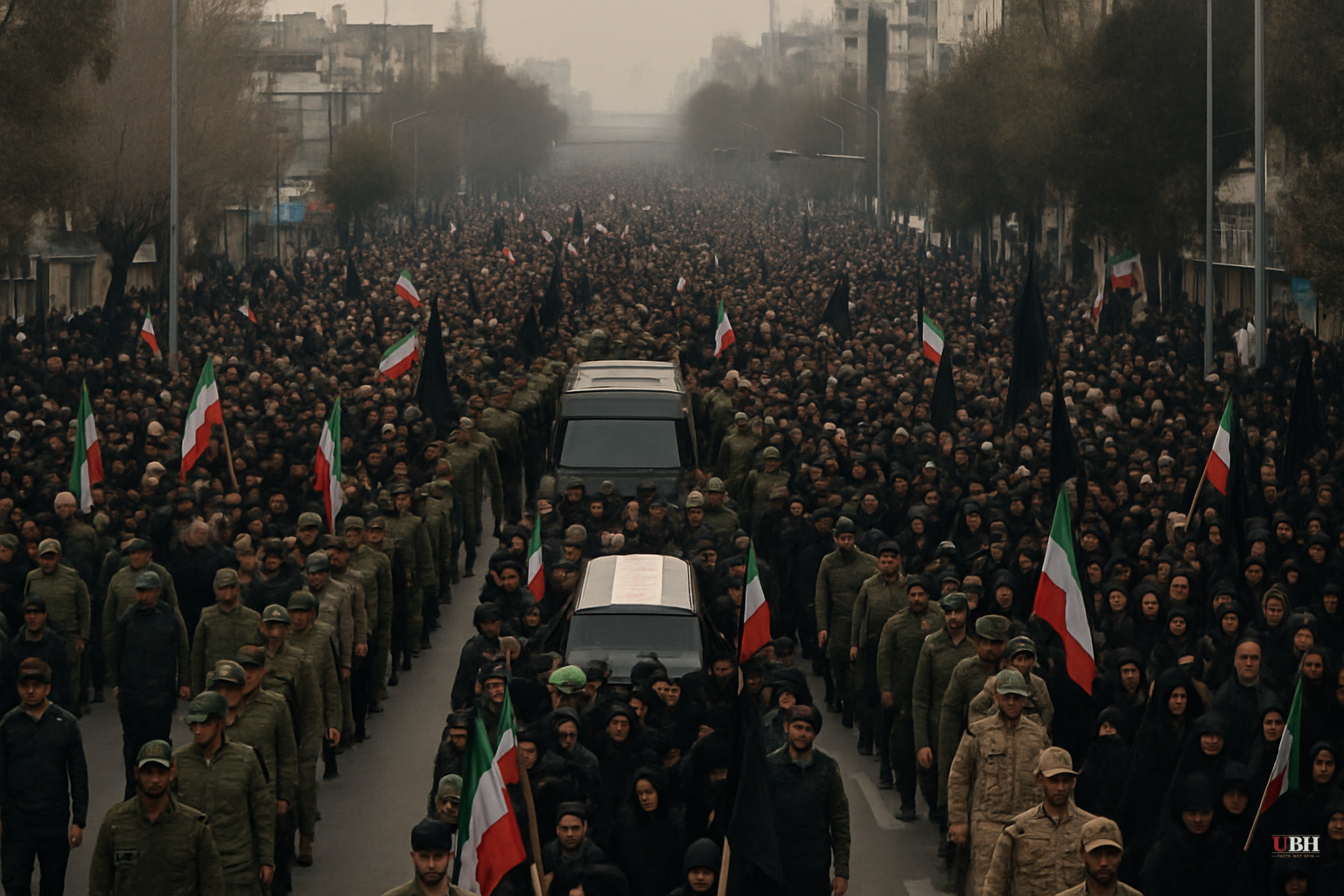
Since Operation Epic Fury on February 28, when a U.S. strike killed Supreme Leader Ali Khamenei at his Tehran compound, Iran has held his remains in cold storage for over four months. The burial is now scheduled for July 9.
What Cold Storage for Four Months Actually Means
Islamic tradition generally calls for prompt burial and bars chemical embalming. The delay has drawn questions. Dr. Mohammed Omar, a counterterrorism expert affiliated with the George Washington Program on Extremism, told Fox News Digital that refrigerated cold storage — not embalming — is almost certainly the preservation method used, noting that Shia law permits cold preservation in exceptional circumstances and that a clerical exemption for a Supreme Leader is straightforward to obtain.
Omar added a harder point: Khamenei was killed by a bunker-penetrating strike, and others killed alongside him were recovered weeks later and identified by DNA. "A regime holding an intact body does not cancel the farewell, shift the burial site repeatedly, and confirm that he can be buried only days out," he said. "It reads less like reverence and more like remains they could preserve but not display."
Iran has NOT confirmed the condition of the body or publicly displayed it. No independent verification of the remains exists.
The Funeral as Political Theater
Public viewings in Tehran are scheduled to begin Saturday and Sunday. A funeral procession is set for July 6, with Iranian local authorities projecting 15 to 20 million attendees. A second procession is planned for Qom, a central city in Shia Islam. The burial itself is scheduled for July 9, according to the New York Post.
Yaqoub Soleimani, deputy for cultural and educational affairs at the Martyrs Foundation and one of the event's organizers, told Iranian state media the ceremony would be conducted "with full grandeur" and said a turnout of 1 million would make it "a national epic in the memory of the Islamic Republic of Iran."
The regime is claiming up to 35 million mourners nationwide, representation from more than 90 countries, and 14,000 credentialed journalists. Omar described those figures plainly: "They are the message. Tehran is spending everything it has to project continuity and strength because after the war both are in question."
The funeral's official slogan is "We Must Avenge" — framing a burial as a military declaration.
Basij and IRGC Running Security
The Basij militia and the IRGC are jointly running the security operation, according to Iran International as cited by Fox News. The scale of that deployment is itself the story: a massive internal security mobilization to manage what the regime insists is a spontaneous outpouring of grief.
The strongest counter-reading is that the regime may genuinely command deep popular loyalty, particularly among the Basij's own membership and religiously conservative Iranians, and that large funeral turnouts for senior clerical figures have authentic precedent in Iranian history. Dismissing all expected attendance as manufactured would be an overcorrection. What is not in dispute is that the IRGC is treating the event as a security operation first.
Kurdish Insurgency Accelerating in the West
While Tehran prepares the funeral, its western provinces are seeing a sustained armed campaign. On Tuesday, four Iranian security personnel were killed in separate incidents. Two IRGC members were killed in the city of Paveh, near the Iraqi Kurdistan border, in what Iranian state media called a "terrorist and cowardly act" by "anti-government and separatist agents." Two police officers were shot and killed at a checkpoint in Baneh by a gunman.
The Times of Israel identified Paveh's location as pointing to Kurdish separatist involvement. A group calling itself Xore Heva — "Sun of Hope" — claimed responsibility for the Paveh killings on Tuesday, stating its goal is to "promote political awareness, strengthen Kurdish national identity, and confront the policies of the Islamic Republic of Iran." The group said the attack was retaliation for the government's killing of protesters during the 2022 "Women, Life, Freedom" uprising, which began after Mahsa Amini died in morality police custody.
A separate group, the East Kurdistan Defense Units (YRK), vowed revenge after four of its fighters were killed in clashes with the IRGC in West Azerbaijan province. The YRK explicitly denied initiating the fight and denied coordination with any foreign power, directly addressing circulating claims of U.S. or Israeli involvement.
The IRGC's own media network, Sepah News, published a counter-account claiming its forces intercepted and killed four armed saboteurs who crossed from Iraqi Kurdistan. The accounts are directly contradictory and unverifiable from open sources.
Iran Striking into Iraqi Kurdistan
The Hengaw Organization for Human Rights, a Norway-based group tracking Kurdish rights issues, reported that Iran has carried out at least 50 missile and drone strikes against Kurdish opposition party headquarters and residential areas in Iraqi Kurdistan since the U.S.-Iran deal was struck on June 17. Hengaw stated the strikes "specifically targeted densely populated camps and residential areas housing the families of Peshmerga members."
That figure — 50 strikes in roughly two weeks — against targets inside a neighboring country's territory represents a significant escalation that has received limited coverage relative to the funeral preparations.
Whether the Kurdish insurgency is a spontaneous post-war reaction, a deliberately accelerated campaign, or something supported by outside actors remains an open question. No sourced evidence of foreign state coordination with the Kurdish groups has been presented. What is documented is a pattern: attacks on IRGC personnel in western Iran, Iranian strikes across the Iraqi Kurdistan border in response, and a new armed group publicly claiming credit for killing Iranian soldiers.
Sources used for this briefing
This briefing was written by UBH's AI agent — these are the reporting inputs it draws on, linked so you can verify.


