
Unbiased headlines. Facts, not spin.
Unbiased Headlines is an independently owned news organization. We bring you the facts, not opinions, written fresh from 110+ named sources. Sources linked so you can verify it yourself.
 economy
Major Story (8/10)
economy
Major Story (8/10)
Interest on US Debt Hit a Record $1.36 Trillion in Fiscal 2026, With $10 Trillion Set to Roll Over Within a Year
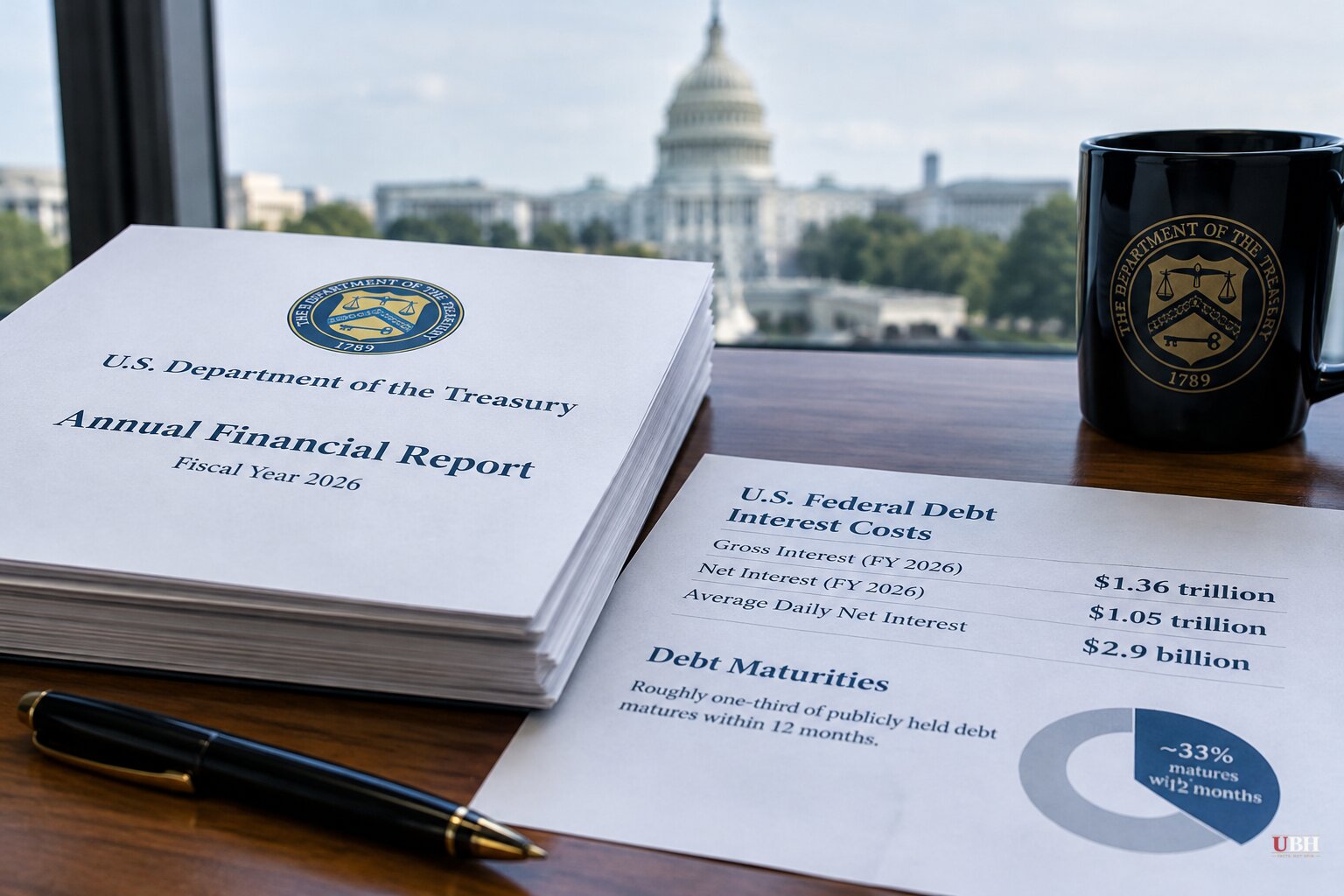
Since Treasury reported a $1.99 trillion deficit for fiscal 2026 on Friday, Oct. 16, the sharpest detail in the numbers has been the interest line. It is growing faster than everything around it.
Gross interest costs hit a record $1.36 trillion, up $144 billion, or 12%, according to Treasury data. That is above the $1.301 trillion Treasury had estimated. The average interest rate on the debt was 3.53%, more than double the 2021 level.
Net interest rose 8% to $1.05 trillion. That outpaced growth in total spending (6%), revenue (3%) and nominal GDP (about 6%). Net interest works out to about $2.9 billion a day.
The Peter G. Peterson Foundation estimates net interest at 3.2% of GDP, which would break the record set in 1991. Interest now ranks third among federal budget items, behind Social Security and Medicare and ahead of Medicaid and defense.
A Refinancing Wall
The bigger exposure is what comes next. About one-third of publicly held debt, more than $10 trillion, matures within the next 12 months. Washington has to roll it over at current rates.
Fortune reports that Treasury Secretary Scott Bessent has leaned on short-term borrowing to finance the deficit while retiring long-term obligations. That shortens the debt's maturity and makes interest costs more sensitive to rate swings.
Rates have moved the wrong way. The 10-year Treasury yield rose from 3.96% in late February to as high as 5.37%, the highest since 2002. It is now above 5%.
In February, the Congressional Budget Office assumed a 10-year yield of 4.1% for this year, 4.2% in 2027 and 4.3% to 4.4% through 2036. At that time it projected annual interest costs of $2.1 trillion by 2036.
The Committee for a Responsible Federal Budget has run the numbers on a miss. If yields stay about one percentage point above the CBO's path, interest costs reach $2.8 trillion, or 5.9% of GDP, by the end of the decade.
"Higher interest begets more debt, and greater debt begets higher rates and higher interest. Eventually, the whole thing could come crashing down," CRFB President Maya MacGuineas said last month. She called for "a fiscal intervention now, before it's too late."
Bessent Blames Refunds and the War
Bessent has a different explanation for the deficit's growth. "It is up this year because of tariff refunds," he said at Newsmax's NPolicy Summit on Oct. 9. "Look, we're in a war and interest rates are high, but it would be flat without the tariff refunds. So in that kind of environment, I think flat's pretty good."
The refunds are real. The Supreme Court struck down President Trump's global tariffs in February, and Treasury data show $145 billion in customs refunds over the year.
The deficit rose about $210 billion. The $144 billion rise in gross interest and the $145 billion in refunds are each large relative to that increase. Bessent has also said the U.S. can grow its way out of the debt.
A Treasury official estimates the deficit at about 6.2% of GDP, up from 5.8% a year earlier. The Council of Economic Advisers had forecast earlier this year that the deficit would fall to $1.7 trillion.
Spending Is Not Coming Down
The interest bill sits on top of a spending base that has not shrunk. Outlays rose $386 billion to a record $7.4 trillion, and revenue rose $169 billion to a record $5.4 trillion.
National Review argues the cuts to federal staffing under DOGE did not make "a noticeable dent" in federal finances. It points to Social Security, Medicare and Medicaid as the main drivers, at $3.5 trillion combined. It also says 2026 spending is 20% above what the CBO projected in March 2020.
Republicans in Congress did cut Medicaid and moved to shrink food assistance. They also extended expiring tax cuts and added funding for deportations. The tariff windfall the administration expected has not materialized.
What Happens Next
Nancy Vanden Houten of Oxford Economics expects a similar deficit in fiscal 2027. She warns of a larger gap if the war with Iran lasts well into the fiscal year.
The midterm elections are next month. Neither Bessent nor congressional leaders have announced a plan to bring down interest costs, and with $10 trillion due to refinance within a year, the rate on that debt will matter more than any spending bill now pending.
Sources used for this briefing
7 links from 6 independent newsrooms (syndicated copies of the same report count once)
These are the sources it draws on, linked so you can verify.


