
Unbiased headlines. Facts, not spin.
Unbiased Headlines is an independently owned news organization. We bring you the facts, not opinions, written fresh from 110+ named sources. Sources linked so you can verify it yourself.
 economy
Notable (6/10)
Event date: October 15, 2026 ·
economy
Notable (6/10)
Event date: October 15, 2026 ·
Tens of Thousands March in Lisbon Over Housing and Living Costs as Government Says It Won't Yield to the Street
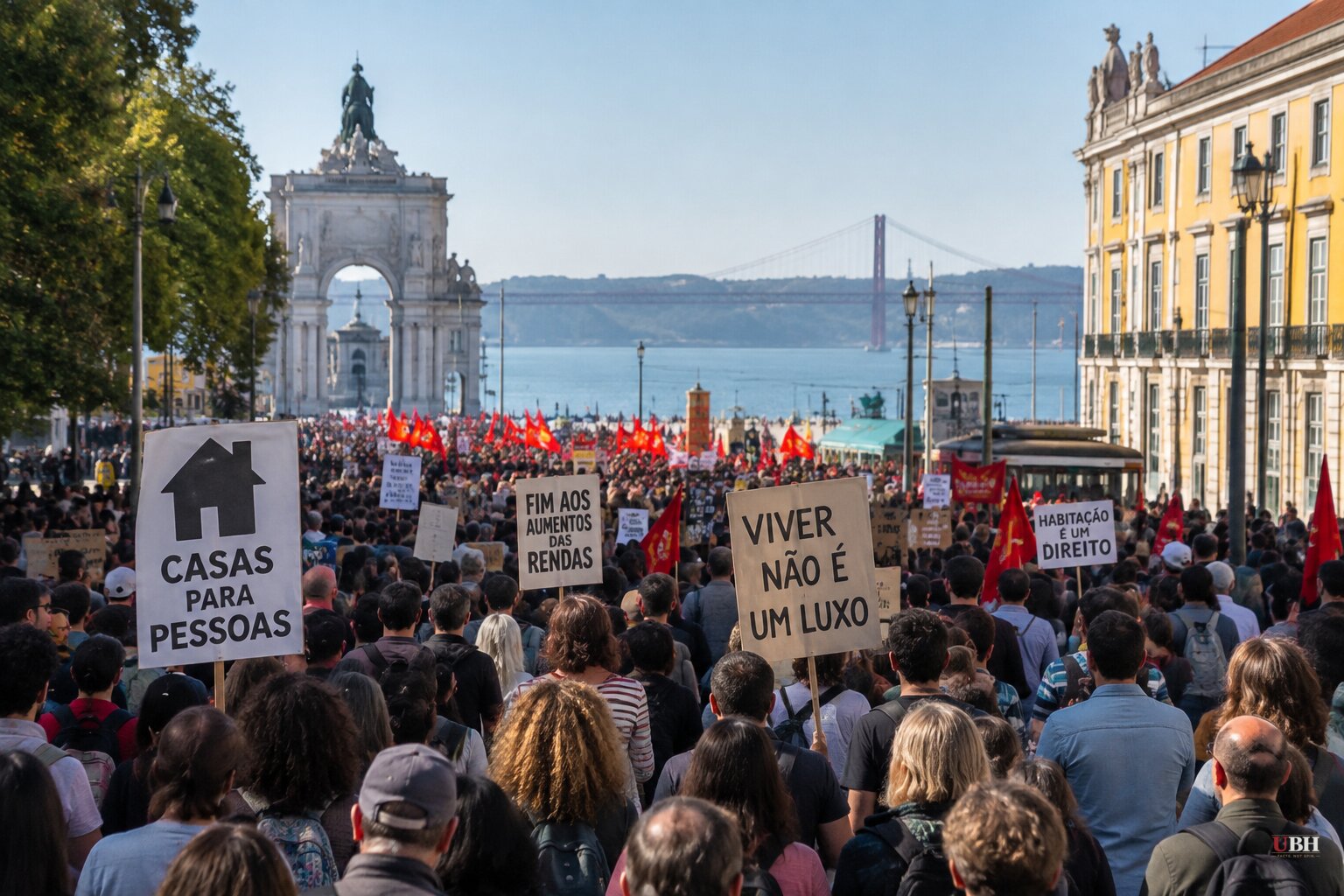
Since housing activists pitched about 50 tents in Porto's Praça D. João I on Oct. 10, Portugal's housing protests have gone from a local camp-out to a national movement. On Saturday, Oct. 17, it reached its largest crowd yet.
Tens of thousands of people marched through central Lisbon, according to Reuters. Portugal's biggest union federation, CGTP, said "many tens of thousands" packed one of the capital's main avenues. Police gave no crowd estimate.
The march ran from Cais do Sodré to Rossio. Rallies were also held in Porto and Coimbra, with more planned in Aveiro, Braga and Funchal. Around 1,500 people reportedly turned out in Porto.
The numbers behind the anger
Portugal's inflation hit 3.6% in September. Food and fuel prices drove it, with fuel up 15% year-on-year after rising tensions in the Middle East.
House prices have more than doubled since 2017. Rents for new leases have nearly doubled. National statistics institute INE puts the house price index up 16.5% year-on-year, the median purchase price at €2,337 per square metre, and the median new-lease rent at €9.46 per square metre.
Carolina Cruz, 26, is a PhD biology researcher living on a scholarship of about €1,300 a month. She and her partner pay €716 for an apartment in the Lisbon area. Renewal could push that above €1,200.
"I'm the first person in my family to enter a doctoral programme, and even with all the studying I've done, I still can't make it," Cruz said.
Pedro Penilo, 62, a teacher, said his mortgage is about to be adjusted and he is "very worried." He called Portugal's leaders "out of touch with reality."
What the protesters want
The CGTP march ran under the slogan "Higher wages, better pensions, and public services. Against the rising cost of living." CGTP general secretary Tiago Oliveira pointed to a "brutal increase" in housing prices.
A separate civil-society platform called "You can't live like this anymore" is behind much of the street mobilization. Its coordinating council is demanding price controls on essential food and energy. It also wants special taxes on the excess profits of large banks, energy firms and distributors, plus emergency protections for tenants.
The Left Bloc's José Manuel Pureza said people want the debate to center on "the right to housing for everyone." He stressed the protests have been "always peaceful."
The Porto crackdown
The movement's momentum owes a lot to what happened in Porto. Police ordered the tents removed on Oct. 12, citing "unauthorized occupation of public property," and confiscated tents and belongings, according to protesters who spoke to Amnesty International.
Porto mayor Pedro Duarte said he would take an "absolutely uncompromising" stance against attempts to put tents back in the square.
At about 2:30 a.m. on Oct. 15, roughly 40 officers moved in to disperse the camp. Activists and their lawyers say 35 people suffered minor injuries and two were seriously hurt, with head injuries, a broken arm and a broken wrist. A person with a disability was among the injured.
Tomás Varela, a protester treated at Santo António Hospital, said a baton strike to the head required nine stitches. Porto's fire service reportedly assisted eight people and sent two to hospital.
Amnesty International Portugal Executive Director João Godinho Martins said reports that police beat protesters with batons "raise serious concerns that the use of force was disproportionate." He said dispersal of peaceful protests "must be a last resort." Amnesty also called Portugal's blanket ban on night-time protests "problematic" and contrary to the right to protest. According to Amnesty's statement, police pointed to protesters' resistance to removing the tents.
The government's answer
The centre-right government is not budging on tone. Parliamentary Affairs Minister Carlos Abreu Amorim said Friday that the "government will not yield to shouts from the street." He added that concrete measures to address the concerns are already being rolled out.
Lisbon's mayor called the cause "a just cause" but warned that protests must take place "within the law."
The Portuguese demonstrations coincide with cost-of-living protests elsewhere. Euronews reported that demonstrations in France on Saturday turned violent, with protesters clashing with riot police. There were smaller protests in Belgium and mass protests in Albania, where demonstrators are demanding the prime minister's resignation.
The Spanish precedent
Many Portuguese protesters are openly copying Spain. Housing protests there erupted after the eviction of 87-year-old Maricarmen Abascal, who later died.
Teresa Fonseca, who marched in Lisbon, told the Lusa news agency she saw the protest on Instagram. "Enough is enough," she said. "We need to leave our homes and take to the streets to make our voices heard, just as the Spanish did." A group in Porto stood next to a sign reading "let's do it like they do in Spain."
In Spain, Prime Minister Pedro Sánchez's government proposed emergency housing legislation as pressure mounted. It failed to pass, and Sánchez called a snap general election for late November.
Portugal's government is now holding a line that Spain's did not hold. Whether Abreu Amorim's "concrete measures" blunt a movement that drew tens of thousands into Lisbon's streets, and whether Amnesty's call for an inquiry into the Porto operation gets an answer, are the open questions heading into next week.
Sources used for this briefing
7 links from 6 independent newsrooms (syndicated copies of the same report count once)
These are the sources it draws on, linked so you can verify.


