
Unbiased headlines. Facts, not spin.
Unbiased Headlines is an independently owned news organization. We bring you the facts, not opinions, written fresh from 110+ named sources. Sources linked so you can verify it yourself.
 economy
Major Story (7/10)
economy
Major Story (7/10)
Brazil's Amazon deforestation falls 41.8% to lowest level since records began in 1988
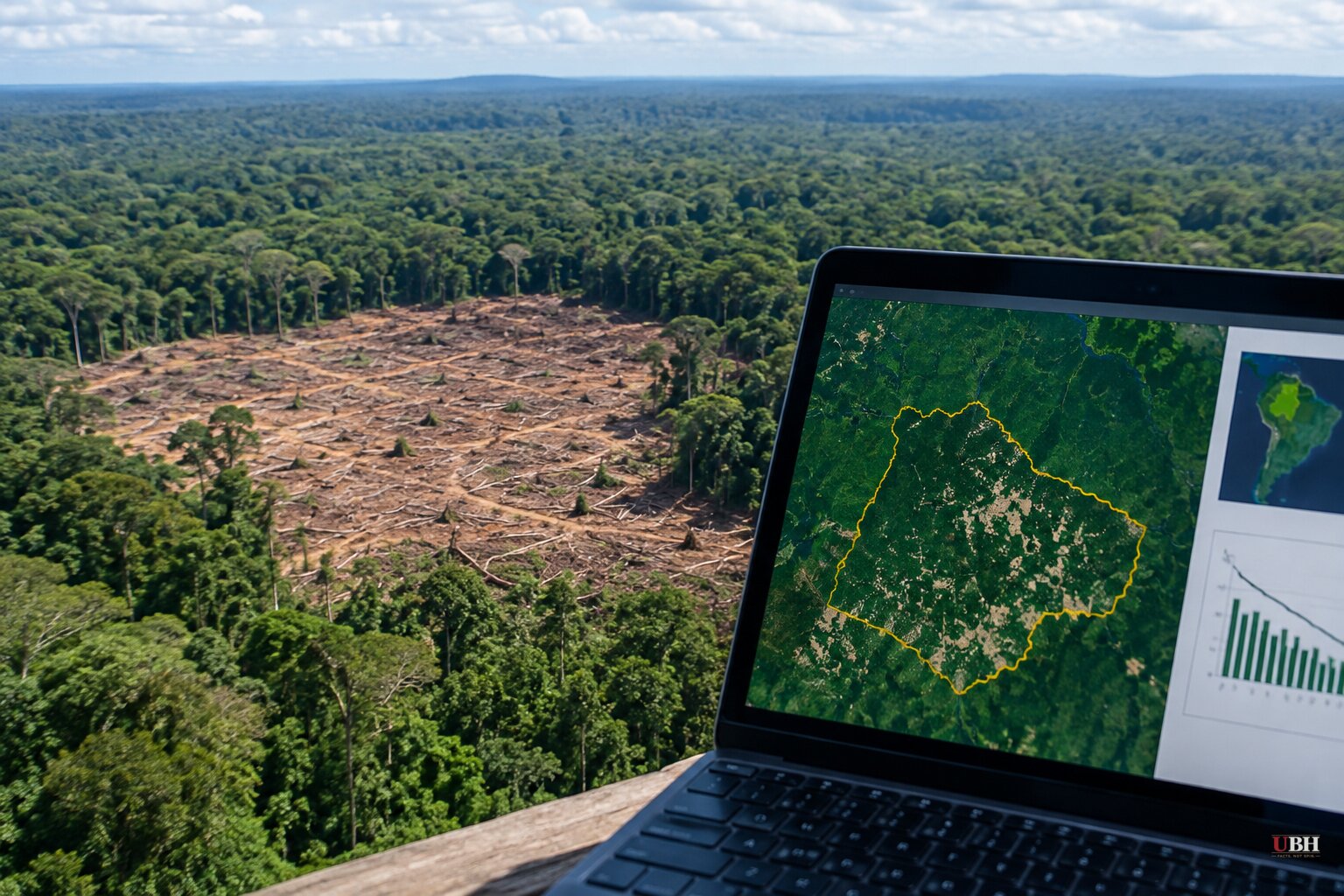
Brazil's government announced Friday, Oct. 16, that Amazon deforestation has dropped to the lowest level on record.
Satellite data from Inpe, the national space research agency, shows 3,335 square kilometres (1,288 square miles) of forest cleared in the 12 months through July 2026. That is 41.8% below the 5,731 square kilometres cleared the year before.
The previous low was 4,571 square kilometres in 2011-12. The new figure beats it by 1,236 square kilometres. Annual losses peaked near 30,000 square kilometres in the mid-1990s.
The numbers
Inpe's Prodes program measures August to July because cloud cover is lower in mid-year. Under that count, clearing is down 71.2% since 2022, the year before President Luiz Inácio Lula da Silva returned to office.
The drop was broad. Pará accounted for 33.9% of Amazon clearing, Mato Grosso 25.5% and Amazonas 15.7%. Even in those three states, clearing fell by more than 45% from the prior year. Roraima was the exception, with a 0.4% increase.
The Cerrado, Brazil's savanna, also improved. Clearing there fell to 5,516 square kilometres, the lowest annual figure since 2001, and is down 48.4% over four years.
Environment Minister João Paulo Capobianco called the Amazon result "an absolutely stratospheric drop... it's like a dream" at a news conference in Brasília. Lula wrote on X: "Our goal is to achieve zero illegal deforestation by 2030."
What the government did
The government credits a revived program called PPCDAm, the Action Plan for the Prevention and Control of Deforestation in the Legal Amazon. Lula's first administration launched it in 2004. It was shelved under Jair Bolsonaro.
The measures include restoring sanctions for illegal clearing detected by satellite, which the government says is the most effective tool it has. Officials also proposed barring properties with illegal deforestation from bank loans. More money went to priority Amazon municipalities that cut forest loss, and to enforcement against environmental crime.
Márcio Astrini, executive secretary of the climate network Observatório do Clima, said the formula is "determination, enforcement on the ground, fighting crime and enforcing the law." He also argued the numbers undercut the claim that environmental protection holds back growth, saying agriculture has set production and export records while deforestation fell. That is his claim, and he leads an advocacy group.
The contrast with the Bolsonaro years is stark. The Amazon lost about 11,600 square kilometres a year on average during Jair Bolsonaro's 2019-2022 term, nearly 60% more than in the previous four years, according to official data. Lula's government and environmental groups tie that surge to cuts in enforcement agencies and weaker penalties. Bolsonaro was later convicted of plotting a coup and is serving a 27-year sentence under house arrest.
The run-off
The data arrives as Lula faces Senator Flávio Bolsonaro, the former president's eldest son, in a run-off on Oct. 25. Polls show the two neck and neck. Lula fell behind in the first round despite his record on the forest.
Flávio Bolsonaro's manifesto does not call for abandoning enforcement. It pledges to strengthen environmental oversight in the Amazon and prioritise areas under the greatest pressure from clearing and fires. It would focus enforcement on organised crime rather than on extractive workers and small farmers, and it sets a goal of ending illegal deforestation by 2029, a year ahead of Lula's target.
His opponents read that differently. Environmental groups and Lula allies argue that a Bolsonaro presidency would continue the policies of his father. He has also vowed to free his father and let him take any government position he chooses.
The contrast on enforcement is concrete. Lula's approach penalises illegal clearing wherever satellites detect it. Bolsonaro's manifesto says it would go after criminal networks and spare small producers.
What comes next
The next Prodes reading will cover August 2026 through July 2027. That window will include whichever candidate wins on Oct. 25 and the transition that follows. Whether Brazil holds a figure near 3,300 square kilometres, or drifts back toward the 5,731 recorded a year earlier, will be the first test of either candidate's promise.
Sources used for this briefing
8 links from 6 independent newsrooms (syndicated copies of the same report count once)
These are the sources it draws on, linked so you can verify.


