
Unbiased headlines. Facts, not spin.
Unbiased Headlines is an independently owned news organization. We bring you the facts, not opinions, written fresh from 110+ named sources. Sources linked so you can verify it yourself.
 economy
Notable (6/10)
Event date: September 17, 2026 ·
economy
Notable (6/10)
Event date: September 17, 2026 ·
US Factory Output Rose 0.3% in September, but Third-Quarter Growth Slowed to a 0.7% Pace
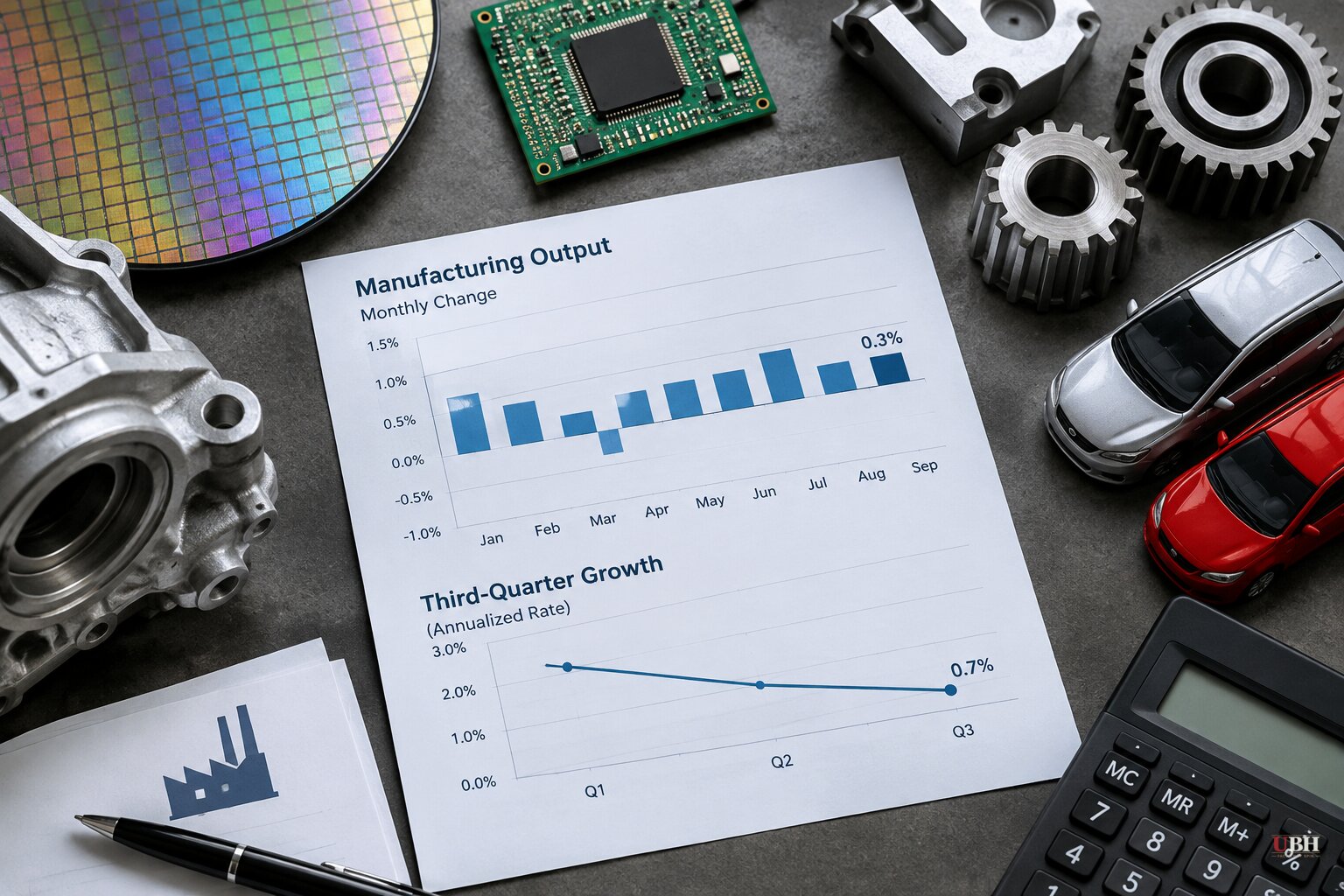
American factories made more stuff in September. They also lost a lot of speed over the summer.
Manufacturing output rose 0.3% last month, the Federal Reserve said Friday, Oct. 16, matching economists' expectations. August was revised to a 0.2% decline from the 0.3% drop first reported. Output was 1.1% above its level a year earlier.
For the third quarter as a whole, manufacturing grew at a 0.7% annual rate. In the second quarter it grew at 5.6%.
Chips and machinery lead, autos drag
Semiconductor and related electronic component production rose 2.1% in September and was 19.9% above a year earlier. Over the third quarter it expanded at a 28.4% annual rate. Reuters tied that surge to the AI spending boom.
Machinery output climbed 1.4% and sits 6.9% above its year-earlier level. Primary metals rose 1.6%. Electrical equipment, appliances and components gained 1.3%.
Motor vehicles and parts fell 3.0%, the third straight monthly decline. Strip out autos and manufacturing output rose 0.5%.
Nondurable goods rose 0.4% for the month on printing and chemicals, but fell 1.6% for the quarter. Durable goods output grew at a 3.8% annual rate in the third quarter.
Industrial production overall rose 0.7% in September and is up 2.2% from a year ago. Capacity utilization in manufacturing edged up to 75.9% from 75.8%, which is still 2.3 percentage points below its long-run average. Manufacturing is about 9.4% of the economy.
Orders and backlogs point up
The forward-looking numbers are firmer. The Institute for Supply Management's manufacturing index came in at 54.5% in September, down 0.1 point from August. It was the ninth straight month of expansion after a 10-month contraction. New orders hit 55.3%, and the backlog index jumped to 56.4% from 51.8%.
"In September, U.S. manufacturing activity remained in expansion territory," said Susan Spence, chair of the ISM Manufacturing Business Survey Committee.
The Empire State survey from the New York Fed showed general business conditions jumping to 25.5 from 7.6, the highest reading since December 2021.
The Association For Manufacturing Technology reported August orders for metalworking machinery of $732.9 million, up 36.3% from a year earlier. Orders for the first eight months of 2026 total $4.76 billion, up 36.9%.
The pledges and the tariff dispute
The White House Council of Economic Advisers published a report on Oct. 10 arguing that manufacturing is seeing "robust growth" under President Trump. The CEA says his tariff policies incentivized companies to build in the United States and that factory construction is soaring.
Some of the people running factories describe a messier picture. In ISM survey comments, a machinery executive said Canada tariffs "have impacted cross-border costs and left our supply chain team scrambling," hurting lead times for government buyers. A computer and electronics executive said the "U.S. tariff schedule is providing challenges," citing trouble finding supply sources outside China and persistent component shortages.
Reuters lists a trade war with Canada, higher energy prices and rising borrowing costs among the downside risks to production. Diesel prices have hit a record high as the US-Israeli war with Iran continues, and economists say the cost could reach consumers through higher prices for goods, including groceries.
The investment figures are large. Avison Young puts manufacturing investment pledges at $3.5 trillion since January 2025, helped by tax breaks in the One Big Beautiful Bill Act passed in July 2025 and by the CHIPS Act from the Biden years. Nvidia has pledged about $500 billion over four years, Micron more than $250 billion through 2035, and Taiwan Semiconductor $265 billion.
Pledges are not plants. Avison Young estimates facilities now under construction carry about $500 billion in capital commitments. Reuters has reported that several analysts view some of the big commitments as overtures to Trump, whose tariffs threaten to raise costs for the technology industry.
What the data leaves open
The CEA also says the Biden administration "shipped over 200,000 American jobs overseas" in its last two years. That is the administration's own claim. The September output data does not address it.
Factory output sits 1.1% above last year, and utilization is below its long-run average. The AI-linked segments are growing fast while autos and nondurables lag. The open question is how much of the roughly $3.5 trillion in pledges becomes the $500 billion-plus already being built, and how much of the rest gets built at all.
Sources used for this briefing
7 links from 6 independent newsrooms (syndicated copies of the same report count once)
These are the sources it draws on, linked so you can verify.


