
Unbiased headlines. Facts, not spin.
Unbiased Headlines is an independently owned news organization. We bring you the facts, not opinions, written fresh from 110+ named sources. Sources linked so you can verify it yourself.
 economy
Major Story (7/10)
Event date: October 12, 2026 ·
economy
Major Story (7/10)
Event date: October 12, 2026 ·
IMF Says Sharp AI Investment Drop Could Cut Global GDP 1.1% by 2028 in Downside Scenario
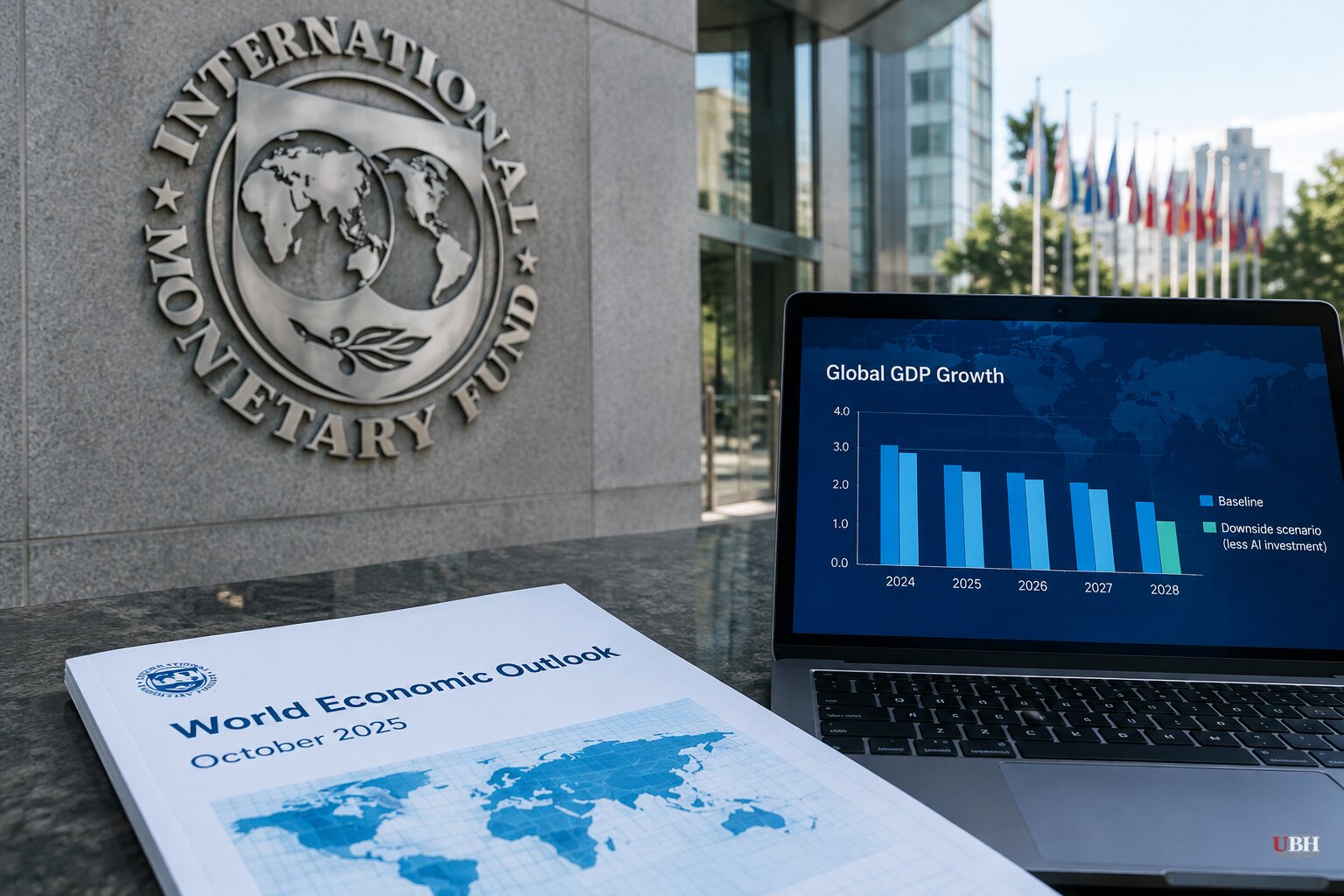
The International Monetary Fund thinks a chunk of the global economy is leaning on one bet, and it said so in plain terms this week.
In its World Economic Outlook, released Oct. 13 at the IMF and World Bank annual meetings in Bangkok, the fund forecast global growth of 3.1 percent in 2026 and 3.4 percent in 2027. That is the baseline. The warning sits in the downside scenarios.
The scenario
In one downside case, a steep drop in AI investment triggers a sharp fall in asset prices. By 2028, that would cut global GDP by 1.1 percent. U.S. output would fall 1.8 percent.
That is a modeled scenario, not a forecast. The IMF is not predicting it will happen.
A separate IMF analysis published Oct. 12 warned policymakers against complacency about financial risks if AI investment and valuations pull back. The fund said hyperscalers, the largest data center operators, are "borrowing more and more, while investors have been leveraging to invest in AI stocks."
The IMF also listed two other shocks that could hit markets: a jump in government bond yields and a major cyberattack on critical infrastructure, including financial institutions. It flagged rising government debt as a further vulnerability.
The circular money
The fund's sharpest numbers concern deals in which AI companies invest in each other. The IMF reviewed 14 such transactions since 2023. They involved about $300 billion in equity investments and $650 billion in debt, in exchange for $1.4 trillion in future revenue commitments.
The IMF's point is that these deals are tied together. If a key company receiving investment runs into trouble, revenue forecasts and valuations drop, and the debt behind those deals loses value too.
"We now have an economy that is standing on one leg, the AI leg," IMF managing director Kristalina Georgieva told a Bretton Woods Committee event. "What if it wobbles? What if there is disappointment and that leads to potentially a more difficult environment?"
Jason Wu, assistant director of the IMF's Global Markets Analysis Division, said at a Bangkok press conference that if there are questions about the monetization of AI, "the equity investments will deplete in value, the debt may be difficult to service, and the revenue commitments in the future may not materialize."
Trade and wealth effects
Athanasios Vamvakidis, deputy director of the IMF's Monetary and Capital Markets Department, said a correction would spread through the real economy. Falling asset prices would reduce household wealth and drag down demand.
Chief economist Silvana Tenreyro pointed to trade. Trade in AI goods grew 29 percent between 2023 and 2025, more than triple the 8.3 percent growth in global trade overall. Strip out AI goods, and total trade growth over that period would have been 4.6 percent.
The boom is not just a stock market story. It is propping up trade numbers and, per the IMF, has helped offset damage from geopolitical upheaval.
Skeptics outside the IMF
The IMF is not alone in sounding the alarm. Joachim Klement, managing director and research analyst at Panmure Liberum, told Bloomberg TV's Open Interest that his "core conviction is that the AI bubble will either burst in 2027 or in 2028."
Klement argued that the industry is pouring money into frontier models in giant data centers while the future lies in smaller, cheaper open-weight models running locally. He also said that if you strip out OpenAI and Anthropic, "there's hardly any demand there for AI compute that justifies the trillion-dollar investments that the hyperscalers alone are expected to do next year."
An analyst writing on Seeking Alpha under the name Agar Capital argues there are really three overlapping bubbles: inflated earnings expectations, interconnected financial risk, and concentrated capital. That author says he has dumped semiconductor exposure and holds about 15 percent in cash. He cites a Gartner estimate that cumulative AI revenue may fall far short of what is needed to justify a 12 percent return. That is one investor's opinion, and he disclosed positions in other funds.
The other side
Not everyone buys the doom. Breitbart Business Digest argues that the "AI Economic Apocalypse" is incoherent. Its writers say a world of AI super-abundance cannot also be a world where ordinary people are shut out of goods and services, because people would still have skills, tools and needs, and would keep trading with one another. In their words, "The robots can take our jobs, but they can't take our economy."
That argument is aimed at the mass-unemployment prediction, not at the IMF's warning about valuations, debt and circular financing. The two concerns are different. One is about what AI does to work. The other is about whether the money flowing into AI gets paid back.
What to watch
The IMF's central number is the $1.4 trillion in future revenue commitments. Those commitments are promises from companies that, per the fund, are partly funded by the very investments they are meant to justify. Klement's window for a reckoning is 2027 or 2028, and the IMF's modeled GDP hit lands in the same year. Whether the revenue shows up is the open question.
Sources used for this briefing
6 links from 6 independent newsrooms (syndicated copies of the same report count once)
These are the sources it draws on, linked so you can verify.


